Why Fit Chains to Your Wheels? (The Ultimate 2025 Winter Safety Guide)
You are halfway up a steep gradient in the Scottish Highlands, or perhaps navigating a switchback in the French Alps. The snow is compacted, the temperature is dropping, and your wheels begin to spin. You press the accelerator, but the revs climb while your car stays perfectly still—or worse, starts sliding backward.
Your electronic traction control light flashes frantically on the dashboard, but the computer can’t find grip where there is none.
This is the exact moment you realize why you fit chains to your wheels.
While many UK drivers view snow chains as extreme equipment reserved for Arctic expeditions, they are often a legal requirement for European travel and a “boot essential” for anyone living in rural Britain.
In this guide, we won’t just answer the common driving theory test question. We will break down the physics of traction, the critical 2025 European regulatory updates regarding winter tyres, and the practical reality of fitting chains when your fingers are numb.
The Official Reason: Preventing Skidding in Deep Snow
If you are here strictly to pass your UK Driving Theory Test, let’s get the official answer out of the way first.
Question: Why would you fit chains to your wheels?
Answer: To prevent skidding in deep snow.
However, understanding why they prevent skidding could save your life. Standard rubber tyres—even expensive winter ones—rely on friction to grip the road surface. When snow is compacted into ice, that friction coefficient drops to near zero. The rubber simply sits on top of the slippery surface.
The Physics of the “Bite”
Snow chains work differently. They do not rely on surface friction. Instead, the steel links physically penetrate the surface of the packed snow or ice.
Think of it like walking on ice. If you wear smooth-soled dress shoes, you slip because you are floating on the surface. If you put on crampons (spikes), you bite into the ice. Snow chains act as crampons for your car. They break the surface tension, digging in to provide the mechanical resistance needed to transfer engine torque into forward motion.
This mechanical grip prevents the vehicle from skidding laterally (sideways) on cambered roads and allows you to climb gradients that would be physically impossible on rubber alone.
UK Law: When Can You Legally Use Snow Chains?
The laws in the United Kingdom are distinctly different from mainland Europe. We do not have a specific “Winter Tyre Law” that mandates dates for winter equipment. However, we do have the Highway Code, and ignoring it can lead to fines or points on your license.
The “Complete Covering” Rule
According to The Highway Code Rule 229, you must ensure your vehicle is safe to drive in adverse weather. While the code doesn’t explicitly force you to carry chains, it dictates how you use them.
You can only legally use snow chains in the UK when the road is completely covered in snow or ice.
This is a critical distinction. You cannot fit them “just in case” because rain is forecast. If you drive with chains on clear tarmac, two things happen immediately:
-
Road Damage: The hardened steel links act like a hammer, destroying the road surface. Local councils can fine you for damaging public infrastructure.
-
Vehicle Damage: On a hard surface, chains cause massive vibration. This can destroy your suspension bushes, wheel arch liners, and tyres.
-
Safety Risk: Metal slides on tarmac. Your braking distance will actually increase significantly if you use chains on a clear road.
Pro-Tip: The “Crunch” Test
How do you know when to take them off? Listen to your car. On snow, chains make a dull, rhythmic thudding sound. The moment you hit clear tarmac, that sound changes to a harsh, grinding metallic “crunch.” If you hear the crunch, pull over safely and remove them immediately.
Driving Abroad: The 2025 “Alpine Symbol” Update (Critical)
If you are planning a ski trip to France, Switzerland, Austria, or Italy in late 2024 or 2025, you need to pay close attention to this section. The rules have changed.
For years, tyres marked with “M+S” (Mud and Snow) were sufficient to meet winter regulation standards in places like Germany and France. That “transitional period” has largely ended as of October 2024.
The 3PMSF Requirement
To be legally compliant in Germany and restricted zones in France (under the Loi Montagne II), your winter tyres must now carry the 3PMSF (Three-Peak Mountain Snowflake) symbol.
If your tyres only have “M+S” without the snowflake inside the three-peak mountain, they are legally considered summer tyres in these specific regulatory zones. This means you must carry snow chains to remain compliant.
The “Blue Sign” (B26)
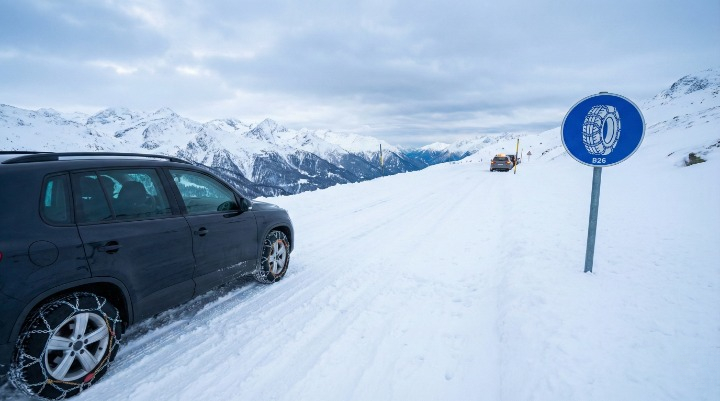
Across Europe, you will see a round blue sign featuring a white tyre with chains on it (Sign B26 in France).
-
If the sign has no text: You must fit chains unless you have compliant winter tyres (and even then, carrying chains is recommended).
-
If the sign says “Chaines à neige obligatoires”: You must fit chains, regardless of whether you have 4×4 or expensive winter tyres. Police often man checkpoints at the bottom of mountain passes to enforce this. Turn up without them, and you will be fined and turned back.
According to the [European Consumer Centre (ECC) Winter Tyre Guidelines], failure to comply not only risks a fine but can void your car insurance in the event of an accident.
Snow Chains vs. Snow Socks vs. Winter Tyres
A common question we get is: “Can I just use Snow Socks instead?” The answer depends on where you are driving and what you are driving.
Here is a direct comparison to help you decide:
| Feature | Steel Snow Chains | Snow Socks (Textile) | Winter Tyres (3PMSF) |
| Grip Level | Maximum. Bites into thick ice. | Medium. Good for fresh snow, poor on ice. | High. Excellent all-rounder. |
| Ease of Fitting | Difficult. Requires practice and strength. | Easy. Stretches over like a sock. | N/A. Already fitted. |
| Ride Comfort | Poor. Vibrates and noisy. | Good. Smooth ride. | Excellent. Standard feel. |
| Max Speed | 30mph (50km/h) | 30mph (50km/h) | Normal road speeds. |
| Durability | High. Can last for years. | Low. Will rip if driven on tarmac. | 20,000+ miles. |
| Legal Status (Euro B26) | Always Accepted. | Accepted (France/Italy) if certified. | Sometimes accepted, often insufficient alone. |
The Verdict?
-
For the UK Commuter: If you live in a flat area and just want to get off your driveway during the one week of snow a year, Snow Socks are likely sufficient and easier to use.
-
For the Adventurer: If you are driving to the Scottish Highlands or the Alps, you need Steel Chains. Socks simply do not provide the mechanical bite required to stop a heavy car sliding down an icy Alpine pass.
How to Fit Snow Chains (Without Freezing Your Fingers)
You have bought the chains. You put the box in the boot. Now, it is 11:00 PM, it is -5°C, and you are stuck on the side of a dark road. This is not the time to open the instruction manual.
Fitting chains is a physical skill. You must practice it on your driveway in the dry and light before you leave.
Step 1: Preparation
Before you even start, ensure you have a “Fitting Kit” in the box. Do not rely on the flimsy plastic gloves that come with the chains—they will freeze and snap in seconds.
-
Pack: Mechanics gloves (thermal dipped), a headtorch, and a kneeling mat (or an old floor mat).
Step 2: Untangle the Mess
When you pull chains out of the box, they will be a tangled web of steel. Shake them out like a spider web. Ensure there are no kinks in the links. If the chain is twisted, it can snap under the weight of the car.
Step 3: The “Drape”
Lay the chain on the ground behind the wheel (for most modern “hoop” style chains) and slide the plastic coated cable behind the tyre. Lift the two ends of the cable up behind the top of the tyre and clip them together.
-
Critical Check: Ensure the cable is not resting on any brake lines or suspension arms behind the wheel.
Step 4: The Front Link
Drape the chain mesh over the front of the tyre. Connect the top link and the bottom tensioning chain. Pull the tensioning chain as tight as you physically can.
Step 5: The 100-Yard Check
This is the step everyone forgets. Drive the car forward very slowly for about 100 yards (or 50 meters). The motion will center the chains on the wheels. Stop the car, get out, and re-tighten the tensioning chain. You will be surprised how much slack appears after the wheels turn.
Warning: If you skip the re-tightening step, the loose chain can whip around and slice through your brake lines or destroy your wheel arch.
Driving with Chains: Speed Limits and Safety
Driving with chains is a visceral experience. The car will feel different. The steering will be heavier, and you will feel a vibration through the seat. This is normal.
The 30mph Rule
Never exceed 30mph (50km/h) with chains on.
At higher speeds, the centrifugal force pulls the chains away from the tyre. If a link snaps at 40mph, it becomes a steel whip that can tear through the car’s bodywork.
Handling Electronic Stability (ESP)
Modern cars have sophisticated computers (ESP/Traction Control) that cut power when wheels slip.
-
To Start: You may need to turn ESP OFF temporarily. Sometimes, you need a little bit of wheel spin to get the chains to “dig” into the snow to get moving.
-
Once Moving: Turn ESP back ON. It will help keep the car stable once you have momentum.
FAQs
Do I need snow chains if I have winter tyres?
In the UK, generally no. Good winter tyres are sufficient for 99% of British roads. However, if you travel to the Alps, you may legally require chains in addition to winter tyres when the “Blue Sign” (B26) is active in heavy snow conditions.
Do you put chains on all 4 wheels?
Usually, you only need them on the “driven” wheels.
-
Front-Wheel Drive: Chains go on the front two wheels.
-
Rear-Wheel Drive: Chains go on the rear two wheels.
-
4×4 / AWD: Check your owner’s manual. Most manufacturers recommend fitting them to the front wheels for steering control, but some require all four.
Can I use snow chains on summer tyres?
Yes. This is the most common setup for UK drivers. It allows you to use standard tyres year-round and only fit the high-grip chains for the few days of extreme weather.
Will snow chains damage my car?
Only if fitted incorrectly or used on clear roads. The most common damage occurs when drivers fail to check their “wheel arch clearance.” Some sports cars with large alloys do not have enough gap between the tyre and the suspension to fit chains. In this case, you must use “ladder tracks” or socks.
How much do snow chains cost?
Basic steel chains start around £30-£50. Premium self-tensioning chains (like Thule/Konig) can cost £150+. Do not buy the cheapest option if you are driving a heavy SUV; the weight will snap cheap links.
Are snow socks legal in Europe in 2025
Yes. In France, certified textile snow socks (which comply with the B26 standard) are legal alternatives to chains under the Mountain Law. However, Austrian police are stricter and often prefer steel chains in heavy conditions.
Why is my car vibrating so much?
If you are on snow, vibration is normal—it means the chains are biting. If the vibration becomes violent or you hear a banging noise, stop immediately. A link may have broken or come loose.
Summary: Better to Have and Not Need
Fitting chains to your wheels isn’t just about answering a theory test question correctly. It is about ensuring that when the weather turns against you, you remain in control.
Whether you are navigating a snowy pass in the Lake District or crossing the border into Switzerland, the logic remains the same: Rubber floats, steel bites.
Key Takeaways:
-
UK Law: Only use chains on snow-covered roads. Remove them on tarmac.
-
Euro Rules: Check for the 3PMSF symbol on your tyres if driving abroad in 2025.
-
Practice: Do not wait for the blizzard to open the box.
Don’t wait until the first flake falls. Check your tyre size (it’s written on the sidewall, e.g., 205/55 R16) and order your chains or socks today. When the beast from the east returns, you’ll be the one driving past the stranded cars, not the one stuck in the drift.
About the Author