How Orange Juice Affects Immune Cells: The Truth Behind the New Science
For decades, the advice has been simple: drink orange juice for Vitamin C to ward off a cold. It was the standard “old wives’ tale” that happened to have some scientific backing.
But new research published in late 2025 has shifted the conversation entirely. We now know that orange juice does something far more complex than just supplying vitamins. According to a breakthrough study in Molecular Nutrition & Food Research, orange juice acts almost like a “software update” for your immune system, directly influencing how your genes express themselves.
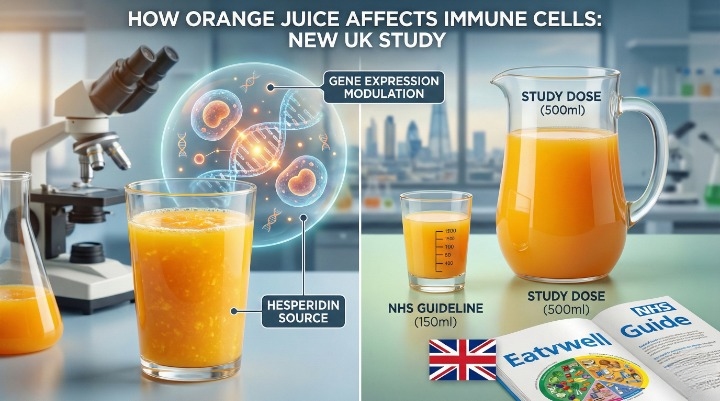
This sounds fantastic until you look at the fine print. The study participants drank 500ml daily, more than triple the NHS recommended limit.
So, where does that leave us? Should you be downing a pint of juice every morning for your heart health, or sticking to the strict 150ml rule to save your waistline? This article breaks down exactly how orange juice affects immune cells, the specific mechanics of gene expression, and how to get the benefits without the massive sugar spike.
The Science: How Orange Juice Changes Gene Expression
The headline finding isn’t about Vitamin C. It is about Nutrigenomics, the study of how food interacts with your genome.
What the Study Actually Found
Researchers discovered that daily consumption of orange juice led to a significant change in the gene expression of white blood cells, specifically PBMCs (Peripheral Blood Mononuclear Cells).
Using a technique called transcriptomics, the study identified that 1,705 genes changed their expression after participants drank the juice. This wasn’t a minor fluctuation. The juice downregulated (switched off or lowered) genes responsible for inflammation and oxidative stress.
Think of your immune cells as a factory. Before the juice, the factory was churning out inflammatory signals. After the juice, the “management” (your genes) sent down new orders to slow that production line down. This leads to a measurable drop in systemic inflammation, which is a key driver of heart disease and diabetes.
If you take a Vitamin C supplement, you do not get the same results. Why? Because the real hero in this study is Hesperidin.
Hesperidin is a polyphenol (specifically a flavanone) found almost exclusively in citrus fruits. It has poor bioavailability on its own, but when consumed in the complex matrix of orange juice, it enters the bloodstream and interacts directly with the endothelial lining of your blood vessels and your immune cells.
Did You Know? Commercial, pasteurised orange juice often contains more Hesperidin than home-squeezed juice. This is because industrial squeezers apply massive pressure to the whole fruit, extracting the nutrient from the peel and pith where it is most concentrated.
The “Dosage Paradox”: 500ml vs. NHS Guidelines
This is the section most health blogs gloss over, but it is the most critical part for your health. The science shows benefits, but the dosage creates a dilemma.
The 500ml Requirement
To achieve the gene-editing results seen in the study, participants consumed 500ml of orange juice every day.
From a nutritional standpoint, 500ml of orange juice contains approximately:
-
220 calories
-
40g – 45g of free sugars
That is more sugar than a standard can of full-fat cola. While it is “natural” fruit sugar (fructose), your liver still has to process a massive load if you drink it all at once.
The NHS Stance (The UK Context)
The [External Link: NHS Eatwell Guide] is very clear: you should limit fruit juice and smoothies to a combined total of 150ml a day.
They classify juice as “free sugars” because the fibre has been removed. Without the fibre matrix of the whole fruit, the sugar hits your bloodstream rapidly. The NHS warns that exceeding this limit contributes to tooth decay and weight gain.
So, who is right? The researchers (focusing on inflammation) or the NHS (focusing on obesity/dental health)? The answer lies in the dose-response. You likely do not need the full 500ml to get some benefit. The study tested a high dose to prove the concept, but Hesperidin is effective at lower doses over time.
Mechanism of Action: Reducing Inflammation & Oxidative Stress
To understand how orange juice affects immune cells deeply, we have to look at two specific markers mentioned in the research.
Lowering IL-6 and Inflammation
One of the primary genes downregulated by the juice is the one coding for Interleukin-6 (IL-6). IL-6 is a pro-inflammatory cytokine. High levels of IL-6 are associated with chronic low-grade inflammation, which scientists call “inflammaging.”
By reducing the expression of IL-6, orange juice helps cool down the immune system’s overreaction. This is particularly relevant for post-viral recovery or general autoimmune support.
Improving Endothelial Function
Your immune cells travel through your blood vessels. If the lining of those vessels (the endothelium) is inflamed, immune cells get “sticky” and cause plaque buildup.
The Hesperidin in orange juice improves Flow-Mediated Dilation (FMD), basically, it helps your arteries relax and widen. This explains why the study linked the gene changes to better blood pressure outcomes.
Practical Advice: How to Drink It for Maximum Benefit
You want the Hesperidin for your genes, but you don’t want the sugar crash. Based on the data, here is the optimised strategy for a UK diet.
Pasteurized vs. Freshly Squeezed vs. Concentrate
There is a common misconception that “raw” or “cold-pressed” is always better. For Vitamin C, that is true (heat destroys it). However, for Hesperidin, commercial pasteurised juice is surprisingly superior.
The industrial extraction process pulls more flavonoids from the peel. So, a high-quality, “100% squeezed” carton from the supermarket (not from concentrate) is actually a solid choice for this specific immune benefit.
Timing Matters (Glycemic Control)
Never drink your 150ml glass on an empty stomach.
-
The Mistake: Drinking it first thing in the morning before food. This spikes insulin.
-
The Pro-Tip: Drink it with your eggs or porridge. The protein, fats, and fibre in your meal will slow down the absorption of the fructose, giving you the Hesperidin without the sharp glucose spike.
Whole Fruit vs. Juice
If you are pre-diabetic or strictly watching carbs, skip the juice. Eat two whole oranges instead. You will get less concentrated Hesperidin than the 500ml juice dose, but the fibre (pectin) feeds your gut microbiome, which is the other headquarters of your immune system.
FAQs
Does orange juice increase white blood cells?
It doesn’t ncessarily increase the number of white blood cells, but it changes their behaviour. It alters the gene expression within PBMCs (a type of white blood cell), making them less inflammatory and more efficient.
Is 100% orange juice good for reducing inflammation?
Yes. The flavonoids, particularly Hesperidin, have been proven to lower inflammatory markers like IL-6. However, the sugar content can cause inflammation if consumed in excess, so moderation (150ml) is key.
How much orange juice should I drink for my immune system?
While the study used 500ml, the NHS recommends a maximum of 150ml daily. To balance the benefits, stick to 150ml and supplement your diet with other polyphenol-rich foods like berries and green tea.
Does store-bought pasteurized juice work as well as fresh?
For gene expression benefits, yes. Pasteurized juice often has higher Hesperidin levels due to the extraction pressure used during processing.
What is hesperidin and why is it in orange juice?
Hesperidin is a bioflavonoid found in citrus. It protects the heart and blood vessels. It is the main compound responsible for the gene-regulating effects seen in recent studies.
Is orange juice bad for you if you are diabetic?
Diabetics should be extremely cautious. Even though the anti-inflammatory benefits are real, the glycemic load of juice is high. Consult your GP or dietitian; usually, whole fruit is the safer option.
Can drinking orange juice everyday improve heart health?
Yes, habitual consumption is linked to lower blood pressure and better blood vessel function, largely due to the antioxidant effects on the endothelial lining.
What did the University of Westminster say about orange juice?
Researchers like Dr. David C. Gaze from the University of Westminster have highlighted these findings, noting that the health benefits of the bioactive compounds in orange juice likely outweigh the risks of sugar if consumed within recommended limits.
Conclusion
The recent findings on how orange juice affects immune cells are a reminder that food is information, not just fuel. The fact that a glass of juice can alter the expression of over 1,000 genes is a powerful testament to the impact of diet on our biology.
However, biology is all about balance. While the study used 500ml to prove a point, you do not need to replicate that extreme dosage to see improvements.
Your Action Plan:
-
Check the Label: Buy “100% Squeezed” juice (not concentrate) to maximise Hesperidin.
-
Measure It: Pour a small 150ml glass. Do not guess.
-
Pair It: Always drink it with a fibre-rich meal.
By treating orange juice as a potent supplement rather than a thirst quencher, you can harness the gene-editing power of Hesperidin while keeping your sugar intake in check.
[Read more about Anti-Inflammatory Foods in our UK Diet Guide] [The Truth About Vitamin D Supplements]
About the Author