Morrisons Rotisserie Chicken VAT Ruling: Why Your Sunday Roast Just Got 20% More Expensive
The British rotisserie chicken has long been a staple of the “lazy Sunday” or the quick weeknight dinner. For around £4.50, you could grab a bird that was hot, juicy, and ready to go. But a decade-long legal battle between supermarket giant Morrisons and HM Revenue and Customs (HMRC) has finally come to a “roasted” conclusion.
In December 2025, the First-tier Tribunal handed down a landmark ruling that will change the price of your grocery shop. Morrisons now faces a staggering £17 million tax bill. The reason? The court decided that these chickens aren’t just groceries; they are “hot takeaway food.”
This distinction might seem like splitting hairs, but in the world of UK tax, it is the difference between 0% and 20% VAT. If you have noticed the price of your favourite rotisserie bird creeping up towards the £5.40 mark, this ruling is the reason why.
The £17m Verdict: Why Morrisons Lost to HMRC
The legal drama reached its climax on 11 December 2025. The First-tier Tribunal (FTT) dismissed Morrisons’ appeal in the case of WM Morrison Supermarkets plc v HMRC [2025] UKFTT 1542 (TC). The supermarket had been fighting since 2012 to prove that their “cool-down” chickens should be zero-rated for VAT.
Morrisons argued that their rotisserie chickens were not “hot food” in the catering sense. Their logic was simple: most customers don’t eat the chicken the moment they leave the shop. In fact, research presented by Morrisons’ former finance director, Richard Nichols, suggested that 80% of customers eat the chicken cold later or reheat it for a family meal at home.
However, HMRC disagreed. They argued that because the chickens were kept in heated cabinets and sold in specific packaging, they were “intentionally hot.” The Tribunal judges eventually sided with the taxman, ruling that the chickens were indeed a “supply in the course of catering.”
[Official HMRC VAT Notice 709/1 on Catering and Takeaway Food]
The 13-Year Battle: A Pasty Tax Legacy
To understand why this matters, we have to look back to 2012. Then-Chancellor George Osborne introduced the “Pasty Tax,” which aimed to close loopholes where some hot snacks were tax-free while others were not. After a massive public outcry (and some very famous sausage roll protests), the rules were refined.
The law landed on a specific test: Is the food kept hot on purpose, or is it just “incidentally hot” because it recently came out of the oven? For thirteen years, Morrisons gambled that their rotisserie birds fell into the “incidentally hot” category. That gamble just cost them £17 million in backdated tax from the period of 2017 to 2020 alone.
The “Foil Bag” Evidence: How Packaging Proved Intent
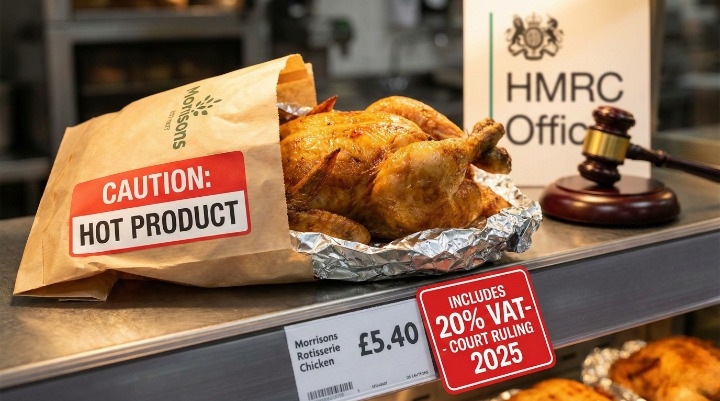
If you have ever picked up a Morrisons chicken, you know the packaging. It is a sturdy, grease-proof paper bag with a shiny foil lining. You might think that foil is just to stop the grease from ruining your car seats, but in a courtroom, that bag became a piece of forensic evidence.
Heat Retention vs. Ambient Temperature
One of the most fascinating parts of the 2025 ruling was the “cooling trajectory” test. To be tax-free (zero-rated), a product must be allowed to cool naturally toward the ambient temperature (room temperature).
The court heard evidence that a rotisserie chicken left out on a counter would naturally drop to about 31.8°C within two hours. However, inside the Morrisons foil-lined bag, those same chickens were measured at between 42°C and 45°C after two hours.
Expert Insight: The judge noted that the foil lining was specifically designed for heat retention. By selling the bird in a bag that actively fights against the natural cooling process, Morrisons was effectively “keeping the food hot” for the customer.
The Labelling Trap
Another “smoking gun” was the label on the bag itself. Every bag was clearly printed with the words: “Caution: Hot Product.” While Morrisons argued this was a health and safety requirement, HMRC used it to prove that the product was being marketed and sold as hot food. You cannot tell a customer to be careful because a product is hot and then tell the taxman the heat is just an “incidental” side effect.
Incidentally Hot vs. Intentionally Hot: The VAT Rules Explained
The UK tax system is famous for its quirks—think Jaffa Cakes being cakes (0% VAT) and not biscuits (20% VAT). The rotisserie chicken case falls into a similar category of “VATA 1994” complexity.
The 2-Hour Rule
Perhaps the most damaging evidence against Morrisons was their own internal food safety policy. The supermarket has a strict rule: any rotisserie chicken not sold within two hours of leaving the oven must be discarded as waste.
HMRC argued that if the goal was simply to sell “cooked chicken,” Morrisons would move the birds to a fridge after they cooled down. By throwing them away while they were still warm, Morrisons proved that the hot state of the chicken was an essential part of the product they were selling.
| Food Item | VAT Rate | The “Hot” Logic |
| Freshly Baked Bread | 0% | Meant to cool; heat is incidental to the baking process. |
| Greggs Sausage Roll (on shelf) | 0% | Sold as it cools; not kept in a heated environment. |
| Morrisons Rotisserie Chicken | 20% | Kept in a heated cabinet/foil bag; discarded if it cools. |
| McDonald’s Burger | 20% | Standard takeaway food; served hot for immediate eating. |
[Check guide on UK Personal Finance and Stealth Taxes]
What This Means for Your Weekly Shop (Price Impact)
The most immediate question for shoppers is: “How much will my chicken cost now?”
Until this ruling, Morrisons (and several other supermarkets) often absorbed the VAT risk or treated the sales as zero-rated. With a £17 million bill to pay and a definitive court ruling against them, the price at the till is almost certain to rise.
From £4.50 to £5.40
Before the ruling, a standard rotisserie chicken was often priced around £4.40 to £4.50. Applying a 20% VAT rate adds 90p to that price, pushing the total to £5.40.
For many families, this is more than just a few pennies. Richard Nichols argued in court that £4.50 was the “psychological ceiling” for most shoppers. Pushing the price above £5.00 could lead to hundreds of thousands of fewer chickens being sold every month.
The Ripple Effect: Tesco, Asda, and Sainsbury’s
Morrisons isn’t the only one in the crosshairs. While this specific case was against Morrisons, HMRC is likely to apply the same logic to every supermarket deli counter in the UK. If Tesco or Sainsbury’s are using heat-retentive packaging or heated display units, they will also have to account for 20% VAT.
My Pro-Tip: If you want to save that 20%, look for the “pre-cooked cold chicken” in the chilled aisle. Because it is sold cold for home consumption, it remains zero-rated. You are essentially paying a 20% “convenience tax” to have the supermarket keep it warm for you.
Expert Analysis: Why Food is a VAT Minefield
Why does the government care so much about a chicken? It comes down to VATA 1994 Schedule 8. This law dictates that “food” is generally zero-rated because it is a necessity. However, “catering” is a luxury service, which is standard-rated at 20%.
The problem is that the line between “groceries” and “catering” has blurred. When you buy a hot chicken to take home, are you buying a grocery item or a catering service?
The “Nutella Biscuit” Precedent
We have seen this before. In October 2025, the Tribunal ruled that “Nutella Biscuits” were zero-rated cakes rather than standard-rated biscuits. Supermarkets spend millions on these cases because their margins are razor-thin. A 20% tax hit on a high-volume product like rotisserie chicken can wipe out the profit for that entire department.
For Morrisons, this ruling comes at a difficult time. Having been taken over by US private equity firm Clayton, Dubilier & Rice in 2021, the company is already battling high debt levels and stiff competition from Aldi and Lidl. A £17m tax bill is a “fowl” blow to their 2026 balance sheet.
FAQs
Why is there VAT on hot chicken but not cold?
Under UK law, hot takeaway food is considered “catering” (20% VAT), while cold food for home consumption is considered a “grocery” (0% VAT). The heat makes it a “service.”
Is rotisserie chicken zero-rated if I buy it to eat later?
Legally, it doesn’t matter when you eat it. The VAT is determined by the state of the food at the point of sale. If the supermarket kept it hot for you to buy, the tax applies.
What is the “Pasty Tax” 2012 rule?
This was a change to ensure all hot takeaway food was taxed equally. It introduced the test of whether food is “intentionally” kept hot after cooking.
Does this ruling apply to all UK supermarkets?
Yes. While the court case specifically named Morrisons, the legal precedent regarding foil bags and heated cabinets now applies to all UK retailers.
Can I avoid the 20% VAT by asking for a cold chicken?
You can buy cooked chicken from the chilled fridge (0% VAT). However, you cannot usually ask a member of staff to take a hot chicken out of the cabinet and “sell it to you cold” to avoid the tax.
Why did Morrisons have to pay £17 million?
The £17 million represents the VAT that HMRC believes should have been collected on sales between 2017 and 2020.
What is “ambient temperature” in VAT law?
Ambient temperature is the temperature of the surrounding air (usually around 18-21°C). If food is sold significantly above this, and steps were taken to keep it that way, it is usually vatable.
How does HMRC define “hot takeaway food”?
It is food that is either: (a) heated for the purpose of being eaten hot, (b) kept hot after being heated, or (c) provided in heat-retentive packaging.
The Bottom Line
The era of the “tax-free” hot rotisserie chicken is officially over. The December 2025 ruling has closed a loophole that supermarkets have used for over a decade. While Morrisons argued that their chickens were just “cooling down,” the court decided that the foil bags and heated cabinets told a different story.
For the consumer, this is another “stealth tax” on a weekly essential. While inflation might be cooling in other areas, your Sunday roast just got a permanent 20% price hike.
The next time you reach for that “Caution: Hot Product” bag, remember that you aren’t just paying for the chicken—you are paying for the heat, the foil, and the 13-year legal battle that finally came home to roost.
Would you like me to create a custom infographic comparing VAT rates for different supermarket foods to accompany this post?
About the Author