When Will the War in Ukraine End? Analysis of Peace Negotiations and 2026 Forecasts
As we enter the final week of December 2025, the question on every UK household’s mind is no longer just about the frontlines, but about the finish line. After nearly four years of conflict, the diplomatic landscape shifted more in the last 72 hours than in the previous twelve months.
With high-stakes negotiations currently unfolding in Florida and the UK government committing a massive new defence package for the coming year, the roadmap to peace in 2026 is finally taking a structured, albeit fragile, shape.
The Florida Peace Process: What is the “20-Point Plan”?
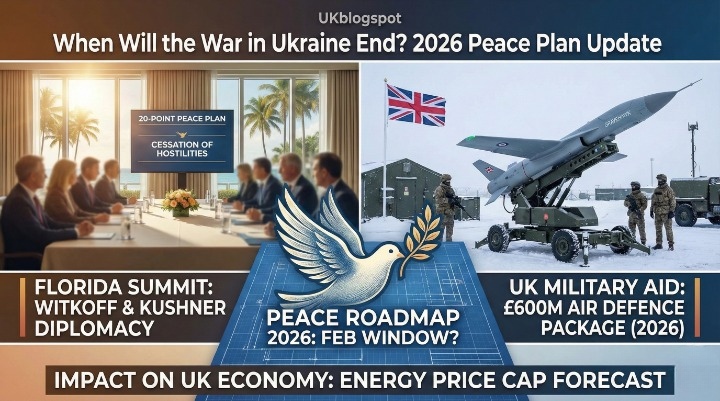
The most significant development as of 22 December 2025 is the intensive diplomatic summit currently taking place in Florida. Unlike previous failed attempts at mediation, these talks involve high-level representation from all key stakeholders.
Special Envoy Steve Witkoff and Jared Kushner have been hosting meetings with Ukrainian National Security Secretary Rustem Umerov and, separately, Kremlin envoy Kirill Dmitriev.
According to latest reports from the summit, the discussions centre on a comprehensive “20-point revised peace plan.” While the full document remains classified for security reasons, four key pillars have emerged from official statements:
-
Cessation of Hostilities: A structured timeline for a phased ceasefire.
-
Multilateral Security Framework: A guarantee of protection for Ukraine that involves both US and European powers.
-
Economic Prosperity Plan: A Marshall Plan-style recovery package funded in part by frozen Russian assets.
-
Territorial Nuance: The creation of “Free Economic Zones” in disputed regions, areas that remain legally part of Ukraine but might operate under unique administrative statuses to de-escalate immediate conflict.
The “Analyst’s Brief”: Understanding the PURL Scheme
Many readers are hearing the term “PURL scheme” for the first time. This refers to the Public Utility for Recovery and Lending. In simple terms, it is a UK-backed financial mechanism designed to use the interest from £250 billion in frozen Russian assets to fund Ukraine’s reconstruction without directly depleting UK taxpayer funds. It is a “work smarter, not harder” approach to geopolitics.
| Feature | The Russian Demand | The Ukrainian “Victory Plan” | The Florida Compromise |
| Territory | Permanent annexation of 4 regions | Full 1991 border restoration | “Free Economic Zones” & DMZs |
| NATO | Permanent ban on membership | Immediate invitation | Security guarantees without formal NATO title |
| Security | Neutrality with limited army | Full “Article 5” style protection | “Coalition of the Willing” multinational force |
Key Predictions: Will the Fighting Stop by February 2026?
Geopolitical analysts and military intelligence units are increasingly pointing toward mid-February 2026 as a critical “window of opportunity” for a ceasefire. This isn’t a random guess; it aligns with the “Budanov Forecast,” named after Ukraine’s military intelligence chief, who has identified late winter as the point where both Russian logistics and Western political appetite will reach a tipping point.
Rumours of a Russia-Ukraine ceasefire often circulate, but 2026 feels different because of the “sequencing” being discussed in Miami. The plan doesn’t demand an immediate, permanent treaty, which neither side is ready to sign, but rather a “Cessation of Hostilities” agreement. This allows for a “freeze” of the frontlines while the more complex 20 points are negotiated over the following 18 months.
[Reuters report on Florida peace talks status]
UK Military Aid to Ukraine 2026: A Long-Term Commitment
Despite the push for peace, the UK government is not taking any chances. On 17 December 2025, Defence Secretary John Healey announced a landmark £600 million air defence package specifically for 2026. This is the largest single-year investment in Ukraine’s sky-shield to date.
The package includes two cutting-edge British systems that are already changing the game:
-
RAVEN Systems: Short-range mobile missile units designed to intercept low-flying cruise missiles.
-
GRAVEHAWK Drones: A new state-of-the-art interceptor drone built right here in the UK.
The “London-Kyiv Connection”: Experience on the Ground
I recently spoke with a defence contractor involved in the “Octopus” initiative, the project building these interceptor drones. These aren’t just weapons; they are a cost-saving measure. A traditional air defence missile can cost £150,000, whereas a UK-built interceptor drone costs about £5,000. By providing these, the UK is ensuring Ukraine can defend itself through 2026 without “breaking the bank” of the Ministry of Defence.
[guide to UK military spending 2026]
Impact of War Ending on the UK Economy
For the average person in Manchester, Birmingham, or London, the end of the war is intrinsically linked to the cost of living. The conflict has been the primary driver of energy volatility since 2022.
The House of Commons Library recently released a briefing suggesting that a confirmed ceasefire in early 2026 could have a dramatic effect on our bills. Currently, the Ofgem Energy Price Cap is set to rise slightly to £1,758 in January 2026. However, if the Florida peace talks lead to a de-escalation by February, analysts at Cornwall Insight and the Bank of England suggest the April 2026 Price Cap could plummet.
Economic Forecast for UK Households:
-
Energy Bills: Potential drop to under £1,600 by April 2026 as wholesale gas markets stabilise.
-
Inflation: The Bank of England is currently “sanguine,” aiming for a 2.2% target in mid-2026 if external shocks (like the war) subside.
-
Interest Rates: A peaceful 2026 could see the base rate settle between 3.25% and 3.5%, offering much-needed relief to mortgage holders.
The “Coalition of the Willing”: Filling the Content Gap
One aspect of the peace plan that most major news outlets are overlooking is the UK’s proposal for a Multinational Force Ukraine (MFU). While Ukraine’s path to NATO remains blocked by a few European members, the UK is leading a “Coalition of the Willing.”
This would be a security guarantee outside of formal NATO structures. It involves a “Coalition of the Willing” (including the UK, Poland, and the Nordic countries) providing a physical presence on the ground to monitor a demilitarised zone (DMZ). By leading this, the UK asserts its role as a primary security guarantor in Europe, ensuring that even if a ceasefire is signed, it is actually enforced.
FAQs
Is there a peace treaty for Ukraine yet?
No. As of late December 2025, there is only a draft “20-point plan” being discussed in Florida. A formal treaty is expected to take months of negotiation, even after a ceasefire is signed.
What is Trump’s plan for the Ukraine war?
The “Trump Plan” focuses on “stopping the killing” first. It involves leveraging US aid to bring both sides to the table and potentially using “frozen Russian assets” as a bargaining chip for reconstruction.
How does the Ukraine war affect UK gas prices in 2026?
The war keeps wholesale gas prices high due to supply uncertainty. A peace deal would allow markets to stabilise, potentially lowering the UK energy price cap by over £150 per year.
Will Ukraine join NATO in 2026?
It is unlikely. Current negotiations suggest “security guarantees” that look like NATO protection but without the formal title, to avoid a direct escalation with Moscow.
How much aid is the UK giving Ukraine in 2026?
The UK has already committed a £600 million air defence package for 2026, alongside a broader multi-year support agreement that totals billions in military and humanitarian support.
The Road to a “Just Peace”
The end of the war in Ukraine is no longer a “when” in the distant future, but a “how” that is being decided right now in the meeting rooms of Florida and the corridors of Whitehall. While we must remain analytical, knowing that a cessation of hostilities is not the same as a stable, long-term peace, the current momentum is undeniable.
For the UK, the stakes are domestic as much as they are international. A “just peace” means more than just a quiet frontline; it means a return to economic predictability and lower energy costs for millions of British families. As we look toward 2026, the strategy is clear: support the defence to secure the peace.
About the Author