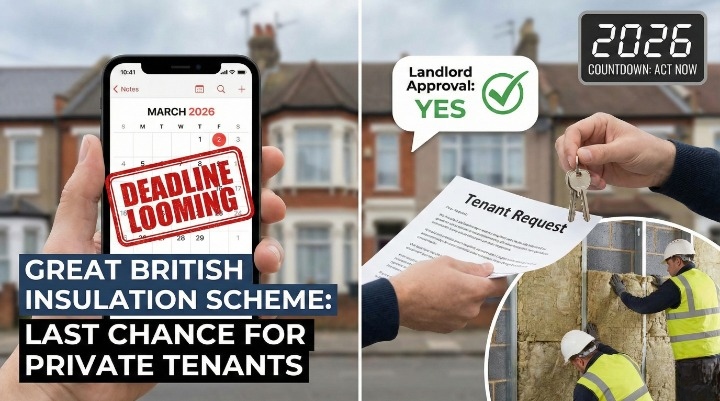
Great British Insulation Scheme Eligibility: The 2026 Private Tenant’s Survival Guide
If you have tried to check your Great British Insulation Scheme eligibility as a private tenant recently, you likely hit a brick wall. You went to the official GOV.UK portal, only to find the online application service is now closed.
Panic sets in. Your energy bills are still skyrocketing, your home loses heat faster than you can pay for it, and you assume you have missed the boat.
Here is the truth: The funding is not gone yet.
While the government’s central application portal closed its doors in October 2025, the legislation behind the scheme runs until 31 March 2026. This means you currently sit in a critical “eligibility window.” You can still secure thousands of pounds worth of free insulation, but you must now apply directly through energy suppliers rather than a government form.
This guide acts as your survival manual for these final months. We will cover exactly how to bypass the closed portal, the specific criteria for renters in 2026, and—crucially—how to get your landlord to say “yes” before the clock runs out.
Is the Great British Insulation Scheme Still Open in 2026?
Let’s clear up the confusion immediately. The “scheme” and the “portal” are two different things.
The Great British Insulation Scheme (GBIS) is a legal obligation placed on major energy suppliers (like British Gas, E.ON, OVO, and EDF) to upgrade the UK’s least efficient homes. Under the Ofgem ECO4 Order, these suppliers must meet specific targets by March 2026.
Because the central GOV.UK referral system has stopped taking new leads, these suppliers are now arguably more desperate to find eligible households to meet their quotas before the deadline.
This creates a unique opportunity for you. If you act now, you are helping them solve a compliance problem. But time is tight. Retrofit assessments and installations take weeks to organise. If you wait until February 2026 to apply, suppliers will likely have closed their books to ensure they finish work before the March cutoff.
GBIS Eligibility for Private Tenants: Do You Qualify?
Eligibility rules for renters are stricter than for homeowners, but they remain clear-cut. To qualify for a grant, your rented home must generally have an Energy Performance Certificate (EPC) rating of D or E.
Important Warning regarding EPC F and G: Legally, landlords cannot rent out properties rated F or G due to Minimum Energy Efficiency Standards (MEES) unless they have a valid exemption. If your home is rated F or G, the GBIS scheme might technically reject you because your landlord should have already improved the property using their own money.
Beyond the EPC rating, eligibility splits into two distinct groups.
1. The Low-Income Group (Free Insulation)
You fall into this group if you receive one of the following means-tested benefits. If you are in this category, you are typically eligible for single insulation measures entirely for free.
-
Universal Credit
-
Pension Credit (Guarantee Credit)
-
Income-based Jobseeker’s Allowance (JSA)
-
Income-related Employment and Support Allowance (ESA)
-
Income Support
-
Housing Benefit
-
Tax Credits (Child Tax Credits and Working Tax Credits)
2. The General Group (Partial Funding)
If you do not receive benefits, you can still qualify based on your home’s Council Tax Band.
-
England: Council Tax Band A-D
-
Scotland & Wales: Council Tax Band A-E
The “Renter Trap” for the General Group: If you are in the General Group, the scheme often requires a customer contribution. Since you do not own the property, you cannot legally pay for improvements to the structure yourself, and your landlord might refuse to pay the difference.
However, for cavity wall insulation and loft insulation, grants often cover 100% of the cost, even for the General Group. It all depends on the specific supplier’s offer at the time of your application.
The “Landlord Permission” Hurdle: How to Get a Yes
This is the number one reason tenants give up. You find out you are eligible, but you are terrified your landlord will say no, increase the rent, or see the request as a nuisance.
According to Citizens Advice, nearly 70% of renters hesitate to ask for repairs or improvements for fear of eviction or rent hikes. But remember: GBIS increases the value of their asset for free.
You need to sell this as a benefit to them, not a favour to you.
The “Asset Upgrade” Script
Use this email template to approach your landlord or letting agent. It frames the installation as a smart financial decision for them.
Subject: Proposal to increase property EPC rating at no cost to you
Dear [Landlord Name/Agent Name],
I’m writing to share some good news regarding [Property Address].
I have checked the property’s eligibility for the Great British Insulation Scheme (GBIS). Because of the current energy rating and my tenancy status, the property qualifies for fully funded insulation upgrades (likely loft or cavity wall insulation).
This work is government-backed and carried out by TrustMark accredited installers. It would increase the property’s EPC rating and market value without you needing to spend any money. It also helps future-proof the property against upcoming tighter rental energy regulations.
I am happy to handle the application process and be present for the surveys. All I need is your written permission to proceed with the free assessment.
Can I send you the supplier link to review?
Best regards, [Your Name]
The “MEES” Leverage
If they still refuse, or if your home is freezing cold, you have legal leverage. Under the Homes (Fitness for Human Habitation) Act 2018, rented homes must be free from “excess cold.”
If your home is EPC D or E and you are shivering, you can politely remind them that this grant helps them avoid potential future enforcement action from the local council.
Step-by-Step: How to Apply After the Portal Closure
Since you cannot click “Apply” on GOV.UK anymore, follow this Direct-to-Supplier route.
Step 1: Verify Your Data
Check your current EPC rating on the Government EPC Register. If your certificate is over 10 years old, it is expired, and you may need a new assessment (the scheme often covers this). Next, find your Council Tax band on your local council’s website.
Step 2: Choose a Supplier
You do not need to apply through your current electricity provider. You can apply to any obligated supplier. Major suppliers with active application pages include:
-
British Gas
-
E.ON Next
-
OVO Energy
-
EDF Energy
-
Octopus Energy
Pro-Tip: Check smaller suppliers too. Sometimes “challenger” brands have more capacity in their installation supply chain than the big names.
Step 3: The “Retrofit Assessment”
Once you apply, the supplier will book a “Retrofit Assessment.” A coordinator will visit your home to measure walls, check loft depth, and look for damp.
-
Clear the loft: If your loft is full of boxes, they will refuse to survey it. Clear the hatch area before they arrive.
-
Ventilation: They will check if you have adequate vents. If not, they may need to install trickle vents in your windows (also covered by the grant) to prevent mould.
Step 4: Installation
If the survey passes and your landlord signs the digital consent form, a PAS 2030 certified installer will do the work. This usually takes 1-2 days.
What Insulation Measures Can Renters Actually Get?
The Great British Insulation Scheme is a “single measure” scheme. Unlike previous schemes that did whole-house retrofits, GBIS focuses on the one upgrade that makes the biggest difference for the lowest cost.
For private tenants, the most common approvals are:
-
Cavity Wall Insulation: Injecting insulation material into the gap between your brick walls. This is quick, non-intrusive, and saves around £240 a year on bills (based on Energy Saving Trust 2025 figures).
-
Loft Insulation: Top-up insulation if you have less than 100mm currently. They will boost it to the recommended 270mm.
-
Solid Wall Insulation: This is rare for renters in the General Group because it is expensive (often £8k+). Suppliers rarely fund this fully without a landlord contribution.
FAQs
Is the Great British Insulation Scheme still running?
Yes. The scheme runs until 31 March 2026. Only the government’s referral portal has closed. You must now apply directly to energy suppliers.
Can my landlord say no to free insulation?
Technically, yes. It is their property. However, if they unreasonably refuse permission for energy efficiency improvements, you may have grounds to challenge this, especially if the house is dangerously cold.
Do I have to pay anything toward GBIS?
If you are in the Low-Income Group, no. If you are in the General Group, you might be asked for a contribution (e.g., £200-£500) for larger jobs. In rental situations, the landlord should pay this, as it improves their asset.
Will this increase my rent?
Landlords cannot increase rent during a fixed-term tenancy just because they added insulation. However, when your contract renews, they might argue the property is now “premium.” This is why getting the agreement in writing—that this is a grant-funded repair—is essential.
Don’t Let the March Deadline Pass
The clock is ticking louder than you think. The Great British Insulation Scheme application deadline is effectively here. While the law says March 2026, the reality of logistics means you need to get your application into a supplier’s system by January 2026 at the latest.
Suppliers need time to book surveys, get landlord signatures, and source materials. If you wait until the final weeks, you will find closed waiting lists and unanswered phones.
You have the right to a warm home. You have the script to convince your landlord. The only thing missing is action.
Next Step: Locate your EPC certificate immediately, then search for “British Gas GBIS application” or “E.ON insulation grant” to start the process directly with a supplier today.
About the Author