Adeniyi Mobolaji Kayode: Who is the Driver in AJ’s Fatal Crash?
Everything to know about the man charged, the legal battle ahead, and the anatomy of the tragedy on the Lagos-Ibadan Expressway.
The new year has begun with a tragedy that has shaken the sports world. While boxing fans were expecting news of Anthony Joshua’s next fight, they are instead grappling with a devastating report from Nigeria: a fatal crash that claimed two lives and left the former heavyweight champion injured.
But as Joshua recovers, the legal focus has shifted squarely onto one man: Adeniyi Mobolaji Kayode.
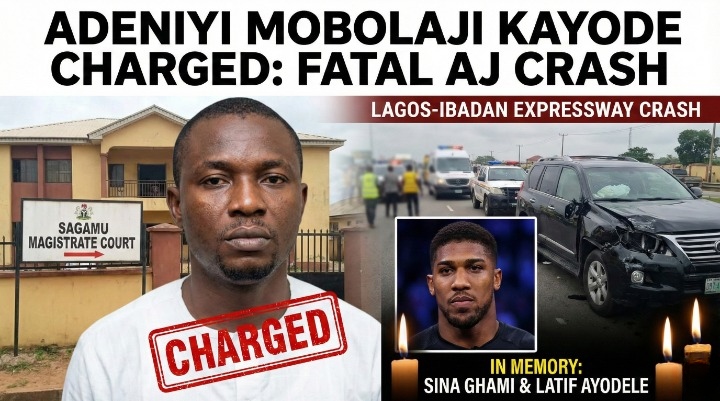
On January 2, 2026, Kayode stood before the Sagamu Magistrate Court, not as a victim, but as the accused. The 46-year-old driver is now at the centre of a high-stakes legal case, facing four serious criminal charges following the crash on the Lagos-Ibadan Expressway.
Here is a verified breakdown of who Adeniyi Mobolaji Kayode is, the specific charges he faces, and why this case highlights a deadly infrastructure crisis in Nigeria.
Who is Adeniyi Mobolaji Kayode? The Man Behind the Wheel
Contrary to early rumours suggesting a locally hired taxi driver, our sources confirm that Adeniyi Mobolaji Kayode is a trusted, long-term member of Anthony Joshua’s logistics team in Nigeria.
Kayode has served as a lead driver for Joshua’s security detail during previous visits to the country. This deeper relationship adds a layer of complexity to the tragedy, this was not a stranger, but a member of the “inner circle” tasked with the safety of Britain’s most famous boxer.
Kayode was reportedly behind the wheel of the black Lexus SUV when it collided with a stationary truck at the Makun axis of the expressway. Following the crash, he was treated for minor injuries at Lagoon Hospital before being officially taken into police custody on New Year’s Day.
The 4 Criminal Charges: A Legal Breakdown
The legal proceedings moved rapidly. Just days after the December 29 crash, the Ogun State Police Command brought Kayode before Chief Magistrate B.J. Ojikutu.
For UK readers unfamiliar with the Nigerian legal system, the charges are prosecuted under the Federal Highway Act, Cap F:135. This is federal legislation specifically governing conduct on interstate trunk roads.
Here is the breakdown of the four counts Kayode is facing:
1. Dangerous Driving Causing Death (Section 5(1))
This is the most severe charge. Under Section 5(1) of the Federal Highway Act, it is an offence to drive “recklessly or at a speed or in a manner which is dangerous to the public,” resulting in death. If convicted, this carries a potential prison sentence of up to seven years.
2. Reckless and Negligent Driving (Section 6(1))
This charge focuses on the manner of driving. Police prosecutors allege that Kayode was speeding significantly above the limit for the road conditions, leading to a loss of control when a tyre burst.
3. Driving Without a Valid National Driver’s License
Perhaps the most shocking revelation from the arraignment was the allegation that Kayode did not hold a valid license at the time of the crash. In professional logistics, valid documentation is the first rule of employment, raising serious questions about the vetting process for the entourage.
4. Bodily Harm and Property Damage
This count covers the injuries sustained by Anthony Joshua and the total write-off of the luxury Lexus SUV.
Official Statement: Ogun State Police spokesperson, Oluseyi Babaseyi, stated outside the court: “The investigation has shown clear negligence. The law must take its course, regardless of the status of the passengers involved.”
The Bail Conditions: £3,500 and “Judicial Remand”
During the January 2 hearing, Kayode pleaded not guilty to all charges.
His defence team successfully argued for bail, which was set at 5 million Naira (approximately £3,500). However, granting bail and getting out are two different things in the Nigerian judicial system.
Kayode was not released immediately. Instead, the Magistrate ordered that he be remanded in custody at the Sagamu Correctional Centre until he “perfects” his bail conditions. This requires him to provide two sureties (guarantors) who own property within the court’s jurisdiction and can prove tax payments.
Until these strict paperwork requirements are met, Kayode remains behind bars. The case has been adjourned until January 20, 2026.
The Anatomy of the Crash: Speed, a Burst Tyre, and a Stationary Truck
To understand why this happened, we must look at the specific mechanics of the crash.
The incident occurred on the Makun axis of the Lagos-Ibadan Expressway. According to the Federal Road Safety Corps (FRSC) report, three factors combined to create a “death trap”:
-
Excessive Speed: Witnesses report the convoy was travelling at high speed to beat the notoriously heavy Lagos traffic.
-
Mechanical Failure: The Lexus SUV reportedly suffered a burst rear tyre. At high speed, this caused the vehicle to veer uncontrollably.
-
The Stationary Truck: This is the critical factor. The SUV did not hit a moving vehicle; it slammed into a heavy-duty truck that had broken down and was parked directly on the highway without warning lights or safety cones.
The “Seat Swap” That Saved AJ
In a chilling detail that has emerged from the camp, Anthony Joshua may have saved his own life with a split-second decision. Reports suggest that minutes before the crash, Joshua moved from the front passenger seat to the back to stretch his legs.
The front passenger side took the brunt of the impact. The man who was sitting there, Sina Ghami, died instantly.
Remembering the Victims: Sina Ghami and Latif “Latz” Ayodele
While the headlines focus on the boxer and the driver, the true tragedy lies in the loss of two beloved members of the sporting community.
-
Sina Ghami: A close friend and personal physiotherapist to Joshua. He was known for his infectious energy in the training camp.
-
Latif “Latz” Ayodele: A veteran trainer and key logistics coordinator for Matchroom Boxing in Africa.
Arrangements are currently being made to repatriate their remains to the UK, a sombre process that is running parallel to the criminal investigation.
Why the Lagos-Ibadan Expressway is a “Death Trap”
For those who have never travelled in Nigeria, the Lagos-Ibadan Expressway is known as the country’s busiest—and deadliest, road.
It is a vital artery connecting the port city of Lagos to the rest of the country. However, it is plagued by a specific hazard: stationary trucks.
Drivers often abandon broken-down haulage trucks in the middle of active lanes. At night or in poor visibility, these become invisible concrete walls.
My Experience: Having travelled this route during assignment, the danger is palpable. There are no hard shoulders in many sections. If a truck breaks down, it simply stops in the fast lane. If you are driving at 70mph and a stationary object appears out of the darkness, reaction times are often insufficient.
This systemic issue will likely be a key part of Kayode’s defence. His lawyers may argue that while he was speeding, the primary cause of death was the negligent placement of the stationary truck, a common defence in Nigerian road traffic cases.
What Happens Next?
For Anthony Joshua, the physical wounds will heal, but the emotional toll of losing two close friends will be immense. He has been discharged from the hospital and is expected to return to the UK shortly.
For Adeniyi Mobolaji Kayode, the nightmare is just beginning. He sits in a cell in Sagamu, awaiting the verification of his sureties. If he cannot meet the bail terms, he will remain in custody until the trial resumes on January 20.
This case is no longer just about a car accident; it is a criminal trial that will examine the responsibilities of those entrusted with the lives of superstars.
[Read the full FRSC Road Safety Report for Jan 2026] [Anthony Joshua’s Career Timeline: From Gold to Global Icon]
FAQs
Who was driving Anthony Joshua during the car accident in Nigeria?
Adeniyi Mobolaji Kayode, a 46-year-old member of Joshua’s logistics team, was the driver.
What are the charges against Anthony Joshua’s driver?
He faces four charges: dangerous driving causing death, reckless driving, driving without a valid license, and causing property damage.
Is Anthony Joshua still in hospital?
No, Anthony Joshua has been discharged from the hospital with minor injuries and is in stable condition.
What is the bail amount for Adeniyi Mobolaji Kayode?
Bail was set at 5 million Naira (approx. £3,500), with two sureties required.
Who died in the Anthony Joshua car crash?
wo team members died: Sina Ghami (physiotherapist) and Latif “Latz” Ayodele (trainer).
What caused the Anthony Joshua crash?
A combination of excessive speed, a burst tyre, and a collision with a stationary truck on the highway.
When is the next court date?
The case has been adjourned until January 20, 2026, at the Sagamu Magistrate Court.
About the Author