Self-Improvement Trends UK 2026: The New Rules of the Arc, Soft Life, and Monk Mode
Burnout is rising in the UK. Are the Winter Arc, Soft Life, or Monk Mode the cure? Master 2026’s viral trends to reclaim your focus without the hustle.
Work-related stress, depression, and anxiety caused the loss of 35.2 million working days in Great Britain in 2023/24, according to the Health and Safety Executive (HSE). By 2025, 18% of UK adults were reporting moderate to severe depressive symptoms, with the figure rising to 26% among 16–29-year-olds.
These numbers aren’t just statistics; they are the driving force behind the massive shift in how we approach self-improvement. The era of “hustle culture”, where sleep was for the weak and 4 AM starts were mandatory, is dead.
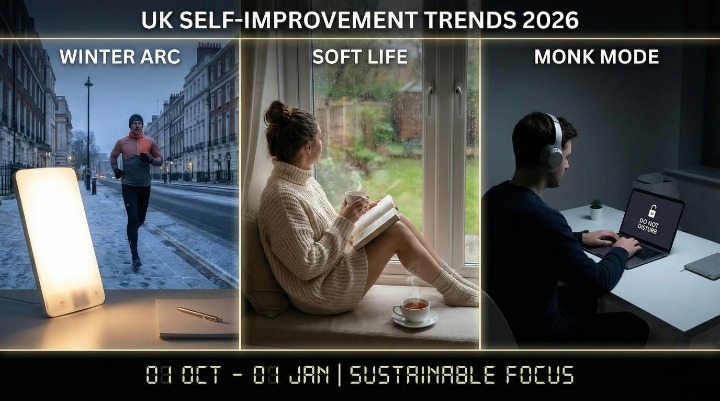
In 2026, UK wellness trends have evolved. We are seeing a move toward sustainable performance. The “Winter Arc” isn’t just about getting shredded; it’s about mental resilience against Seasonal Affective Disorder (SAD). The “Soft Life” isn’t about laziness; it’s a strategic rebellion against economic burnout. And “Monk Mode” has become the ultimate tool for deep work in a distracted world.
This guide cuts through the TikTok noise. We explore the self-improvement trends UK 2026 actually needs, providing you with actionable rules, routines, and reality checks to navigate the year ahead.
The Winter Arc: Why UK Gen Z is “Locking In” Before 2027
The “Winter Arc” has become a cultural phenomenon, but its roots run deeper than social media aesthetics. Traditionally, people wait for the New Year to set goals. The Winter Arc flips this script. It demands you “lock in” from 1 October to 1 January, using the darkest months of the year to build discipline while everyone else slows down.
For the UK population, this trend is particularly potent. With sunset as early as 3:45 PM in parts of Scotland and Northern England, the “winter blues” are a biological reality. A 2025 report from Huel UK noted that roughly one-third of Brits suffer from symptoms of SAD. The Winter Arc combats this by enforcing structure when your body naturally wants to hibernate.
The 1st October Reset: Winter Arc Rules Explained
The rules are simple but strict. The goal is to enter the New Year having already established the habits others are just starting to think about.
The Core Rules of the Winter Arc:
Pro-Tip: The “Arc” is Personal Don’t copy an influencer’s routine blindly. If you work a 9-5 in London, a 4 AM gym session might just lead to burnout. The most successful Winter Arc is the one you can sustain until March, not just January.
Beating the 4 PM Sunset: Circadian Alignment in the UK
One major gap in most online guides is the lack of geographical context. Doing a Winter Arc in Miami is very different from doing one in Manchester.
In the UK, your primary enemy is the lack of light. Our circadian rhythms, the internal body clocks that regulate sleep and alertness, get disrupted when we wake up in the dark and commute home in the dark.
How to optimise your Arc for the UK Winter:
-
-
Light First: Get outside within 20 minutes of sunrise, even if it’s cloudy. The lux intensity of natural light triggers serotonin production better than any indoor bulb.
-
Vitamin D3: The NHS recommends all adults consider a supplement during autumn and winter. This isn’t optional for a high-performance Arc; it’s fuel.
-
The “Fake Commute”: If you work from home (WFH), walk around the block before logging on. This separates “home mode” from “work mode” and fights the cabin fever that derails productivity.
-
If the Winter Arc is the accelerator, the “Soft Life” is the steering wheel.
Originating from Nigerian influencers and Black creators on TikTok, the Soft Life meaning has often been misinterpreted by mainstream media as “luxury and laziness.” In reality, for the UK audience in 2026, it is a response to the cost-of-living crisis and high-stress environments.
Hustle Culture vs Soft Life: A 2026 Perspective
Hustle culture taught us that our value was tied to our output. It glorified exhaustion. The Soft Life rejects this premise entirely. It prioritises low stress, emotional boundaries, and intentional living.
Key Differences:
-
Hustle Culture: “Grind while they sleep.”
-
Soft Life: “Rest so you can function.”
-
Hustle Culture: Monetise every hobby.
-
Soft Life: Keep hobbies for joy, not profit.
This shift aligns with the rise of “Slow Productivity”, a concept gaining traction as UK workers push back against unpaid overtime and constant connectivity.
Is the Soft Life “Lazy”? The Case for Smart Productivity
Critics often label the Soft Life as indulgent. However, data from the Office for National Statistics (ONS) highlights that younger generations (16–29) face the highest risks of depression and anxiety. For this demographic, the Soft Life is a survival mechanism, not a luxury.
Expert Perspective: The Neurobiology of Soft Living
Constant “fight or flight” mode floods the body with cortisol. Over time, this shrinks the prefrontal cortex—the part of the brain responsible for decision-making and focus. By adopting Soft Life principles (boundaries, rest), you actually protect your brain’s ability to perform deep work later.
How to live the Soft Life on a budget:
-
Romanticise the Mundane: Make your morning coffee a ritual, not a caffeine injection.
-
Strict Boundaries: Do not answer work emails after 5 PM.
-
Say “No”: Decline social events that drain your battery.
Monk Mode Routine for Beginners: A UK Implementation Guide
For those who need to get serious work done, whether it’s a dissertation, a side business, or a career pivot, Monk Mode is the strategy of choice.
Monk Mode is a period of enhanced focus where you eliminate distractions to achieve a specific goal. It differs from the Winter Arc because it is usually shorter and more intense.
The Three I’s: Introspection, Isolation, and Improvement
A successful Monk Mode routine for beginners relies on three pillars:
-
Isolation: Cutting out digital noise and unnecessary social obligations.
-
Introspection: Analysing what habits are holding you back.
-
Improvement: Dedicating the freed-up time to a singular “North Star” metric (e.g., writing 10,000 words, launching a website).
A Beginner’s 7-Day “Switch Off” Schedule
Jumping into a 3-month Monk Mode can be shocking. We recommend a 7-day trial first.
-
07:00 – 08:00: Wake up, hydration, movement (No phone).
-
08:00 – 09:00: Deep Work Block 1 (Most difficult task first).
-
09:00 – 17:00: Standard Work/Study (with phone on “Do Not Disturb”).
-
17:00 – 18:00: Physical Activity (Gym/Run/Walk).
-
18:00 – 19:00: Admin/Chores.
-
19:00 – 21:00: Reading or Skill Acquisition (No Netflix/Scrolling).
-
21:00 – 07:00: Sleep.
Reality Check: The Isolation Paradox While isolation boosts productivity, prolonged loneliness is a serious issue in the UK. A Mental Health Foundation report highlighted that feelings of loneliness are strongly linked to poor mental health. Our Advice: Do not go “full monk” for more than 2-3 weeks without a scheduled social break. If you are prone to depressive episodes, modify Monk Mode to include one social connection per week.
Integrated Wellness: Can You Mix the Arc with the Soft Life?
This is the most common question we see in 2026. Can you be in a “Winter Arc” (discipline) while living a “Soft Life” (ease)?
Yes. In fact, you should.
The “All or Nothing” mindset is toxic. The most effective self-improvement trends UK 2026 has to offer are hybrid ones.
The Hybrid Approach:
-
Use Monk Mode for Work: Be ruthless with your 9-5 hours. Block distractions and output high-quality work.
-
Use Soft Life for Recovery: Once the laptop closes, switch gears. Do not “hustle” in your downtime. Cook a slow meal, read fiction, or take a bath.
-
Use Winter Arc for Health: Maintain the discipline of exercise and diet to support both your work and your relaxation.
This triad creates a sustainable loop: Discipline (Arc) funds the Lifestyle (Soft Life), which is protected by Focus (Monk Mode).
FAQs
When exactly does the Winter Arc start and end in the UK?
Technically, it runs from 1 October to 1 January. However, many extend it to the “Spring Equinox” (late March) to cover the full duration of the British winter.
What is the difference between 75 Hard and the Winter Arc?
75 Hard is a rigid challenge with immediate failure conditions (miss a workout, start over). The Winter Arc is a framework for lifestyle change. It is generally more flexible and focused on long-term habit formation rather than a 75-day sprint.
How can I afford a “Soft Life” during the UK cost-of-living crisis?
Soft Life is an internal state, not a purchase. It is about removing stress. A walk in the park, a library book, and saying “no” to an expensive night out are all Soft Life choices that cost £0.
Can Monk Mode help with ADHD and focus?
Many people with ADHD find Monk Mode helpful because it removes “decision fatigue.” By pre-planning every hour, you remove the paralysis of choosing what to do next. However, keep the “deep work” blocks shorter (25-45 mins) to suit your neurotype.
What are the core “Monk Mode” non-negotiables?
For most, these are: No alcohol, no doom-scrolling, 7+ hours of sleep, and at least 4 hours of focused work daily.
How do I explain my “Winter Arc” isolation to friends and family?
Be honest. Say, “I’m locking in on some personal goals until January, so I won’t be out as much.” Real friends will respect the hustle; you might even inspire them.
Are these trends sustainable for more than 3 months?
Strict Monk Mode is not sustainable long-term. The Soft Life mindset is sustainable. The Winter Arc is seasonal. The key is to cycle through them based on your life’s current demands.
What UK mental health resources support these lifestyle shifts?
If you feel overwhelmed, resources like Mind UK and local NHS talking therapies can help you manage the transition. Never sacrifice your mental health for a trend.
Conclusion
The landscape of self-improvement trends UK 2026 is shifting away from punishment and toward purpose. We are no longer impressed by burnout. We are impressed by longevity.
Whether you choose to lock in for a Winter Arc, set boundaries with a Soft Life, or go deep with Monk Mode, remember that the goal is a better life, not just a better Instagram grid.
Next Step: Ready to start? Don’t wait for Monday. Choose one pillar from this guide, perhaps the “Digital Curfew” or the “Fake Commute”, and implement it tomorrow morning. Consistency beats intensity every time.
About the Author