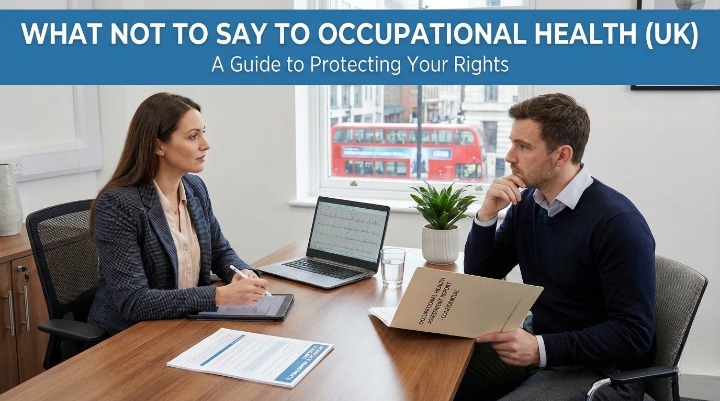
What Not to Say to Occupational Health (UK): A 2026 Guide to Protecting Your Rights
Receiving an Occupational Health (OH) referral often feels like a trial. You might worry that your employer is building a case to dismiss you, or that the clinician is “on their side.” These fears are natural, but they often lead employees to clam up or, worse, say things that accidentally damage their case for support.
With the Employment Rights Act 2025 now in full effect, the stakes have changed. The removal of “waiting days” for Statutory Sick Pay (SSP) and new Day One rights mean your OH report is more than just a medical summary, it is a critical document that defines your employment security.
Knowing what not to say to occupational health UK clinicians isn’t about being dishonest. It is about understanding the difference between a chat with your GP and a functional assessment for your employer. This guide will help you navigate that conversation, ensuring you get the reasonable adjustments you are legally entitled to without handing HR ammunition to use against you.
The Role of Occupational Health vs. Your GP
Before we cover specific phrases to avoid, you must understand who you are talking to. A common mistake employees make is treating an OH assessment like a standard doctor’s visit.
Your General Practitioner (GP) acts as your advocate. Their primary goal is your treatment and recovery. An Occupational Health professional, however, acts as an impartial advisor. Their goal is to determine your functional ability, specifically, what you can and cannot do safely in your workplace.
The General Medical Council (GMC) guidelines are clear: OH physicians must be objective. They are not there to “fix” your back pain or prescribe medication. They are there to answer specific questions from your employer about your fitness to work.
The Difference at a Glance
| Feature | Your GP | Occupational Health (OH) |
| Primary Goal | Treatment and cure | Fitness to work advice |
| Client | You (the patient) | The Employer (referring manager) |
| Output | Prescription / Fit Note | Functional Ability Report |
| Confidentiality | Absolute (mostly) | Shared with employer (relevant functional info only) |
When you understand this, you realise that complaining about symptoms without linking them to work tasks is wasted breath. You need to speak their language: Capability.
5 Critical Phrases to Avoid During Your OH Assessment
Your choice of words dictates the content of the report sent to HR. Here are five phrases that often backfire, and why you should avoid them.
1. “I’m fine, really.” (The Downplaying Trap)
We are culturally conditioned to put on a brave face. You might sit in the assessment chair, smile, and say, “I’m coping okay,” because you don’t want to look weak or “difficult.”
Why this is dangerous:
If you tell the clinician you are “fine,” they may report that you are “fit for full duties” with no adjustments needed. If your condition later causes you to miss deadlines or take more sick leave, your employer can argue that they had no medical evidence suggesting you needed support. You have effectively removed your safety net under the Equality Act 2010.
Pro-Tip: Never mask your bad days. If your condition fluctuates, like MS, migraines, or depression, describe your worst days, not your best ones. This ensures the report covers you for when things get tough.
2. “My manager is the reason I’m sick.” (The Blame Trap)
It is very common for workplace stress to stem from management styles. However, an OH assessment is not a grievance hearing. Venting anger about your boss makes the conversation personal rather than medical.
Why this is dangerous:
The clinician cannot fix a personality clash. If you focus entirely on blaming a person, the report might conclude that the issue is “interpersonal conflict” rather than a medical condition. HR often treats conflict as a disciplinary issue, not a health issue.
Better Approach: Focus on workplace stressors. Instead of “My boss shouts at me,” refer to “Unclear communication channels,” “Unrealistic deadlines,” or “Lack of structured support.”
3. “I don’t need any adjustments.” (The Legal Waiver Trap)
You might say this because you fear being a burden or looking incapable.
Why this is dangerous:
Under UK law, an employer has a duty to make reasonable adjustments only if they know (or should reasonably know) that you are at a disadvantage due to a disability. If you explicitly state you don’t need help, you may be waiving your right to claim discrimination later if you struggle to perform your role without those adjustments.
4. “I just want a sick note.” (The Referral Goal Trap)
Employees often arrive expecting the OH doctor to sign them off work for a month.
Why this is dangerous:
OH clinicians generally do not issue “Fit Notes” (formerly sick notes), that is still your GP’s job. If you demand a sick note, you waste the session. The OH role is often to find a way to keep you in work safely, perhaps through a phased return. Telling them you just want to stay home can make you appear disengaged from the return-to-work process.
5. “My colleague gets to do X, so I should too.” (The Comparison Trap)
“Sarah in accounting gets to work from home three days a week, so I should be allowed to.”
Why this is dangerous:
Occupational Health is based on individual clinical need, not fairness or precedent. Bringing up other colleagues is irrelevant to your medical assessment and can make you sound resentful. Focus strictly on your health condition and why working from home mitigates your specific symptoms.
The “What to Say Instead” Strategy: Focusing on Functional Impact
The most effective way to communicate with Occupational Health is to map your symptoms to your job description. This is called establishing the Functional Impact.
Don’t just list symptoms; describe what those symptoms stop you from doing.
How to Flip the Script
| Instead of saying… | Say this (Functional Impact)… |
| “I have really bad anxiety.” | “In high-pressure meetings, my anxiety affects my cognitive processing, making it hard to answer questions on the spot.” |
| “My back hurts when I sit.” | “I cannot sit for longer than 20 minutes without significant pain, which prevents me from completing long data entry tasks without breaks.” |
| “I can’t cope with the workload.” | “The current volume of cases exceeds my concentration span due to my fatigue, increasing the risk of errors.” |
Handling Mental Health Discussions
Discussing mental health is daunting. You may worry about the stigma. However, ACAS guidelines emphasize that mental health should be treated with the same weight as physical health.
When discussing stress or depression, use the “Trigger-Response” model. Identify specific work triggers (e.g., “consecutive night shifts”) and the medical response (“leads to insomnia and migraines”). This keeps the conversation objective and professional.
How the 2026 Employment Rights Act Changes the Stakes
The landscape of UK employment law shifted significantly with the Employment Rights Act 2025. As we move through 2026, these changes directly impact your OH referral.
Day One Rights and SSP
Previously, there were “waiting days” before you could claim Statutory Sick Pay (SSP). The new Act has removed these for many workers, meaning financial support starts from the first day of illness.
Why this matters for OH:
Employers are now financially liable for sickness absence sooner. This may lead to faster OH referrals—sometimes as early as week two of an absence. Do not view a quick referral as aggressive; it is often a procedural necessity for the business to manage these new costs.
The Unfair Dismissal Threshold
The new Act has strengthened protections against unfair dismissal from “Day One” of employment. However, there are still allowable reasons for dismissal, one of which is “Capability” (ill health).
Your OH report is the primary evidence in a Capability Hearing. If the report says, “There are no foreseeable adjustments that would enable a return to work,” an employer can legally dismiss you on capability grounds, provided they have followed a fair process. This is why ensuring the report accurately reflects your potential to work with adjustments is vital.
[GOV.UK Guide to Employment Rights Act 2025]
Your Legal Rights: Consent and the AMRA 1988
You are not powerless in this process. Your rights are protected under the Access to Medical Reports Act 1988 (AMRA) and GDPR.
1. Right to See the Report First
You must never agree to let the OH report go directly to your employer without you seeing it. On the consent form, tick the box that says: “I wish to see the report before it is sent to my employer.”
This gives you a crucial window (usually 2-3 days) to review the document.
2. Correcting Factual Errors
If you read the report and see a mistake, for example, the doctor noted you have worked there for 5 months instead of 5 years, or they listed the wrong medication, you have the legal right to request a correction.
Important Distinction: You cannot demand they change their clinical opinion. If the doctor thinks you are “unfit for night shifts,” you cannot force them to delete that just because you disagree. You can only attach a note of your disagreement to the final report.
3. Can You Refuse an Assessment?
Technically, yes. Medical consent is always voluntary. However, your employment contract likely includes a clause requiring you to consent to medical examinations.
If you refuse, your employer is legally entitled to make decisions about your future based on the incomplete information they have. Without medical advice protecting you, they may proceed to dismissal much faster. It is almost always better to attend and control the narrative than to refuse.
Preparation Checklist: What to Have Ready Before the Call
Walking into the assessment unprepared is a major error. Treat this like a professional meeting.
- Job Description: Bring a copy of your role’s responsibilities so you can point out exactly where you struggle.
- Medication List: Have a list of all current prescriptions and their side effects (e.g., “This painkiller causes drowsiness, so I cannot drive machinery”).
- Fit Notes: Any previous notes from your GP.
- A “Bad Day” Diary: A brief log of dates where your symptoms prevented you from working, to prove the condition is ongoing.
- Written Questions: If you want to ask about specific adjustments (like a standing desk or amended hours), write them down so you don’t forget.
Summary
Occupational Health should be a tool that works for you, not against you. By avoiding emotional outbursts, refusing to downplay your symptoms, and understanding the specific “functional” language these clinicians use, you can ensure your report is accurate and helpful.
The 2026 legal updates have made employment rights stronger, but they also require you to be more proactive. The report produced from this assessment will likely dictate the next few years of your career. Ensure it tells the truth about what you need to succeed.
If you are currently unsure about the wording of your referral letter or feel your report contains serious errors, contact your Union representative immediately.
FAQs
Can I record my Occupational Health assessment?
Generally, no. Most OH providers do not allow recording due to data protection for the clinician. However, you can take detailed notes or ask to bring a companion (like a union rep) to take notes for you, though this usually requires advance permission.
Does an OH report override my GP’s advice?
Not exactly, but employers usually give more weight to the OH report. This is because OH specialists understand the specific context of your workplace, whereas a GP is a generalist. If the two disagree, your employer should arguably ask for clarification, but they often follow the OH guidance.
What happens if I refuse to let HR see the OH report?
If you withdraw consent for the report to be released, your employer will have to make decisions about your employment without that medical advice. This often disadvantages you, as they may assume you are unable to work and proceed to capability dismissal proceedings.
Can Occupational Health recommend I be fired?
OH clinicians do not recommend “firing” people. They provide an opinion on whether you are fit to work. If they state you are “permanently unfit” for your role and no adjustments can be made, your employer may use this as evidence to dismiss you on grounds of ill-health capability.
Do I have to pay for an Occupational Health assessment?
No. If your employer refers you, they cover the full cost of the assessment.
Can I bring someone with me to an OH meeting?
You can ask, but there is no statutory right to be accompanied to a medical appointment like there is for a disciplinary hearing. Many OH providers allow a friend or family member for support if it helps with your anxiety.
How long does an Occupational Health report stay on my record?
The report forms part of your personnel file. Under GDPR, it should only be kept for as long as necessary. However, if it relates to health surveillance (e.g., exposure to chemicals), it may need to be kept for up to 40 years. For standard sickness referrals, it is usually retained for the duration of your employment plus 6 years.
About the Author