NASA ISS Evacuation 2026: Why Crew-11 Returned Early Today
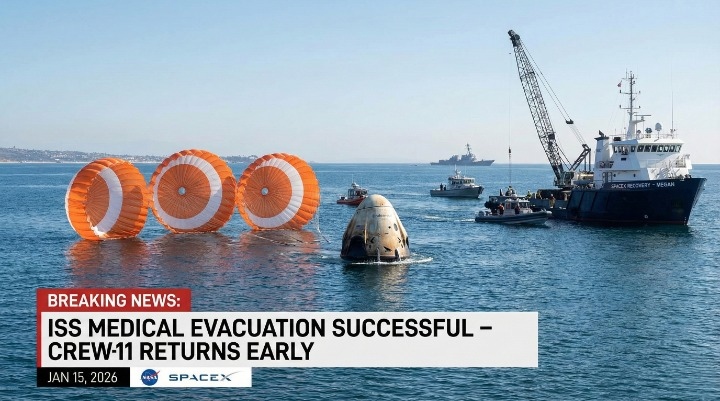
SpaceX Crew Dragon Endeavour splashdown: 15 January 2026.
Yesterday marked a pivotal moment in aerospace history. At 08:41 GMT, the SpaceX Crew Dragon Endeavour splashed down off the coast of San Diego, concluding the mission of Crew-11 nearly a month ahead of schedule. For the first time in the International Space Station’s 25-year history of continuous habitation, a NASA astronauts space station evacuation was executed for a medical emergency.
This was not a standard return. The sudden departure of NASA astronauts Zena Cardman and Mike Fincke, alongside JAXA’s Kimiya Yui and Roscosmos cosmonaut Oleg Platonov, has left the orbital laboratory operating with a skeleton crew. While NASA has confirmed the patient is in stable condition, the event raises serious questions about orbital safety protocols as the station nears its 2030 retirement.
This report breaks down the timeline of the evacuation, the specific “Lifeboat Protocols” that forced four healthy astronauts to return with one patient, and what this means for the future of UK and international space operations.
The 2026 Medical Evacuation: Timeline of a Historic Return
To understand the severity of this event, we must look at the rapid sequence of decisions made over the last week. Medical privacy laws prevent NASA from naming the specific crew member affected, but the operational timeline reveals the urgency of the situation.
From Spacewalk Cancellation to Splashdown
The first sign of an anomaly occurred on 8 January 2026. A scheduled spacewalk (EVA) to upgrade the station’s solar array was abruptly cancelled just hours before the airlock procedure was set to begin. At the time, NASA cited “a non-emergency medical issue,” a phrase often used for minor ailments like space adaptation sickness.
However, the situation escalated on 14 January. Following consultation with flight surgeons at Mission Control in Houston, the decision was made to trigger a “controlled medical evacuation.” This differs significantly from a “panic” deorbit. It is a calculated, rapid return procedure designed to minimise G-force stress on the patient while ensuring a landing near definitive medical care.
According to statements from NASA Administrator Jared Isaacman NASA Press Release Jan 2026, the decision prioritized “long-term health outcomes over mission duration.”
The SpaceX Crew Dragon Endeavour Landing Details
The undocking occurred at 17:05 GMT on 14 January, initiating a 10.5-hour return trajectory. This is faster than the typical 18-24 hour return often used to save fuel and align with orbital mechanics, highlighting the medical necessity of speed.
Crew-11 Splashdown Data:
| Parameter | Data Point |
| Spacecraft | SpaceX Crew Dragon Endeavour |
| Undocking Time | 14 Jan 2026, 17:05 GMT |
| Splashdown Time | 15 Jan 2026, 08:41 GMT |
| Location | Pacific Ocean (West of San Diego) |
| Recovery Vessel | Megan (SpaceX Recovery Ship) |
| Sea State | Calm (Wave height < 2ft) |
[Space.com Live Updates – Crew-11 Recovery Operations]
The recovery vessel Megan was on the scene within 30 minutes. All four crew members were extracted, and the affected astronaut was immediately airlifted to a specialized medical facility in California for advanced diagnostics.
Understanding ISS Emergency Protocols: Why One Sick Astronaut Means a Full Evacuation
A common question circulating on social media is: “If only one person was sick, why did all four astronauts have to leave?”
The answer lies in the “Lifeboat Rule,” a fundamental safety tenet of the International Space Station.
The “Lifeboat” Rule Explained
In the context of a NASA astronauts space station evacuation, spacecraft are not like taxis; they are lifeboats. Each crew member launching to the ISS is assigned a specific seat in a specific capsule (either a SpaceX Dragon or a Russian Soyuz).
-
Custom Pressure Suits: Each seat is fitted with a custom liner molded to the astronaut’s body. During the high-G re-entry (up to 4Gs), an ill-fitting seat could cause severe physical injury.
-
No Man Left Behind: If Crew Dragon Endeavour had returned with only the sick astronaut and a pilot, the remaining two crew members on the station would be stranded without a lifeboat. If a fire or depressurization event occurred on the ISS shortly after, those left behind would have no way to escape.
Technical Insight: NASA protocols strictly forbid leaving any crew member on the station without a dedicated, functional return vehicle capable of immediate departure. Therefore, when the Endeavour leaves, everyone assigned to the Endeavour leaves.
Medical Diagnostic Gaps in Microgravity
Why couldn’t the astronaut be treated in orbit?
The ISS Crew Health Care System (CHeCS) is impressive but limited. It includes:
-
Advanced Life Support (ALS) packs.
-
Ultrasound imaging.
-
Defibrillators and intubation kits.
-
Basic dental and surgical tools.
What the Flight Surgeon Sees:
While ultrasound is useful, it cannot replace an MRI or CT scan. If a flight surgeon suspects a condition like a deep vein thrombosis (blood clot), an intracranial issue, or a complex internal infection, the onboard equipment cannot provide a 100% confirmed diagnosis.
In 2020, a blood clot was treated remotely using onboard blood thinners. However, the 2026 incident evidently required intervention or imaging beyond the station’s capabilities. As noted by Dr James Polk, NASA’s Chief Health and Medical Officer, in yesterday’s briefing: “The microgravity environment complicates physiology. When we hit a diagnostic wall, Earth is the only safe option.” [NASA Medical Officer Briefing Jan 2026]
The Skeleton Crew: Who is Left on the International Space Station?
With the departure of Crew-11, the population of the orbital outpost has dropped from seven to three. We are now in a “Skeleton Crew” operational phase.
Expedition 74 Status and Reduced Operations
The station is now manned by the Soyuz MS-28 crew:
-
Chris Williams (NASA)
-
Sergey Kud-Sverchkov (Roscosmos)
-
Sergey Mikayev (Roscosmos)
This reduction has immediate consequences. Running the football-field-sized laboratory requires constant maintenance. With only three hands on deck, the focus shifts almost entirely from scientific research to station upkeep.
According to a report from NPR NPR Science News Jan 2026, all non-critical experiments in the European Columbus module and the Japanese Kibo module have been powered down to “simmer mode.” The remaining crew will prioritize life support systems, water recovery monitoring, and routine exercise to maintain bone density.
Impact on 2026 Science and Maintenance
The reduced staffing creates a backlog. Several high-profile experiments, including a UK-led study on protein crystallization for Alzheimer’s research, are now paused.
Furthermore, no spacewalks (EVAs) can be conducted. An EVA requires at least two astronauts outside and one inside to monitor systems. With only three people total, performing a spacewalk would leave the station effectively unpiloted during an emergency, a risk mission control will not take.
Normal operations are not expected to resume until the launch of Crew-12, which is tentatively scheduled for no earlier than 15 February 2026.
Is the ISS Safe? Connecting 2026 Medical Risks to 2030 Decommissioning
This NASA astronauts space station evacuation brings the age of the ISS into sharp focus. Launched in 1998, the station is operating well beyond its original 15-year design life.
Ageing Hardware and Crew Health
While the 2026 evacuation was medical, not mechanical, the two are linked. An ageing station requires more maintenance, placing a higher cognitive and physical load on the crew. The stress of maintaining older life support systems, fixing leaks (like the persistent issue in the Russian Zvezda service module), and managing outdated hardware contributes to crew fatigue.
Fatigue suppresses the immune system, making astronauts more susceptible to illness. As we approach the 2030 decommissioning date, NASA and its partners must balance the scientific value of the station against the increasing risks to human occupants.
The Role of the US Deorbit Vehicle (USDV)
NASA has already contracted SpaceX to build the US Deorbit Vehicle (USDV), a massive spacecraft designed to tow the ISS into a controlled destruction over the Pacific Ocean in 2030.
Events like the Crew-11 early return serve as a dry run for the final days of the station. They test the “emergency egress” procedures that will be vital if the station’s systems fail catastrophically before the planned end date. The successful medical evacuation proves that the logistics for a rapid exit are sound, even if the medical limitations of spaceflight remain a challenge.
The UK Perspective: Implications for Future Space Missions
For the UK space sector, this event is a significant learning opportunity. With the UK Space Agency (UKSA) heavily invested in the Artemis programme and the upcoming all-UK commercial mission (referenced as likely occurring in late 2026 or 2027), safety protocols are under review.
Impact on Artemis II and UK-ESA Collaborations
The UK is a key member of the European Space Agency (ESA). The medical data gathered from this evacuation will likely influence the medical kits and protocols for the Artemis II mission (scheduled for later this year) and the Gateway lunar station.
If a medical emergency occurs in lunar orbit (3 days away from Earth), a 10.5-hour evacuation like the one we saw yesterday is impossible. The Crew-11 incident reinforces the need for autonomous medical AI and surgical robotics—technologies currently being developed in UK innovation hubs like Harwell.
According to The Guardian’s science correspondence The Guardian Space Analysis 2026, this event may delay upcoming commercial astronaut rotations as insurance providers and safety boards reassess the risk models for private citizens in orbit.
Summary
The historic NASA astronauts space station evacuation of 15 January 2026 has concluded with the safe return of Crew-11. While the specific medical condition remains confidential, the successful execution of the “Lifeboat Protocol” demonstrates the maturity of SpaceX and NASA’s emergency procedures.
However, the event leaves the ISS with a skeleton crew and significant operational delays. As we look toward the station’s retirement in 2030, this incident serves as a reminder that space remains a hostile environment where human biology is the most fragile component.
We will continue to monitor the condition of the crew and the revised launch schedule for Crew-12.
[Subscribe to our Science Alert Newsletter for real-time updates on Crew-11’s recovery and the future of the ISS.]
FAQs
Which NASA astronaut had the medical emergency in 2026?
NASA has not released the name of the specific astronaut due to medical privacy laws. The evacuated crew included NASA’s Zena Cardman and Mike Fincke, JAXA’s Kimiya Yui, and Roscosmos cosmonaut Oleg Platonov.
How long does it take to evacuate the ISS in an emergency?
A standard emergency return takes roughly 3.5 hours from undocking to landing. The Crew-11 return took approximately 10.5 hours to ensure a gentler trajectory for the patient and to target a specific landing zone off San Diego.
Where did Crew-11 splash down?
The SpaceX Crew Dragon Endeavour splashed down in the Pacific Ocean, west of San Diego, California.
Why did the whole crew return if only one person was ill?
Under ISS safety rules, the crew cannot be separated from their assigned “lifeboat.” Leaving three astronauts behind without a return vehicle would leave them stranded in case of a station emergency.
What happens to the ISS experiments after the 2026 evacuation?
Most non-critical experiments have been paused or put into “simmer mode.” The remaining three crew members are focusing almost exclusively on station maintenance and life support systems.
Is the ISS being abandoned early in 2026?
No. The station is still operational with three crew members aboard. Full operations are expected to resume when Crew-12 launches, likely in mid-February 2026.
When is the next crew (Crew-12) launching to the ISS?
NASA targets a launch no earlier than 15 February 2026 to allow time for the investigation into the medical incident and to prepare the next rotation.
How does a space evacuation differ from a standard return?
An evacuation prioritizes speed and landing proximity to a hospital. A standard return is timed for optimal fuel efficiency, weather conditions, and recovery team logistics, often taking up to 24 hours.
About the Author