Bulgaria Weather September: 2026 Euro Update & Coastal Guide
While the headlines for 2026 are dominated by Bulgaria’s financial shift, the real story for September travellers remains the climate. Imagine a destination where the summer crowds have vanished, the Black Sea is still warm enough for swimming, and the daytime highs linger at a comfortable $25^{\circ}C$.
September has long been the “Golden Month” for savvy UK holidaymakers. However, the travel landscape has changed fundamentally this year. As of 1 January 2026, the official adoption of the Euro (€) has streamlined payments but introduced new dynamics for budgeting.
This guide provides the latest weather data, regional breakdowns, and critical travel advice to ensure your September trip is as smooth as the calm autumn seas.
Bulgaria Weather in September: The Averages
September in Bulgaria marks the transition from the scorching continental summer to a milder, more breathable autumn. For most UK travellers, the climate feels like a perfect English July, warm, sunny, but without the oppressive humidity of the Mediterranean peak season.
Temperature Averages: Coastal vs. Inland
The country is divided into two distinct climate zones: the Black Sea coast (moderated by water) and the inland plains/mountains (subject to sharper temperature drops).
Typical September Temperature Ranges:
| Region | Average High | Average Low | Real-Feel Note |
| Black Sea (Sunny Beach, Varna) | $24^{\circ}C – 26^{\circ}C$ | $14^{\circ}C – 17^{\circ}C$ | Warm days, cool evenings requiring a light jacket. |
| Inland (Sofia, Plovdiv) | $20^{\circ}C – 23^{\circ}C$ | $9^{\circ}C – 11^{\circ}C$ | Crisp mornings; significant drop after sunset. |
| Mountains (Bansko, Rila) | $15^{\circ}C – 18^{\circ}C$ | $3^{\circ}C – 6^{\circ}C$ | Distinctly autumnal; frost possible at high altitudes. |
Source: Historical data (2025) from the National Institute of Meteorology and Hydrology (NIMH), Bulgaria.
Sunshine Hours & Daylight
You can expect approximately 8 to 9 hours of sunshine per day in early September. However, keep in mind that the days shorten rapidly in the Balkans. According to 2026 solar data, Bulgaria loses about 2 minutes of daylight per day throughout the month. By the final week of September, sunset occurs around 7:15 PM, meaning your beach days will naturally become shorter.
Rainfall September Bulgaria: What to Expect
One of the biggest misconceptions is that September is a “wet” month. In reality, it is historically one of the drier periods of the year.
- Average Precipitation: $35mm – 40mm$
- Rainy Days: 4–5 days on average
The rain typically arrives as short, sharp showers rather than days of drizzle. This “continental climate” pattern means that even if you catch a shower, the sun often returns within an hour.
Black Sea Sea Temperature & Beach Conditions
Is it still warm enough to swim in Sunny Beach?
Yes, but timing is everything. The Black Sea acts as a giant heat store, retaining the warmth of July and August well into early autumn.
- Average Sea Temperature: $22^{\circ}C$ (Source: Weather-and-Climate.com, 2026)
My Pro-Tip: Aim for the first two weeks of September. During this window, the water temperature ($22^{\circ}C$) is almost identical to the air temperature in the late afternoon, creating a seamless swimming experience. By the last week of September, the water remains swimmable for brave souls, but the ambient air cools down quickly once you get out.
The Best Coastal Resorts for September Sun
While Sunny Beach begins to wind down its party atmosphere, the southern coast retains its charm.
- Sozopol & Nessebar: These UNESCO-protected towns are actually better in September. The cobblestone streets are walkable without the crushing heat ($35^{\circ}C+$) of August, and the restaurants remain fully open until the end of the month.
- Varna: As a working city rather than just a resort, Varna remains vibrant year-round, making it a safe bet if you are travelling late in the month.
The 2026 Travel Reality: Euro Adoption & Prices
This year brings the most significant change for UK tourists in decades. As of 1 January 2026, Bulgaria has officially joined the Eurozone.
Navigating the New Currency Transition
If you have visited Bulgaria before, you will remember the Lev (BGN) and the constant mental arithmetic of dividing prices by two. That is now history.
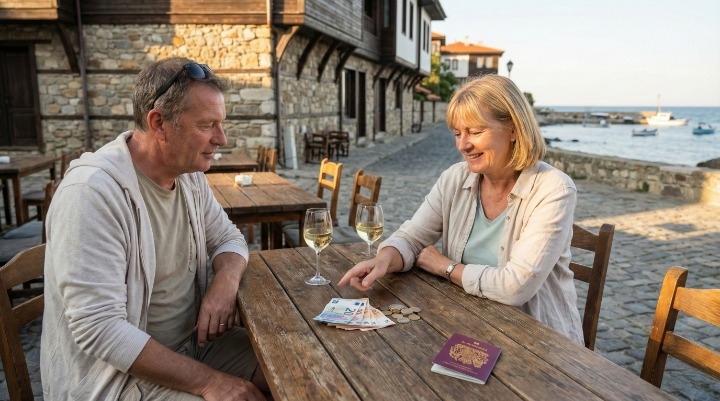
- The Currency: You will now pay exclusively in Euros (€).
- Old Banknotes: According to the European Central Bank (ECB) and local regulations, the transition period for exchanging old Lev notes at commercial banks ends in June 2026. If you have old currency from a previous trip, you must exchange it at the Bulgarian National Bank, shops will no longer accept it.
- Prices: You may see “Dual Pricing” on menus (prices listed in both BGN and EUR) strictly for consumer protection, but payment is Euro-only.
UK Travel Advice September Bulgaria
The Foreign, Commonwealth & Development Office (FCDO) advises that while the currency has changed, the value proposition remains strong. However, be aware of “rounding up.” With the new currency, some tourist-trap restaurants in Golden Sands may have adjusted prices upward. Always check the menu price before ordering.
Visa Update 2026:
British citizens can still travel to Bulgaria for up to 90 days in any 180-day period without a visa. This rule remains unchanged post-Euro adoption.
Regional Climate Breakdown: Where to Stay
Bulgaria’s geography creates distinct micro-climates. Choosing the wrong region in September can mean the difference between sunbathing and shivering.
Sofia & Central Bulgaria (Plovdiv)
In the capital, Sofia, September feels like a classic “Indian Summer.” The average high of $23^{\circ}C$ is ideal for urban exploration. The cafes along Vitosha Boulevard are bustling, and the heat radiating from the pavement—so brutal in August, is gone.
- Be Aware: Sofia is at a high altitude ($550m$). As soon as the sun sets, the temperature plummets to $9^{\circ}C – 10^{\circ}C$. You will need a proper jacket for evening dinners.
The Balkan Mountains & Hiking (Early Frost Risks)
For hikers heading to the Rila or Pirin mountains (home to the Seven Rila Lakes), September is a month of caution.
- Conditions: While the valleys are warm, peaks above 2,000m can see temperatures near freezing ($0^{\circ}C – 5^{\circ}C$) and strong winds.
- Warning: NIMH data indicates that September often brings the first “dustings” of snow to the highest peaks (Musala/Vihren).
- Advice: Stick to lower-altitude trails if you are not an experienced mountaineer, and always check the mountain rescue service bulletins before setting out.
Packing Essentials for a September Trip
The key to mastering September travel in Bulgaria is layering. You are packing for two seasons simultaneously: summer days and autumn nights.
The “Layering” Strategy
-
Daytime Base: T-shirts, shorts, and swimwear. The UV index is still moderate (around 4-5), so sun protection is necessary.
- The “Transition” Piece: A light zip-up hoodie or denim jacket. You will need this around 6:00 PM when the coastal breeze picks up.
- Evening Warmth: A medium-weight fleece or sweater. If you are dining outdoors in Sozopol or Plovdiv at 9:00 PM, you will be thankful for it.
- Footwear: Breathable trainers for walking (cobblestones can be slippery if it rains) and sandals for the beach.
Events & Festivals You Can’t Miss in September 2026
September is the cultural peak of the year, driven by the cooler weather and harvest celebrations.
Apollonia Festival of Arts (Sozopol)
Taking place in late August and early September, this is the premier arts festival in Bulgaria.
- What to expect: Open-air jazz concerts, theatre productions, and art galleries scattered throughout the Old Town of Sozopol.
- Why go: It transforms the town from a beach resort into a sophisticated cultural hub.
Independence Day (22 September)
This is a national public holiday. Expect parades and fireworks in major cities like Veliko Tarnovo and Sofia. Note that banks and public offices will be closed, but tourist amenities generally remain open.
Conclusion
Bulgaria in September 2026 offers a sophisticated alternative to the chaotic peak summer months. The adoption of the Euro has simplified the logistics for UK travellers, while the climate remains reliably pleasant.
With sea temperatures hovering at $22^{\circ}C$ and air temperatures hitting a balmy $25^{\circ}C$, the “Golden Month” lives up to its name. The key is to respect the shoulder season: pack layers for the evening chill, stick to the coast for the warmest weather, and time your swim for the sunniest part of the day.
If you are looking for a destination that offers European culture, reliable sunshine, and excellent value without the July crowds, Bulgaria in September remains an unbeatable choice.
FAQs
Is Bulgaria hot in September?
Yes, pleasantly so. Highs average $24^{\circ}C-26^{\circ}C$ on the coast, which is warm enough for sunbathing but rarely suffocating.
Can you swim in Bulgaria in September?
Absolutely. The sea averages $22^{\circ}C$. The first half of the month is best for swimming; by late September, it can feel brisk.
Is Bulgaria still cheap in 2026 after the Euro?
While prices have nudged upward due to inflation and the Euro transition, Bulgaria remains one of Europe’s best-value destinations compared to France or Italy.
What is the sea temperature in Sunny Beach in September?
It holds steady at around $22^{\circ}C$, dropping slightly towards the end of the month.
Does it rain a lot in Bulgaria in September?
No. It is one of the drier months with only 35-40mm of rainfall on average.
Are things still open in Bulgaria in late September?
In major towns like Sozopol and Varna, yes. However, purely seasonal “resort” hotels in quieter areas may start closing down after the 20th.
What currency should I take to Bulgaria in 2026?
Take Euros (€). The Lev is no longer legal tender in shops.
About the Author