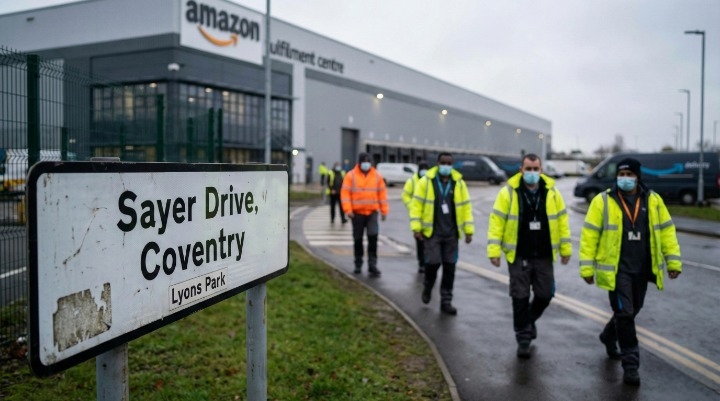
Amazon Warehouse Disease Outbreak: The Coventry BHX4 TB Situation Explained (2026 Update)
While Amazon recently celebrated high-profile safety awards, its Coventry BHX4 warehouse is currently at the centre of a significant public health investigation. In January 2026, health officials confirmed that a tuberculosis (TB) outbreak has affected multiple staff members at the site.
This situation has sparked a heated confrontation between the retail giant and the GMB Union. Ten employees have tested positive for latent TB, following a small number of active, contagious cases identified in late 2025. As the UK Health Security Agency (UKHSA) expands its screening programme, workers and safety officers are left navigating a complex landscape of infection control and employment law.
This guide separates clinical facts from union claims. It provides a roadmap for understanding the amazon warehouse disease outbreak, your legal rights to medical suspension pay, and the steps required to manage biological risks in a high-velocity fulfilment centre.
The Timeline of the Amazon Coventry TB Outbreak (BHX4)
The current health crisis at the Amazon fulfilment centre on Sayer Drive, Lyons Park, did not appear overnight. Understanding the progression of these cases is vital for assessing the actual risk to the workforce and the wider Coventry community.
From September 2025 to January 2026: What We Know
According to the UKHSA West Midlands and official statements from Amazon, the first instances of TB at the BHX4 site were identified in September 2025. These initial cases involved a “handful” of workers with active tuberculosis.
By January 2026, the situation evolved. Ten additional employees were confirmed to have latent tuberculosis. Amazon maintains that it followed all “best practice safety procedures” immediately upon notification. However, the GMB Union argues that the site should have been closed during the peak Christmas period to prevent the current spread.
Latent vs. Active Tuberculosis: Risk Assessment at Sayer Drive
A primary source of anxiety for the 3,000 employees at BHX4 is the distinction between latent and active infection. To address these fears, it is helpful to look at how these two states differ in a warehouse environment.
| Feature | Latent TB (Dormant) | Active TB (Infectious) |
| Symptoms | None. The person feels healthy. | Cough (3+ weeks), fever, night sweats. |
| Contagious? | No. Cannot spread to others. | Yes. Spread through airborne droplets. |
| Test Result | Positive blood or skin test. | Positive sputum test or chest X-ray. |
| Status at BHX4 | 10 confirmed cases. | Initial cases (now treated). |
The UKHSA emphasises that the ten most recent cases are latent. This means these individuals cannot infect their colleagues, delivery drivers, or customers receiving packages.
Public Health Response and UKHSA Amazon Screening Protocols
The response to the amazon warehouse disease outbreak has been led by the UKHSA in collaboration with the NHS. This is a standard procedure when a cluster of a “notifiable disease” is found in a communal workplace.
The Role of the NHS and UK Health Security Agency
Dr Roger Gajraj, a consultant in health protection with UKHSA West Midlands, has stated that the overall risk to the public remains low. The agency’s primary goal is “contact tracing.” In a facility as large as BHX4, this involves identifying anyone who spent significant time in close proximity to the original active cases.
What Happens During a Workplace TB Blood Test?
NHS staff have been visiting the Coventry site to perform screenings. If you are asked to attend a screening, you will likely undergo an Interferon Gamma Release Assay (IGRA) blood test.
Experience Note: What to Expect
As someone who has observed workplace health screenings, I can tell you the process is usually quick. Unlike the older “Heaf” or Mantoux skin tests that required a return visit to check for a bump, the IGRA blood test is a single appointment. If your result is positive for latent TB, it does not mean you are “sick” in the traditional sense; it means you have the bacteria in your body and require a course of antibiotics to prevent it from ever becoming active.
GMB Union vs. Amazon: The Fight for Warehouse Safety
The industrial tension at Coventry BHX4 is at an all-time high. The GMB Union has been vocal, describing the site as a potential “engine room of a mass TB outbreak.”
Why the GMB is Calling for a Temporary Site Closure
Amanda Gearing, a senior organiser for the GMB, has demanded that Amazon close the warehouse immediately. The union’s argument is twofold:
- Infection Control: They believe the density of workers in “picking” and “stowing” areas makes social distancing impossible.
- Transparency: GMB claims that workers were not adequately informed when the first cases appeared in September 2025.
The union wants all staff sent home on full pay until a deep clean and full medical audit are completed.
Amazon’s Official Position: “Safety is Our Top Priority”
Amazon has strongly refuted the union’s claims. A spokesperson noted that the company’s RIDDOR (Reporting of Injuries, Diseases and Dangerous Occurrences Regulations) rate is significantly lower than the industry average. They argue that because the current cases are latent and non-contagious, a site closure is medically unnecessary and would be a disproportionate response.
Know Your Rights: Employment Law and Medical Suspension Pay
For many workers at the BHX4 site, the concern is not just health, but also their mortgage and bills. If you are told you cannot work due to the amazon warehouse disease outbreak, you need to know which legal protections apply.
Am I Entitled to Full Pay if the Site Closes?
If an employer chooses to close a site or suspend an employee for medical reasons, the rules differ from standard sick leave. Under Section 64 of the Employment Rights Act 1996, an employee is entitled to “medical suspension pay” for up to 26 weeks, provided they have been employed for at least a month.
This is full pay, not just Statutory Sick Pay (SSP). However, this only applies if you are suspended because of a statutory requirement or a recommendation in a Code of Practice. If you are personally sick with active TB, you would move onto standard sick pay.
Refusing to Work: Section 44 of the Employment Rights Act
Some employees are considering staying away from the site due to fear of infection. Section 44 provides workers the right to leave their workplace or refuse to return if they reasonably believe there is a “serious and imminent danger” which they could not be expected to avert.
Compliance Check for H&S Officers
In the case of latent TB, proving “imminent danger” is legally difficult because the bacteria are not currently spreading. H&S officers should ensure that all risk assessments are updated to reflect the UKHSA’s findings. Failing to do so could give weight to a Section 44 claim.
The Broader Context: Why TB is Rising in the UK (2024-2026)
The incident at Amazon Coventry is part of a larger, more worrying trend. Tuberculosis, once thought of as a “Victorian disease,” has made a comeback in England.
The 13.6% National Increase and the WHO Threshold
In 2024, the UKHSA reported a 13.6% rise in TB notifications across England. By 2025, the numbers reached nearly 5,500 cases. Public health analysts point to several factors:
- Delayed Diagnoses: A backlog in health screenings post-2022.
- Migration Patterns: A higher incidence rate in individuals born in countries where TB is endemic.
- Cost of Living: Overcrowded housing in urban areas like Coventry and Birmingham facilitates spread.
The UK is currently struggling to meet the World Health Organization (WHO) 2035 elimination targets. The Coventry outbreak is a localized symptom of this national challenge.
Migrant Worker Health and Vaccination Gaps
Large logistics hubs often employ a diverse workforce. The UKHSA notes that 81.9% of TB notifications in early 2025 were among people born outside the UK. This highlights a critical need for accessible workplace health programmes that offer BCG vaccinations or screenings without fear of immigration repercussions.
Pro-Tip: Check Your Records
If you are unsure of your vaccination status, you can check your medical records via the NHS App. While the BCG vaccine is no longer given as a standard school-age jab in the UK (since 2005), it is still recommended for workers in high-risk environments or those with family from high-incidence countries.
Recognising Symptoms: A Guide for Fulfilment Centre Staff
The UKHSA and Coventry City Council are urging all residents and workers to remain vigilant. If you work at a site affected by a amazon warehouse disease outbreak, do not ignore the following symptoms:
-
A persistent cough: Specifically one that lasts for more than three weeks and may produce phlegm or blood.
-
Unexplained weight loss: Losing weight without trying.
-
Night sweats: Waking up with drenching sweats that require a change of clothes.
-
Extreme fatigue: Feeling exhausted even after rest.
-
Fever: A high temperature that does not go away.
If you experience these, contact NHS 111 immediately. TB is fully treatable with a six-month course of antibiotics, but early intervention is the only way to prevent it from spreading to your family or colleagues.
FAQs
Is TB contagious if it is latent?
No. Latent TB means the bacteria are “asleep” in your body. You cannot pass the infection to anyone else while it is in this state.
Can I be fired for having TB in the UK?
No. Tuberculosis is a medical condition. If you are unable to work, you are protected by the same disability and sickness laws as any other illness. Dismissing an employee solely because they have TB could lead to an unfair dismissal claim.
Are Amazon packages safe from TB?
Yes. TB is an airborne disease spread through prolonged, close contact with an infected person’s breath. It does not live on surfaces like cardboard boxes or plastic packaging.
Is Amazon Coventry closing due to the disease?
As of late January 2026, the warehouse remains open. Amazon states it is following UKHSA guidance, which currently does not require a site closure for latent cases.
Conclusion
The amazon warehouse disease outbreak in Coventry is a stark reminder that workplace safety involves more than just hard hats and high-vis vests. In 2026, biological risk management is a critical pillar of corporate responsibility.
The “Experience” lesson here for large employers is transparency. When health risks are identified, early and open communication with both staff and unions is the only way to prevent panic and maintain operational stability. For the workers at BHX4, the focus must remain on completing the screening process and understanding that with modern medicine, TB is a manageable challenge, not a Victorian death sentence.
Next Steps: If you are a BHX4 employee, ensure your contact details are up to date in the A to Z app to receive screening notifications. If you are an H&S officer, review your infectious disease policy against the latest 2026 UKHSA “Infections at Work” guidance.
[UKHSA Tuberculosis (TB) Guidance]
[Understanding Your Rights to Medical Suspension Pay]
About the Author