Is Baking Soda the Same as Bicarbonate of Soda? A UK Baker’s Complete Guide
I’ll never forget the first time I tried an American cookie recipe. It called for “baking soda.” I stood in my UK kitchen, pot of Dr. Oetker Bicarbonate of Soda in hand, completely stumped. Were they the same? Would my cookies be ruined if I used the wrong one?
This confusion is the most common question I get from new bakers. It’s a simple question, but getting it wrong is the difference between a light, fluffy scone and a flat, dense bake with a dreaded “soapy taste.”
In this guide, we will give you the definitive answer. We’ll also explain the real ingredient you’re probably confused about (baking powder) and show you from an expert’s perspective how to use each one, what to buy in a UK supermarket, and how to avoid the most common baking fails.
The Simple Answer: Are They the Same Thing?
Let’s clear this up immediately.
Yes, baking soda and bicarbonate of soda are the exact same thing.
The only difference is the name. “Bicarbonate of Soda” (or just “bicarb”) is the British English term. “Baking Soda” is the American English term.
They are both 100% pure sodium bicarbonate, a fine white powder with the chemical formula $\text{NaHCO}_3$. In food labelling, you’ll see it listed as the food additive E500. Wikipedia – Sodium bicarbonate It is a chemical base, or alkaline, which is the key to its power in baking.
Why Am I Seeing “Baking Soda” in UK Supermarkets in 2025?
You’re not imagining it. This is why the confusion is perfectly understandable.
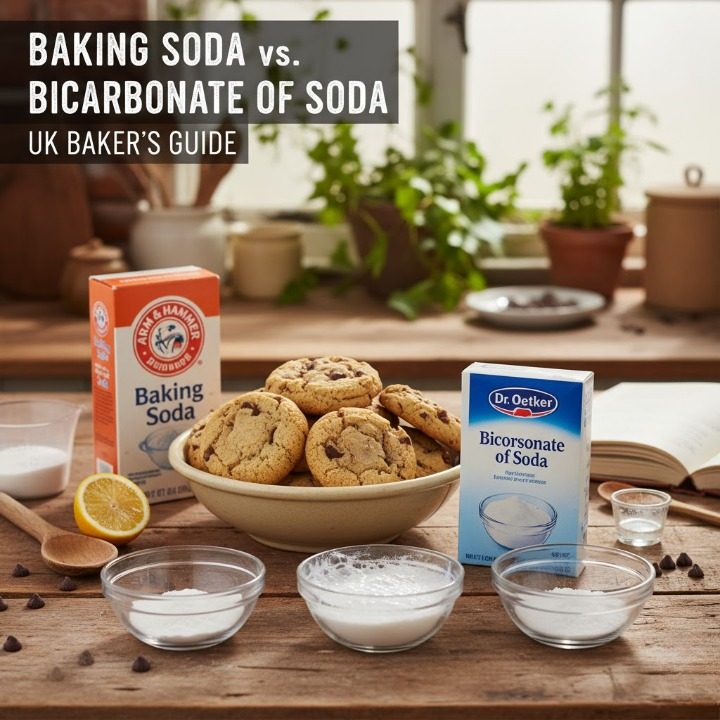
In stores like Tesco, Sainsbury’s, or Asda, you will often see American brands like Arm & Hammer (in its famous orange box) labelled “Baking Soda.” It will be sitting on the shelf right next to UK brands like Dr. Oetker labelled “Bicarbonate of Soda.”
They are identical. You can buy and use either one interchangeably in your recipes. It’s just a case of American branding making its way into UK shops.
The Real Confusion: Bicarbonate of Soda vs. Baking Powder
Here is the mix-up that will ruin your recipe. While the names “baking soda” and “bicarb” are interchangeable, neither is the same as baking powder.
They are not the same thing and cannot be substituted 1:1. This is the most critical distinction for any baker to learn.
Let’s break it down in the simplest way possible.
| Feature | Bicarbonate of Soda (Baking Soda) | Baking Powder |
| What it is: | 100% pure sodium bicarbonate. | A complete mixture. |
| Ingredients: | Just one: $\text{NaHCO}_3$. | Bicarb + a powdered acid + a filler. |
| Chemical Type: | An alkaline (a base). | A complete leavening agent. |
| How it activates: | Needs an acidic ingredient + liquid. | Just needs liquid (it has its own acid). |
| UK Brand: | Dr. Oetker Bicarbonate of Soda | Dr. Oetker Baking Powder |
What is Bicarbonate of Soda? (The Pure Base)
Think of bicarbonate of soda as a pure, concentrated power source. As food scientist Harold McGee notes in his book On Food and Cooking, it’s one of the only truly alkaline ingredients in the kitchen. Harold McGee – On Food and Cooking
On its own, bicarb does very little. To create a “rise” or leavening, it must react with an acid. It’s only one half of the equation.
What is Baking Powder? (The Complete Mixture)
Baking powder is a “full-service” raising agent. It’s a convenient mixture that contains:
- The Base: Bicarbonate of soda.
- The Acid: A dry, powdered acid (like cream of tartar).
- The Filler: A filler (like cornflour or cornstarch) to keep the other two ingredients separate, dry, and stable.
As baking expert Nigella Lawson explains, this means baking powder already contains its own acid, so it doesn’t need an acidic ingredient in the recipe to work. Nigella.com – Bicarb vs Baking Powder
Most UK baking powder is “double-acting.” This means it fizzes once when it gets wet (in the mixing bowl) and a second time when it gets hot (in the oven), giving you a more reliable, sustained rise.
How These Raising Agents Work: A Baker’s Science Lesson
Understanding why you use one or the other will make you a better baker. It all comes down to the reaction that creates carbon dioxide ($\text{CO}_2$)—the gas bubbles that make your bakes light and fluffy.
How Bicarbonate of Soda Works (Acid-Activated)
Bicarb’s leavening power is unlocked only when it is mixed with a liquid and an acidic ingredient.
When the alkaline bicarb meets an acid, they react instantly to neutralize each other. This acid-base reaction releases a big burst of carbon dioxide gas. This is why recipes using bicarb often instruct you to bake the mixture immediately, to trap those bubbles before they all escape.
Common acidic ingredients you’ll see in recipes that call for bicarb include:
- Lemon juice or other citrus
- Buttermilk or yogurt
- Brown sugar or molasses
- Natural cocoa powder (not Dutch-processed)
- Cream of tartar
- Honey
- Vinegar
How Baking Powder Works (Water-Activated)
Since baking powder already contains its own acid, it only needs one thing to activate: liquid.
The moment you add milk, water, or eggs to your dry ingredients, the base and acid in the baking powder dissolve and react, creating carbon dioxide.
This is why recipes for simple cakes or biscuits with non-acidic ingredients (like a classic vanilla sponge or a plain scone using regular milk) will always call for baking powder.
The “Heat Activation” Nuance: Can Bicarb Work Without Acid?
Here’s an expert-level detail that most articles miss. Yes, heat alone (above 80°C / 176°F) will cause bicarbonate of soda to decompose and release some $\text{CO}_2$ gas. You’ll see this in recipes for things like gingerbread, where it helps with browning and texture.
However, this is generally not what you want. It’s a slow, inefficient reaction that releases less gas. More importantly, this heat-only reaction creates a byproduct: sodium carbonate. And that leads directly to the #1 baking fail.
Avoiding the #1 Baking Fail: The Dreaded “Soapy Taste”
This is the core “experience” problem that we need to solve. If you’ve ever eaten a scone or a cake that had a bitter, soapy, or “metallic” aftertaste, you’ve tasted this problem first-hand.
Why Does My Bake Taste Metallic or Soapy?
That unpleasant taste is unneutralized bicarbonate of soda.
It means one of two things happened in your bake:
- You added too much bicarb. You were “guesstimating” with the teaspoon.
- Your recipe didn’t have enough acid to “use up” all the bicarb you added.
All that leftover, unreacted alkaline powder is what assaults your taste buds with that awful soapy flavour. Faye Palmqvist – Metallic Taste in Cakes It’s the most common and easily avoidable baking mistake.
From the Expert’s Kitchen: A Common Mistake
“As a baker, I see this all the time. People ‘add a bit extra for good luck,’ thinking it means more lift. It doesn’t. It just means you’ll have leftover bicarb that makes your lovely bake taste awful. This is why you must measure precisely and trust the recipe’s acid-base balance. Baking is chemistry, and this is a reaction you need to respect!”
A Practical Guide: Substitution, Testing & Safety
Now for the practical, hands-on questions.
Can I Substitute Bicarb for Baking Powder?
- In a recipe calling for baking powder: No. Your bake will likely not rise at all. The recipe doesn’t have the acid needed to activate the bicarb. Your bake will be flat, dense, and probably taste soapy.
- In a recipe calling for bicarb: It’s not recommended. Bicarb is 3-4 times stronger than baking powder. To get the same leavening power, you’d need to use 3-4 times the amount of baking powder, which will add a “chemical” or bitter taste from all its extra acid. Stick to the recipe.
How to Test if Your Bicarb is Still Active (The 30-Second Test)
Bicarbonate of soda is very stable, but it can lose its power over time (we’re talking years, or if it gets contaminated with moisture). Don’t risk a flat bake with an old pot.
Pro-Tip: Is Your Bicarb Potent?
“I test my leaveners every 6-12 months. It’s simple.
The Test: Add 1/4 tsp of your bicarbonate of soda to a small bowl. Add 1 tsp of white vinegar or lemon juice.
The Result: If it fizzes aggressively and immediately, it’s fresh and powerful. If it’s a weak fizz or a slow bubble, it’s lost its power. Demote it to your cleaning kit and buy a fresh pot for baking.”
⛔ A Critical UK Warning: Bicarb vs. Soda Crystals
This is a vital point of safety and trust for a UK audience. In the cleaning aisle of your supermarket, you will find Soda Crystals.
This is NOT the same as bicarbonate of soda.
Soda crystals are sodium carbonate ($\text{Na}_2\text{CO}_3$), a much stronger, more caustic alkaline. It is a fantastic, heavy-duty cleaning and degreasing agent.
It is NOT EDIBLE and must NEVER be used in baking. Always check the label: you want bicarbonate of soda ($\text{Na}\underline{\text{H}}\text{CO}_3$).
More Than a Bake: Other Uses for Bicarbonate of Soda
Because it’s a safe, non-toxic, and gentle alkaline, bicarb is a famously versatile household product.
- As a Natural Cleaner: Mix with a little water to make a gentle abrasive paste for scrubbing sinks or ovens.
- As a Deodoriser: Its ability to neutralize both acids and bases makes it a brilliant deodoriser. A small pot left open in the fridge or pantry will absorb strong odours.
- For Heartburn: A small amount (1/2 tsp) dissolved in water can neutralize stomach acid and relieve indigestion. This is its original medicinal use.
The Final Answer
So, baking soda and bicarbonate of soda are the same pure ingredient ($\text{NaHCO}_3$), with “bicarb” being the UK term. You can use them 1:1.
The real difference you must know is with baking powder, which is a complete mixture of bicarb plus its own acid.
Bicarb is a powerful tool, but it’s not a standalone solution—it needs an acidic partner. Baking powder is a ready-to-use solution. Understanding this single difference is the key to moving from a person who just follows recipes to a baker who understands why a recipe works.
Call-to-Action: Now that you’re an expert, what’s your next project? Share your favourite recipe that uses bicarb (and its acidic partner!) in the comments below.
Your Baking Questions Answered
Can I use baking soda instead of bicarbonate of soda?
Yes, they are 100% the same thing. “Baking soda” is just the American name for what is called “bicarbonate of soda” in the UK.
Is bicarb soda the same as bicarbonate of soda?
Yes. “Bicarb soda” or just “bicarb” is the common abbreviation used in the UK and Australia for bicarbonate of soda.
What is the UK equivalent of baking soda?
The UK equivalent is bicarbonate of soda.
Is Dr Oetker bicarbonate of soda the same as baking soda?
Yes. Dr. Oetker is a popular UK brand, but the white powder inside is pure sodium bicarbonate, which is the exact same chemical as American “baking soda.”
What happens if I use bicarbonate of soda instead of baking powder?
Your bake will likely not rise. Bicarbonate of soda needs an acid (like lemon juice or buttermilk) to activate. If your recipe calls for baking powder, it’s because it doesn’t contain a strong acid, so it’s relying on the acid inside the baking powder.
Can I use baking powder instead of bicarbonate of soda?
It is not recommended as a 1:1 substitute. Bicarbonate of soda is 3-4 times stronger than baking powder. You would need to use much more baking powder to get the same rise, which would add a bitter, “chemical” taste to your bake from its own acids.
Why do my cakes taste soapy or metallic?
This is the classic sign of using too much bicarbonate of soda, or not having enough acid in your recipe to neutralize it. The leftover alkaline powder is what causes that unpleasant taste.
Is soda crystals the same as bicarbonate of soda?
No, absolutely not. Soda crystals (sodium carbonate) are a powerful, caustic cleaning agent found in the cleaning aisle. They are not edible and must NEVER be used in baking.
About the Author