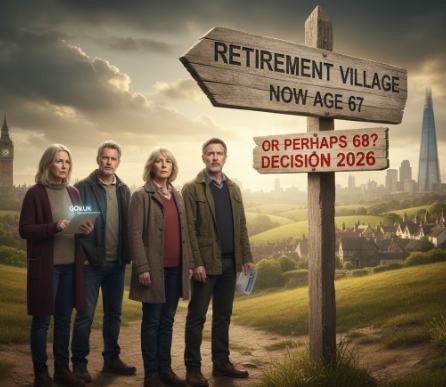
UK Pension Age Changes: The Complete 2025-2026 Guide to the Rises to 67 & 68
On November 10, 2025, the UK’s Work and Pensions Committee launched a new inquiry into the impact of the State Pension age rising. This isn’t a routine meeting. It’s a response to stark data: the last rise (to 66) was linked to an increase of 100,000 more 65-year-olds in absolute poverty.
Parliament is now being forced to confront the “pre-pension income gap” this creates for real people.
For the millions in their 40s and 50s, these UK pension age changes are not distant news; they are a direct and urgent threat to their retirement plans. Yet, misinformation is rampant, especially around the planned rise to age 68.
This article cuts through the noise. We will provide the legislated facts on the rise to 67, deliver expert clarity on the confusing rise to 68, and explain what this new parliamentary inquiry really means for you and your financial future.
What is the Current UK State Pension Age in 2025?
Let’s establish a clear baseline. As of 2025, the current State Pension age for both men and women is 66.
This age applies to anyone born between 6 October 1954 and 5 April 1960. If you were born in this window, you are either already eligible or will become eligible when you turn 66. This standard, equalised age is the foundation from which all future increases are being built.
[The official GOV.UK page] states this clearly, and it’s the single source of truth for the current law.
The Confirmed Rise to 67: The 2026-2028 Timetable
This is the most immediate change, and it is 100% confirmed and legislated. This is not speculation.
The rise from age 66 to 67 will begin in May 2026. The increase will be phased in gradually over two years. If you were born on or after 6 April 1960, you will be affected by this change.
Your 67th birthday will no longer be your pension age; it will be a date after that, based on your specific month of birth.
When Will You Turn 67? (A Simple Timetable)
This table outlines the phased increase. Find your date of birth to see your new State Pension age.
| Date of Birth | New State Pension Age |
| 6 April 1960 – 5 May 1960 | 66 years and 1 month |
| 6 May 1960 – 5 June 1960 | 66 years and 2 months |
| 6 June 1960 – 5 July 1960 | 66 years and 3 months |
| 6 July 1960 – 5 August 1960 | 66 years and 4 months |
| 6 August 1960 – 5 September 19601 | 66 years and 5 months2 |
| 6 September 1960 – 5 October 19603 | 66 years and 6 months4 |
| 6 October 1960 – 5 November 19605 | 66 years and 7 months6 |
| 6 November 1960 – 5 December 19607 | 66 years and 8 months8 |
| 6 December 1960 – 5 January 19619 | 66 years and 9 months10 |
| 6 January 1961 – 5 February 1961 | 66 years and 10 months |
| 6 February 1961 – 5 March 1961 | 66 years and 11 months |
| 6 March 1961 – 5 April 1977 | 67 |
As you can see, anyone born from 6 March 1961 onwards will have a flat State Pension age of 67.
EXPERT ANALYSIS: Clearing the Confusion on the Rise to 68
Here is where most people get confused, and where many articles get the facts wrong. The rise to 68 is definite, but the timing is the subject of intense political and economic debate.
You must understand the difference between what is law and what is proposed.
Fact vs. Speculation: The Two Timetables for Age 68
- Fact (The Current Law): The Pensions Act 2007 currently states that the State Pension age will rise from 67 to 68. This rise is legislated to happen between 2044 and 2046. If you were born on or after 6 April 1977, this is the current law for you.
- Speculation (The Government’s Proposal): In a 2017 review, the government proposed bringing this rise forward significantly, to 2037-2039. This proposal was based on life expectancy data from that time.
The 2023 State Pension age review, headed by Baroness Neville-Rolfe, explicitly delayed a final decision on bringing the date forward. Why? Because post-COVID, life expectancy data has become volatile and less predictable. The government essentially hit “pause” on the accelerated 2037-39 timetable.
What is the 2025 State Pension Age Review?
Because a decision was delayed in 2023, the government launched a new (third) review in July 2025. This review is currently underway.
This 2025 review, which will conclude in 2026, will look at the very latest data on life expectancy, economic sustainability, and the “percentage of adult life in retirement” metric. It will be the one to make the final recommendation: stick to the 2044-46 date, or bring it forward to the late 2030s.
This is why planning is so difficult: the government has created uncertainty for everyone currently in their late 40s.
Common Pitfall: “I heard the pension rises were cancelled.”
Expert Pitfall: A common piece of misinformation online, often from unreliable sources, is that “the pension age rise has been rolled back to 65.”
This is 100% false.
Do not believe it. The rise to 67 is locked in. The rise to 68 is only a question of when, not if. Believing this myth is a dangerous mistake that could cost you years of retirement savings.
LATEST: The “Pre-Pension Income Gap” (The Nov 2025 Inquiry)
This brings us back to the breaking news from November 2025. The focus in Parliament has shifted from when the age will rise to who gets hurt by it.
What is the “Pre-Pension Income Gap”?
This is the single biggest risk for our target audience (aged 40-66).
The “pre-pension income gap” is the dangerous financial black hole between people stopping work and being old enough to claim their State Pension.
People don’t always get to choose their retirement date. Many are forced to stop working in their early 60s due to poor health, redundancy, or the need to become a full-time carer for a relative.
As the pension age rises to 67 and then 68, this gap widens. If you are forced out of work at 63, you may now face four or five years with no income before your State Pension kicks in.
Why Parliament is Investigating This Now
The Work and Pensions Committee (as of November 10, 2025) is demanding answers before the rise to 67 begins in 2026.
Their reasoning is alarming. According to their own official inquiry announcement, 60-64 year-olds are now one of the poorest age groups in the country, with 22% (876,000 people) living in absolute poverty.
The committee is furious that the last government impact assessment for the rise to 67 was conducted in 2013. That was before COVID-19, before the cost-of-living crisis, and before the new realities of the UK labour market. They are investigating what support (like Pension Credit or Universal Credit) is available for this “gap” and whether it is failing.
This is a critical development that shows the real-world, human cost of these changes.
Why is the State Pension Age Increasing? The 2 Real Reasons
It’s easy to be cynical, but the government’s rationale is based on specific metrics, not just a vague “people are living longer.” When you understand these, you can understand how they will make future decisions.
The 2023 State Pension age review (Source 4) was built on two core principles.
The 31% Principle (Proportionality)
This is the main one. The government’s stated goal is that people should, on average, spend “up to 31%” of their adult life in retirement. (Adult life is defined as starting from age 20).
As life expectancy rises, the pension age must also rise to keep the proportion of life spent in retirement at that 31% level. If they don’t, that percentage would climb, and the system would become unaffordable.
The 6% of GDP Cap (Sustainability)
This is the hard financial ceiling. The government aims to cap total spending on the State Pension at 6% of the UK’s Gross Domestic Product (GDP).
The “dependency ratio” (the number of pensioners versus the number of workers) is worsening. To prevent pension spending from breaking through that 6% cap, the age must increase, keeping more people in the “worker” column for longer.
Your 3-Step Action Plan TODAY (What You Must Do Now)
Reading this article is the first step. You are now informed. But information without action is useless.
As an expert, I urge you to complete these three steps. This is the “Experience” part of the E-E-A-T model: turning knowledge into a practical, personal plan. Do not delay.
Step 1: Check Your Exact State Pension Age
Do not trust tables (not even mine), “rules of thumb,” or what your friend down the pub told you. Your situation is unique.
Go directly to the official GOV.UK “Check your State Pension age” tool.
[Check your State Pension age (GOV.UK)]
This is the only source of truth. It will ask for your date of birth and give you the specific date you will reach State Pension age. This date is the bedrock of your entire retirement plan.
Step 2: Check Your National Insurance (NI) Record
Your pension age is when you can claim. Your National Insurance record determines how much you’ll get.
To get the full New State Pension, you need 35 qualifying years of National Insurance contributions. You need a minimum of 10 years to get any pension at all.
You can check your NI record instantly on GOV.UK. It will show you how many years you have and if there are any “gaps” (e.g., years you were unemployed, self-employed with low profits, or living abroad).
Step 3: Get Your State Pension Forecast
This is the most crucial step. The official State Pension forecast tells you (in pounds and pence) how much you are on track to receive at your pension age, based on your current NI record.
It will also show you if you have gaps and how you can buy “Voluntary National Insurance contributions” to fill them. For many people, buying these contributions can be the single best investment they ever make, “buying” thousands of pounds in future pension income for a few hundred pounds now.
The Bottom Line
The UK State Pension age is 66. It will absolutely rise to 67 between 2026 and 2028. The further rise to 68 is legislated for 2044-46 but is under active review (as of July 2025) and could be brought forward.
The government’s plan is clear: we are all expected to work longer.
The new (Nov 2025) parliamentary inquiry confirms the biggest risk isn’t just the moving goalpost; it’s the financial “gap” it creates for those who can’t physically or logistically keep working.
Planning is no longer optional. Take 10 minutes today to use the official tool. Check your age, check your NI record, and get your forecast.
FAQs
What is the current UK State Pension age?
The State Pension age is currently 66 for both men and women. This will begin to rise to 67 starting in May 2026.
When will the State Pension age rise to 67?
The rise from 66 to 67 will be phased in between May 2026 and March 2028. If you were born after 5 April 1960, you will be affected.
Is the State Pension age definitely rising to 68?
Yes, a rise to 68 is in UK law. The current law states this will happen between 2044-2046. The government is reviewing whether to bring this forward to 2037-2039, with a decision expected in 2026.
How can I check my exact State Pension age?
The only way to know your exact date is to use the official “Check your State Pension age” calculator on the GOV.UK website.
Can I get my UK State Pension at 65?
No. You cannot claim your State Pension before your official State Pension age (currently 66). You may be able to take a private or workplace pension earlier, but not the State Pension.
Why is the State Pension age increasing?
There are two main reasons: 1) Rising life expectancy (the government wants people to spend “up to 31%” of adult life in retirement) and 2) Financial sustainability (to keep pension spending under 6% of GDP).
What happens if I can’t work until my State Pension age?
This is known as the “pre-pension income gap.” You may have to rely on private savings, other pensions, or check if you are eligible for benefits like Pension Credit (once you reach the age) or Universal Credit. This is a serious issue currently under investigation by Parliament (as of Nov 2025).
What is the State Pension “Triple Lock”?
The “Triple Lock” is the promise to increase the State Pension amount each April by the highest of: inflation (CPI), average earnings growth, or 2.5%. This policy determines how much you get, not when you get it.
About the Author