British Gas Frozen Pipe Warning: Fix Your Boiler Before 11am (Jan 2026 Update)
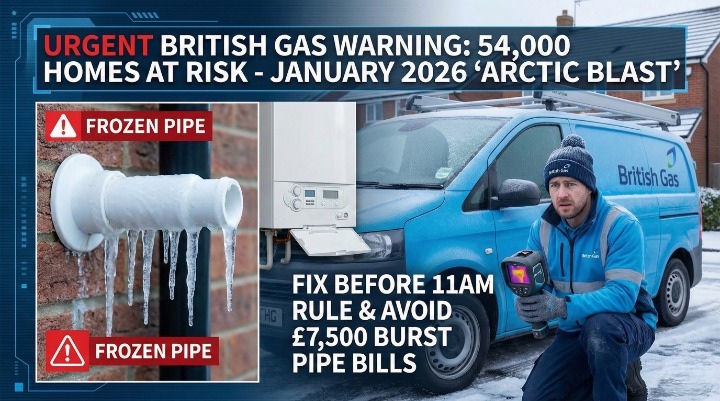
The UK’s record-mild December has ended abruptly, replaced by a brutal 2026 “Arctic blast” that has put British Gas on high alert. The energy giant has issued an urgent warning that up to 54,000 households could face heating failures this week as temperatures plummet.
If your modern condensing boiler has suddenly stopped working, likely making a gurgling sound or displaying a cryptic error code, you are not alone. But before you panic or call an expensive emergency plumber, you need to know that most of these “breakdowns” are actually a simple frozen pipe issue you can fix yourself in 15 minutes.
This guide explains the critical “11am Rule” for repairs, how to instantly diagnose a frozen condensate pipe, and the engineer-approved method to safely thaw it without cracking the plastic.
The 2026 British Gas Warning: Why 54,000 Homes are at Risk
This week’s deep freeze is dangerous because of how sudden it is. After a mild end to 2025, many households have turned their heating schedules down, leaving pipes vulnerable to the sudden sub-zero drop.
British Gas predicts their engineers will visit 54,000 homes this week alone. The primary culprit? The condensate pipe.
Unlike older boilers, modern condensing boilers are highly efficient because they recycle waste heat. However, this process creates acidic wastewater that must be drained away via a small plastic pipe. If this pipe runs outside (as it does in millions of UK homes) and isn’t insulated, even a few hours of -2°C weather can freeze the water inside, causing the boiler to shut down for safety.
Understanding the “11am Rule” for Same-Day Repairs
If you cannot fix the issue yourself (using the steps below), timing is everything. British Gas operates a “same-day promise” for emergency boiler breakdowns, but it comes with a strict deadline.
The 11am Rule: If you have no heating or hot water, you must book your repair appointment before 11am to qualify for a same-day visit.
According to 2025 performance data, 80% of customers who called before this cut-off received an engineer visit that day. If you wait until lunch, you are almost guaranteed to be shivering until tomorrow.
Is Your Boiler Frozen? Look for These 3 Critical Symptoms
Before you call anyone, check for these three signs. If you see them, your boiler isn’t broken, it’s just blocked.
1. The “Gurgling” Warning
If your boiler tries to fire up, makes a bubbling or gurgling sound (like a coffee percolator), and then cuts out, this is the sound of the fan trying to push exhaust gases past a block of ice.
2. Deciphering the Fault Codes
Your boiler’s digital display is trying to tell you exactly what is wrong. While every manufacturer is different, “Frozen Condensate Pipe” usually triggers a specific ignition failure code.
| Boiler Brand | Common Frozen Pipe Error Codes |
| Worcester Bosch | EA (Ignition Lockout) or D5 |
| Vaillant | F28 or F29 (Failure to ignite) |
| Baxi / Potterton | E133 or E1 |
| Ideal | L2 or F2 |
| Glow-worm | F1 or F4 |
[Note: If you see these codes during a cold snap, do not buy a new circuit board. It is almost certainly ice.]
3. The White Plastic Culprit
Go outside and look for a white or grey plastic pipe (about 20mm wide) coming from the wall behind your boiler. If it runs into an external drain and is covered in frost, or if the end is blocked by an icicle, you have found the problem.
How to Safely Thaw a Frozen Condensate Pipe (British Gas Pro-Tips)
Joanna Flowers, a British Gas service engineer, advises that this is one of the few boiler faults you can legally and safely fix yourself. Follow this diagnostic checklist to clear the blockage.
Time required: 15–20 minutes
Tools needed: Kettle, jug, hot water bottle (optional).
-
Locate the Blockage: The ice is usually at the most exposed point, either the very end of the pipe or a sharp bend (elbow).
-
Prepare the Water: Boil your kettle, but stop and let it cool for 10-15 minutes. You need warm water, not boiling.
-
Apply Heat: slowly pour the warm water over the frozen section of the pipe. Do this repeatedly until the ice melts.
-
Alternative: If the pipe is hard to reach, strap a hot water bottle or a microwave heat pack to the pipe and leave it for 10 minutes.
-
-
Listen for the “Whoosh”: As the ice clears, you will often hear a rush of accumulated water draining away.
-
The Restart Procedure: Go back inside and press the “Reset” button on your boiler (often held for 3-5 seconds). It should now fire up immediately.
⚠️ Critical Mistake: The “Kettle Error”
Never pour boiling water directly onto a frozen plastic pipe. The thermal shock (going from -5°C to 100°C instantly) can crack the pipe. If the pipe cracks, you will fix the heating but cause a leak that could rot your external brickwork or dampen your foundations.
The “Thaw-Burst” Paradox: Why Your Real Trouble Starts When It Gets Warmer
The danger isn’t over when the ice melts. In fact, that is when the most damage occurs.
Water expands by about 9% when it freezes. This pressure can split copper and plastic pipes in your loft or garage. While frozen, the ice acts as a plug, sealing the crack. When the temperature rises (or you thaw the pipe), that plug disappears, and water floods your home.
According to the Association of British Insurers (ABI), the average cost of a burst pipe claim during a winter freeze is £7,500.
Action Step: Locate your internal stopcock today. It is usually under the kitchen sink or in a downstairs cupboard. If a pipe bursts, turning this valve clockwise will stop the flood and save your ceiling.
Permanent Fixes: Pipe Lagging vs. Trace Heating
You don’t want to be pouring water on your pipes every morning this week. Here are three ways to stop it happening again.
1. The DIY Fix: Pipe Lagging
For under £10, you can buy foam pipe insulation (often called “lagging”) from any hardware store. It looks like a pool noodle. Wrap this around the external condensate pipe and secure it with cable ties. It offers basic protection against wind chill.
2. The “Condensulate” Upgrade
British Gas recommends upgrading to a “Condensulate” pipe. This is a specialised, double-walled pipe that is effectively designed to withstand temperatures as low as -15°C without freezing.
3. Trace Heating (The Ultimate Solution)
For those in exposed rural areas, trace heating is an electrical element (a wire) that runs along the pipe. It is connected to a thermostat and automatically gently warms the pipe whenever the air temperature drops below 5°C. It uses minimal electricity but guarantees 100% frost protection.
Renters’ Rights: What to Do if Your Landlord Won’t Fix the Heating
If you are renting and your boiler has failed, you are not responsible for repairs, your landlord is.
Under Section 11 of the Landlord and Tenant Act 1985, landlords are legally obligated to keep “installations for the supply of water, gas and electricity” and “space heating and heating water” in good repair.
Your Move:
-
Report the issue in writing (email/text) immediately.
-
If it is a frozen condensate pipe, try the warm water fix yourself, it is faster than waiting for a landlord’s contractor.
-
If the boiler is actually broken and the landlord is unresponsive during this “Arctic blast,” contact your local council’s environmental health department. A freezing home is considered a Category 1 Hazard.
Is British Gas HomeCare Cover Worth It in 2026?
With emergency call-out fees ranging from £90 to £150 just for the first hour, many ask if monthly cover is better.
-
The Pro: You get access to the “11am Rule” priority service, which is invaluable when 54,000 other people are trying to book an engineer.
-
The Con: If your boiler is old, parts may be obsolete.
-
The Verdict: If you are comfortable thawing a pipe yourself, you might not need full cover. But if you have a vulnerable family member (elderly or infant) in the house, the priority access during a national cold snap is often worth the monthly premium.
FAQs
How do I know if my condensate pipe is frozen?
Your boiler will likely lock out and display an error code (like EA or F28), and you may hear a gurgling noise. Visually, the external plastic pipe will be frosted over.
Can I use a hairdryer to thaw my pipes?
Yes, but be careful. Use it on a low heat setting and keep it moving. Do not hold it in one spot for too long, as you can melt the plastic. Never use a blowtorch or naked flame.
Will my insurance cover a burst pipe if the house was empty?
Most policies have an “unoccupied home” clause (usually 30 or 60 days). However, during winter, some insurers require you to keep the heating on at a minimum temperature (often 12-15°C) if you are away. Check your policy wording carefully.
Why is my boiler making a gurgling noise but still working?
This indicates the pipe is partially frozen. The water is draining slowly, but the airway is narrowing. Treat it immediately with warm water before it blocks completely.
What temperature should I leave my heating on to prevent freezing?
British Gas recommends keeping your thermostat set to at least 7°C at all times, even at night or when you are out, to prevent the system water from freezing.
How do I find my internal stopcock?
It is usually under the kitchen sink. If you can’t find it, check the hallway cupboard or under the stairs. Test it now—if it’s seized, you won’t be able to turn it off in an emergency.
Does British Gas offer same-day repairs for non-customers?
Yes, they offer “one-off repairs” for non-customers, but during high-demand events (like this Arctic blast), existing HomeCare customers are prioritised.
Summary
The January 2026 freeze is severe, but a frozen condensate pipe doesn’t have to mean a cold home. Remember the golden rules: check for the gurgling sound, never use boiling water, and if you need an engineer, call before 11am.
Don’t just fix the thaw; fix the flaw. Insulation costs £5; a new boiler circuit board costs £500. Check the Met Office 7-Day Forecast and secure your home tonight.
About the Author