England Bin Collection Rules 2026: Avoid The £300 Bin Fine
The era of the “postcode lottery” for recycling is officially ending.
If you have ever moved from one town to another and found yourself baffled because the green bin is now for garden waste instead of glass, you know the frustration. For decades, English councils have operated under different rules. Some took glass. Some didn’t. Some collected food waste weekly. Others let it rot in the black bin for a fortnight.
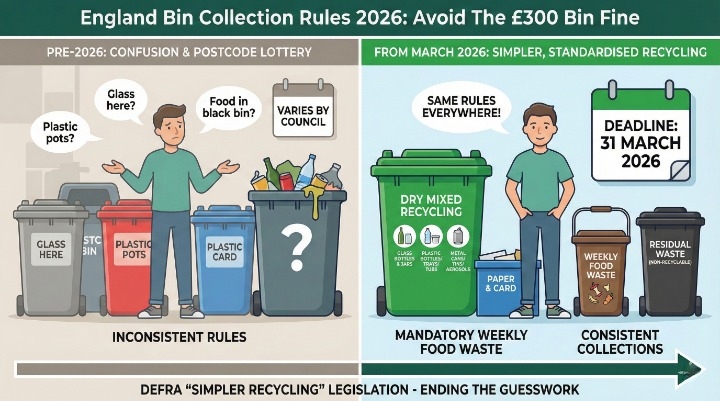
That confusion ends on 31 March 2026.
The government has introduced new legislation known as “Simpler Recycling.” This law forces every local authority to adopt the same England bin collection rules 2026. While this is great news for the environment, it means your weekly driveway routine is about to change. Failure to adapt could result in uncollected rubbish or even “contaminated waste” fixed penalty notices.
This guide breaks down exactly what goes in which bin, the mandatory weekly food waste changes, and how to avoid getting caught out during the transition.
What is “Simpler Recycling”? (Ending the Confusion)
“Simpler Recycling” is the government’s direct response to the stagnant recycling rates in England, which have hovered around 44% for years.
Under the updated Environmental Protection Act 1990 and the Environment Act 2021, the Department for Environment, Food & Rural Affairs (DEFRA) has issued statutory guidance. This guidance strips councils of the right to choose which materials they collect. They can no longer say “it is too expensive to collect glass.”
The goal is uniformity. Whether you live in Bristol, Birmingham, or Berwick-upon-Tweed, a plastic yoghurt pot goes in the same recycling stream. This removes the guesswork for householders and manufacturers alike.
The 2026 Deadline: When Does Your Routine Change?
Mark 31 March 2026 on your calendar.
By this date, every waste collection authority in England must collect the core recycling materials from your kerbside.
However, you might see changes sooner. Many forward-thinking councils are already rolling out the infrastructure. For example, West Suffolk and Durham County Council have already begun trialling new bin configurations and 23-litre food caddies to meet these requirements ahead of time.
Local Resident Tip: Do not wait until March 2026 to check your council’s website. If your local authority changes their contract early, you could find your old bin collection calendar is obsolete overnight.
The 7 Core Waste Streams: What Goes in Which Bin?
The most significant shift in the England bin collection rules 2026 is the mandatory collection of seven specific waste streams.
Previously, councils could ask you to separate paper from card, or glass from plastic. The new rules allow for “commingled” recycling (putting dry mixed items in one bin) to make life easier for residents, but they strictly separate food waste.
Here is the breakdown of what every household must be able to recycle:
-
Glass: Bottles and jars (including metal caps).
-
Metal: Steel and aluminium tins, drink cans, aerosols, and aluminium foil.
-
Plastic: Bottles, pots, tubs, and trays.
-
Paper: Newspapers, magazines, letters.
-
Cardboard: Boxes, toilet roll tubes.
-
Food Waste: All cooked and uncooked food.
-
Garden Waste: Grass clippings, leaves (this remains a chargeable service in many areas).
Mandatory Weekly Food Waste
This is the headline change. By March 2026, all councils must collect food waste weekly.
If you currently put food scraps in your black “residual” bin, that stops. You will likely receive two new containers:
-
A small 5-litre caddy for your kitchen countertop.
-
A larger 23-litre outdoor caddy for kerbside collection.
This waste goes to anaerobic digestion plants to generate biogas, rather than rotting in landfill and producing methane.
The “Dry Mixed” Stream
To keep things simple, most councils will allow you to put glass, metal, and plastic in a single bin. Paper and card may still require a separate bag or box in some areas to prevent it from getting wet and ruining the recycling batch.
Comparison: Old vs New Rules
| Feature | The “Old” System (Pre-2026) | The “Simpler Recycling” Rules (2026) |
| Glass | Optional (often bottle banks only) | Mandatory kerbside collection |
| Food Waste | Rare / Fortnightly | Mandatory Weekly collection |
| Plastic | Bottles only (often) | Bottles, pots, tubs, & trays |
| Bin Colours | Random (Postcode Lottery) | Standardisation encouraged (but not forced) |
| Consistency | Varies by Council | Same rules across England |
The “Dirty Dozen”: 12 Items You Must Stop Recycling in 2026
With stricter rules comes stricter enforcement.
A major issue for recycling plants is “wish-cycling.” This happens when well-meaning people put items in the green bin hoping they will be recycled. According to WRAP (Waste & Resources Action Programme), non-target materials cost councils millions annually in rejected loads.
Under the 2026 rules, placing these items in your dry recycling bin could lead to your bin not being emptied or a fixed penalty notice.
Do NOT Recycle These (Put in Black Bin):
-
Pyrex / Ovenware: It melts at a different temperature to bottle glass.
-
Drinking Glasses: The chemical composition is different from jars.
-
Mirrors: The reflective coating ruins glass batches.
-
Toothpaste Tubes: These are composite materials (plastic and metal).
-
Blister Packs: Medical pill packs are not recyclable at kerbside.
-
Pet Food Pouches: These are flexible plastics (see section below).
-
Greasy Pizza Boxes: Oil contaminates paper pulp.
-
Tissues / Kitchen Roll: The fibres are too short to recycle.
-
Nappies: Never put these in recycling.
-
Crisp Packets: Not yet (wait for 2027).
-
Wallpaper: Often contains vinyl or flakes.
-
Polystyrene: Takeaway boxes or packaging foam.
Common Mistake: Washing your recycling is vital. A half-full jar of pasta sauce can ruin an entire truckload of paper. A quick rinse is all it takes to be compliant.
Rules for Flats, Terraces, and HMOs
One of the biggest hurdles for the England bin collection rules 2026 is properties with limited space. If you live in a flat, a high-rise, or a terrace with no front garden, where do you put four different bins?
DEFRA acknowledges this challenge. The legislation puts the onus on landlords and building managers.
-
Communal Bins: Flats will likely see upgraded communal bin stores. Instead of one giant general waste skip, you will have colour-coded skips for dry mixed recycling and food waste.
-
The “Receptacle” Rule: Councils have the authority to issue specific bags instead of wheelie bins for terraced streets to prevent pavement obstruction.
If you are a tenant, check with your landlord or property management company. They are legally required to provide the facilities for you to comply with the new separation rules.
Why is Plastic Film Delayed Until 2027?
You might have noticed that “soft plastics” are missing from the mandatory list above.
Soft plastics include crisp packets, bread bags, salad bags, and chocolate wrappers. Currently, you have to take these to large supermarkets.
The government has granted a delay for this specific stream. The infrastructure to sort flexible plastic film is not yet ready at a national scale. Plastic film collection will become mandatory by 31 March 2027.
Do not put these in your plastic recycling bin in 2026. They clog the sorting machines. Stick to the “rigid” plastics (bottles, pots, tubs) until the 2027 deadline passes.
Business Waste vs. Household Waste: Don’t Get Caught Out
If you run a business from home, pay attention.
The “Simpler Recycling” rules apply to businesses too, but their deadline is earlier. Most businesses in England must comply with separate waste collection rules by 31 March 2025.
However, micro-firms (fewer than 10 full-time employees) generally have until 31 March 2027 to separate plastic film, aligning with the household timeline.
Pro-Tip for Freelancers: If you use your domestic council bins for business waste, you technically need a “Waste Transfer Note.” With the new strict separation rules, councils may be scrutinising bins more closely. Ensure you are declaring your waste correctly.
Conclusion: Preparing Your Driveway for 2026
The introduction of the England bin collection rules 2026 is the biggest shake-up in waste management for a generation.
While the transition might feel annoying at first, especially getting used to a kitchen food caddy, it solves a long-standing problem. No longer will you have to guess if a yoghurt pot is legal in your area. The rules are finally the same for everyone.
Your Action Plan:
-
Watch your post: Councils will send out literature regarding new bin deliveries closer to the time.
-
Audit your kitchen: Start thinking about where a small food caddy will fit.
-
Stop wish-cycling: Memorise the “Dirty Dozen” list to avoid fines.
By March 2026, recycling won’t just be a good deed. It will be the law.
FAQs
How many bins will I have in 2026?
Most households will have a minimum of three containers: one for residual waste (black bin), one for dry mixed recycling (glass/plastic/metal), and a caddy for food waste. Some councils may provide a fourth container (box or bag) specifically for paper and card to keep it dry.
Is food waste collection mandatory in England?
Yes. Under the Environment Act 2021, all English waste collection authorities must arrange for the separate collection of food waste at least once a week by 31 March 2026.
Can I be fined for putting the wrong item in the bin?
Yes. Councils have the power to issue Fixed Penalty Notices for “contaminated waste” if you persistently ignore instructions, though they typically issue warnings first. The 2026 rules make these categories legally distinct, strengthening the council’s ability to enforce them.
Do I have to pay for garden waste collections under the new rules?
Yes, in most cases. The new legislation gives residents the right to have garden waste collected, but it does not force councils to do it for free. Most authorities will continue to charge an annual subscription fee (the “green bin tax”).
What happens to my old bins if the council changes them?
If your council switches to a new system (e.g., swapping a large bin for smaller crates), they are responsible for removing and recycling your old bins. Do not dump them; wait for the official collection or swap-over date.
Do the 2026 recycling rules apply to London boroughs?
Yes. The rules apply to all waste collection authorities in England, including all London boroughs. However, high-density areas in London may rely more heavily on communal bins and distinctive coloured sacks rather than wheelie bins.
What size is the new mandatory food waste caddy?
While sizes can vary slightly by manufacturer, the standard issue is a 5-litre “kitchen caddy” for indoor use and a 23-litre outdoor caddy (with a locking handle) for the kerbside collection.
Why did the government change the recycling rules?
The government introduced “Simpler Recycling” to meet carbon reduction targets and increase England’s recycling rate. Uniform rules reduce confusion, improve the quality of recyclable material sold to processors, and reduce the amount of waste sent to landfill.
About the Author