Best Extra Wide Fit Shoes for Swollen Feet in the UK: A Complete Buying Guide
Finding shoes when you have swollen feet isn’t just a shopping trip; it’s often a painful ordeal. If you suffer from oedema, lymphoedema, or diabetes, you know the struggle of forcing a tender foot into a standard “wide fit” shoe. It cuts off your circulation, leaves angry red marks, and frankly, makes you want to stay home.
But staying mobile is vital for your health.
The problem is that most “High Street” wide fit shoes only offer an E or EE width. For genuine swelling, you often need a 4E, 6E, or even an 8E fitting. You don’t just need width; you need depth.
This guide cuts through the noise. We will look at the best extra wide fit shoes for swollen feet available in the UK right now. We’ll explain the critical “4PM Rule” for measuring, how to claim your 20% VAT relief from the government, and which brands actually deliver on their promises.
Let’s get you comfortable again.
Why Standard “Wide Fit” Isn’t Enough for Swollen Feet
Many people make the mistake of simply buying a shoe two sizes too big. This is dangerous. A shoe that is too long but still not wide enough creates a trip hazard without solving the pressure problem.
Understanding the Causes
Whether your swelling is due to oedema (water retention), medication side effects, or a condition like arthritis, the result is a foot that changes shape. It doesn’t just get wider; it gets “taller” at the instep (the top arch of your foot).
Standard shoes are designed for a static foot shape. Swollen feet are dynamic—they change volume throughout the day.
Width vs. Depth: The “Volume” Misconception
This is the biggest secret in the orthopaedic footwear industry: Volume matters more than width.
If you have a high instep due to swelling, you need a shoe with a deep toe box. This is where “V-Fittings” (Variable Fittings) come in. Specialized UK brands offer shoes with removable internal socks or insoles.
-
How it works: When you wake up and swelling is low, you wear the shoe with all insoles in. As the day progresses and your feet swell, you remove an insole to create more depth inside the shoe instantly.
My Pro-Tip: Look for descriptions that mention “dual fitting” or “removable insoles.” This feature alone can save you from having to buy two different pairs of shoes for morning and evening wear.
Key Features to Look for in Medical Footwear
Before we look at specific brands, you need to know the non-negotiables. If a shoe lacks these three features, put it back on the shelf.
1. Touch-Fastening vs. Laces (Why Velcro Wins)
Laces are generally a poor choice for swollen feet. Why? Because as your foot expands, laces dig in like a tourniquet. They also require dexterity to tie, which is difficult if you also suffer from arthritis.
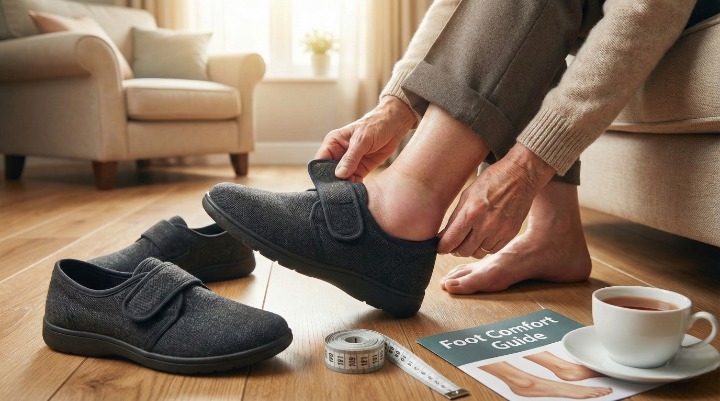
We strongly recommend touch-fastening straps (often called Velcro).
According to The Royal College of Podiatry, footwear retention is crucial for preventing falls. A touch-fastening strap allows you to adjust the tension easily throughout the day. If your feet feel tight at lunch, you can loosen the strap in seconds without bending down for long periods.
2. The “Deep Toe Box”
You need wiggle room. A deep toe box prevents the material from pressing down on the tops of your toes, which is essential if you have hammer toes or sensitive skin. Rubbing leads to blisters, and for diabetics, a blister can quickly become a serious ulcer.
3. Breathable Materials
Swollen feet often sweat more because of the tight skin. Look for natural leathers or high-quality stretch mesh. Avoid cheap plastics or stiff synthetics that trap heat.
How to Measure Your Feet Correctly (The “4PM Rule”)
Stop right now if you were planning to measure your feet in the morning.
Why You Must Measure in the Afternoon
Feet are naturally at their smallest when you wake up. Gravity and activity cause fluids to pool in your lower extremities throughout the day.
The 4PM Rule: Always measure your feet or try on new shoes in the late afternoon (around 4 PM). If a shoe fits perfectly at 9 AM, it will likely pinch and cause pain by tea time. You need to fit the foot at its largest, not its smallest.
Understanding UK Width Codes
The UK sizing system can be confusing. Here is a simple breakdown of what the letters actually mean:
| Fitting Code | Description | Best For |
| D | Standard Width | The average foot. |
| E | Wide | Mild bunions or slightly wide feet. |
| EE / 2E | Extra Wide | Common High Street “Wide Fit”. |
| 4E | Ultra Wide | Moderate swelling, severe bunions. |
| 6E | Mega Wide | Severe oedema, bandaged feet. |
| 8E | Extreme Wide | Lymphoedema, very severe swelling. |
The “Paper Test”
Not sure if your current shoes are damaging your feet? Try this simple home experiment:
-
Place a piece of plain paper on the floor.
-
Stand on it (barefoot or in socks) and have someone trace the outline of your foot.
-
Take your current shoe and place it on top of the drawing.
-
The Verdict: If your drawn foot lines stick out wider than the sole of the shoe, that shoe is crushing your foot. You need a wider fitting immediately.
Top Rated UK Brands for Swollen Feet (2025 Reviews)
Based on availability, specialist features, and customer trust, these are the top contenders in the UK market.
1. Cosyfeet (Best for Severe Swelling)
Cosyfeet is arguably the gold standard in the UK for “Extra Roomy” footwear. Their baseline width is a 6E for women and 3H for men.
-
Why it works: Their shoes are designed specifically for swollen feet, not just wide feet. They have “extensions” available for straps if your ankles are very large.
-
Best for: People with severe oedema or bandaged feet who cannot fit into anything else.
2. DB Wider Fit Shoes (Best for “V-Fitting” Flexibility)
Based in Northamptonshire, DB Wider Fit (often sold as DaBella) offers the best technical adjustability.
-
Why it works: They specialize in variable fittings (e.g., 6V). This means you can adjust the depth of the shoe significantly. They also have some of the most stylish options that don’t look like “medical shoes.”
-
Best for: People who want style without sacrificing the ability to adjust for daily swelling changes.
3. Pavers & Hotter (Best for Mild Swelling/Style)
If your swelling is mild or seasonal (perhaps due to heat), Pavers and Hotter are excellent High Street options.
-
Why it works: They are more accessible and affordable. Look for Hotter’s “Extra Wide” range or Pavers’ “Fly Flot” anatomico clogs.
-
Caveat: They typically top out at an E or EE width. If you have severe medical swelling, these will likely be too narrow.
4. FitVille / Skechers (Best for Walking/Active Users)
For those who are still active but struggle with foot width, FitVille (available online) and certain Skechers lines are popular.
-
Why it works: FitVille offers specific “Rebound Core” technology with extra wide toe boxes (up to 6E). Skechers “Go Walk” series is famous for its soft, stretchy mesh uppers that accommodate bunions well.
-
Best for: Active seniors or those with plantar fasciitis alongside swelling.
How to Claim VAT Relief on Shoes in the UK
Here is the good news: You might be paying 20% too much for your shoes.
In the UK, eligible individuals do not have to pay VAT on medical footwear. This is not a discount code; it is your legal right under HMRC VAT Notice 701/7.
Who is Eligible?
You qualify if you are “chronically sick or disabled.” Regarding footwear, this usually means you suffer from a condition like:
-
Diabetes
-
Lymphoedema or severe Oedema
-
Arthritis
Note: Simply being elderly does not qualify you. You must have a named medical condition.
How the Process Works
You do not usually need a doctor’s note or a prescription.
When buying from specialist sites like Cosyfeet or DB Wider Fit, you will see a “Claim VAT Relief” box at checkout. You simply tick the box and state your condition (e.g., “Type 2 Diabetes”). The 20% tax is deducted instantly from your total.
[Read the official HMRC Guidance on VAT Relief for Disabled People]
FAQs
What is the difference between 4E and 6E width fittings?
The difference lies in the volume of the foot the shoe can hold. A 6E fitting is roughly 6-10 millimetres wider across the joint than a 4E, but crucially, it offers much more depth for swollen insteps.
Can I get wide fit shoes on NHS prescription?
Yes, in severe cases, the NHS can provide orthopaedic footwear. However, the waiting lists are often long, and the style choices are very limited. Many patients prefer to buy their own using VAT relief for faster access and better aesthetics.
Are Velcro or lace-up shoes better for swollen feet?
Velcro (touch-fastening) is superior. It allows you to adjust the fit instantly as your feet swell during the day. Laces are static and can restrict blood flow if not loosened frequently.
Why do my feet swell more in the summer?
Heat causes your blood vessels to expand (vasodilation) and makes it harder for fluid to travel back up your legs. During summer, look for breathable mesh shoes to keep feet cool.
Do I need a doctor’s note to claim VAT relief on shoes?
No. For most online retailers, a “self-declaration” at checkout is sufficient. You just need to write the name of your medical condition.
What are the best slippers for bandaged feet?
Look for “wrap-around” or “opens flat” slippers. These allow you to place your foot on the sole and wrap the upper around it, rather than having to push your painful foot inside a hole.
Can wearing the wrong shoes make oedema worse?
Absolutely. Shoes that are tight act like a tourniquet, restricting the lymphatic and venous flow. This traps fluid in the foot, increasing swelling and pain.
Are Skechers good for swollen feet?
They can be good for mild swelling because of their stretchy fabric. However, most Skechers are standard width or ‘Relaxed Fit’ (E). For severe medical swelling, they often lack the necessary depth and stability of a specialist brand like Cosyfeet.
Conclusion
You do not have to live with foot pain. The key to finding the best extra wide fit shoes for swollen feet is to stop looking at standard shoe sizes and start looking at width and depth.
Remember the three golden rules from this guide:
-
Measure at 4 PM, not in the morning.
-
Prioritize adjustability (touch-fastening straps are your friend).
-
Claim your VAT relief if you have a chronic condition.
Comfort is health. The right shoe doesn’t just stop the pinching; it keeps you mobile, independent, and active.
Ready to find your perfect fit?
Don’t guess your size. We recommend starting with a specialist like DB Wider Fit or Cosyfeet who offer free returns, allowing you to try them on in the comfort of your own home. Your feet will thank you.
About the Author