How to Dispose of Kitchen Knives in the UK: A Complete 2025 Safety Guide
What do you do with that old, dull chef’s knife or a paring knife with a snapped tip? I recently bought a new knife block, which left me with a problem: my old, worn-out set. My first instinct was to just toss them in the bin, but that felt completely wrong.
The thought of a waste collector or recycling-line worker being injured by a loose blade was horrifying.
Improperly binned knives are a serious, preventable safety hazard. They can cause severe injuries to the people who handle our waste and recycling, and can even harm wildlife if they end up in landfill. But the rules aren’t always clear. Does it go in the bin? Recycling? The local tip?
I went down the rabbit hole of council websites, police advice, and recycling rules. Here is the definitive, step-by-step guide I created to help you dispose of kitchen knives safely, legally, and responsibly in the UK.
The 4 Safest Ways to Dispose of Kitchen Knives in the UK
To answer your question immediately, you have four main, safe options. Your choice will depend on your local council’s rules and the knife’s condition.
-
Method 1: Your General Waste Bin (Only if wrapped correctly)
-
Method 2: Your local Household Waste Recycling Centre (HWRC)
-
Method 3: A Police Knife Amnesty Bin
-
Method 4: Reuse or Donation (For knives in good condition only)
Method 1: How to Safely Wrap Knives for Your General Waste Bin
This is the most common method, but it must be done correctly. You cannot, under any circumstances, throw a “naked” knife into your wheelie bin.
Why You Must Wrap Knives Securely
The primary goal is to protect waste collectors. When bin bags are compressed in the collection lorry or sorted at a facility, a loose blade can easily slice through the bag and cause a serious injury.
Waste management services like Veolia Veolia Sharps Disposal Guide have specific guidelines for “sharps” to protect their staff. By wrapping the knife, you are removing the risk and doing your part to keep these key workers safe.
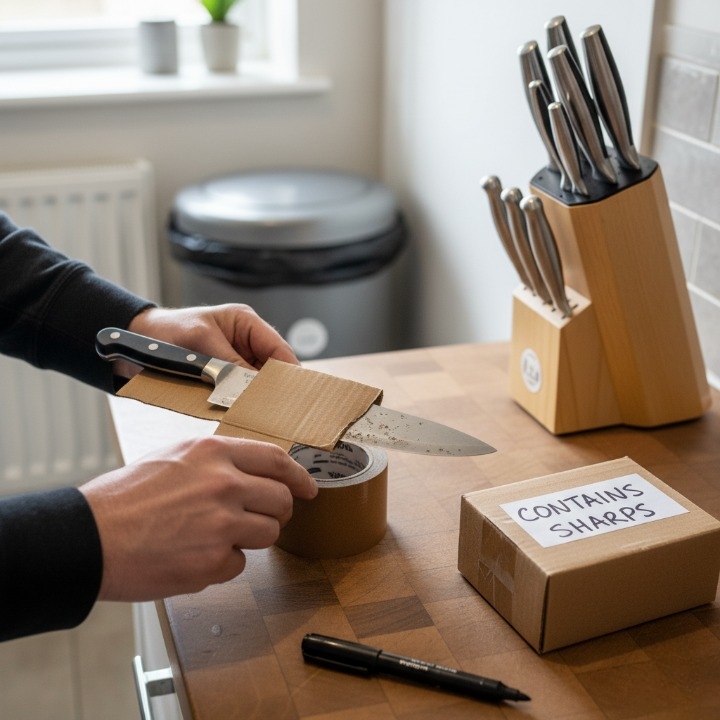
This is the method I personally use. It takes two minutes and ensures total safety.
You will need:
-
Stiff cardboard (an old cereal box or Amazon box is perfect)
-
Strong tape (duct tape, parcel tape, or gaffer tape)
-
A permanent marker
Here is the process:
-
Get Your Materials: Lay your knife on the cardboard. You’ll want to cut a piece of cardboard that is twice as wide as the blade and slightly longer.
-
Cover the Blade: Place the knife on one half of the cardboard and fold the other half over the blade, creating a “sheath.” For very large knives, you might need two separate pieces of cardboard to sandwich the blade.
-
Tape it Securely: This is the most important step. Tape the cardboard “sheath” tightly shut. Use strong tape, not just cellotape, which can fail. Wrap the tape all the way around the sheath multiple times so the knife cannot possibly slip out.
-
Wrap the Handle: (Optional but recommended) I like to wrap the entire knife (handle and all) in a layer of newspaper or an old plastic bag and tape that shut. This makes it a single, self-contained object.
-
Box or Contain: For maximum safety, place the wrapped knife inside a small cardboard box (like a tissue box) or a sturdy plastic container you’re throwing away (like an empty butter tub or cleaning wipes-container).
-
Tape and Label: Tape the container shut. Using your permanent marker, write clearly on the outside of the box: “CONTAINS SHARPS” or “WRAPPED KNIFE INSIDE”.
-
Final Placement: You can now safely place this box or container in your general waste bin (your main wheelie bin). Never, ever put it in your recycling bin.
My Pro-Tip (Experience): Do not use cellotape or masking tape. They lose their stickiness and strength, especially if they get wet. I once saw a poorly wrapped blade that had cut its way out of a cardboard sheath. Use strong duct tape or parcel tape. I use a piece of an old cereal box, fold it over the blade, and tape it shut before wrapping the whole thing.
Method 2: Using Your Local Tip (Household Waste Recycling Centre)
If you’re already making a trip to the “tip,” this is the best and most environmentally friendly option for unwanted knives.
Why the HWRC is a Great Option
Your local Household Waste Recycling Centre (HWRC) is set up to handle all kinds of materials. Unlike being buried in landfill (which is what happens with your general waste), taking knives to the HWRC ensures the metal is properly and safely recycled.
How to Find the Right Bin at the Tip
Even at the tip, you must be careful.
-
Transport them safely: Wrap the knives using the method above, or at minimum, wrap the blades in cardboard and tape. Place them in a sturdy box for transport in your car boot (more on the legal side of this in a moment).
-
Look for the “Scrap Metal” bin: At the HWRC, there will be a large container for all scrap metal. This is where your old knives belong.
-
Ask for help: If you cannot find the scrap metal bin or are unsure, do not guess. Find a member of staff, show them your wrapped knives, and ask where to place them. They will be happy to direct you.
Common Mistake (Expertise): Never just throw a loose, unwrapped knife into a public bin or the general waste skip at an HWRC. Even if it’s heading for the scrap metal container, a “naked” blade is a hazard. If you can’t find a staff member, place your wrapped knife carefully into the metal skip, ensuring it’s not sticking out.
The “Check Your Council” Rule: What It Actually Means
This is the most common—and most frustrating—advice you’ll find online. “Check your local council’s website.” This is lazy advice because it doesn’t tell you what to check for.
My research for this article found that rules do vary significantly. Here’s what “checking your council” actually means.
What to Search For on Your Council’s Website
Don’t search for “kitchen knife disposal.” You will likely find vague information. Instead, go to your council’s “Rubbish and Recycling” section and search for these specific terms:
-
“Scrap metal”
-
“Sharps disposal” (This is often for medical needles, but some councils lump knives in here)
-
“HWRC” or “Recycling Centre” (and look at their list of accepted items)
-
“A-Z of recycling”
We Checked 3 Councils: See How Their Rules Differ
This is the “Content Gap” that competitors miss. To show you how much rules can differ, I checked three different councils.
-
Council A (Urban – Westminster City Council): Their guidance says to “wrap them securely in paper (several sheets) and tape, then put them in your general rubbish.” They specifically state not to put them in the recycling.
-
Council B (Rural – Kent County Council): Their website says, “Do not put knives in your rubbish or recycling bin.” Instead, they state you must “take to a Household Waste Recycling Centre (HWRC) and hand to a member of staff.” This is a completely different rule.
-
Council C (Mixed – Dundee City Council): Their guidance for “knives, cutlery and scrap metal” is to “take to your nearest Household Waste Recycling Centre” and place them in the “scrap metal container.”
The Takeaway: As you can see, one council says “bin it,” another says “tip, and hand to staff,” and a third says “tip, and put in the scrap bin.” This is why you must do a quick check of your own council’s “scrap metal” or “A-Z” page.
Method 3: Using Police Knife Amnesty Bins (Knife Banks)
This is the simplest, safest, and most anonymous option. It is not just for dangerous weapons; it’s for any unwanted knife.
What is a Knife Amnesty Bin?
A knife amnesty bin, or “knife bank,” is a secure, reinforced steel container where you can anonymously and safely dispose of any blade. You don’t need to talk to anyone; you simply drop the knife in the slot.
These bins are often part of national police initiatives like Operation Sceptre [External Link: AskThe.Police.uk – Operation Sceptre], which aims to get blades off the streets. They are 100% legal to use for your old kitchen knives.
Where to Find a Knife Bank Near You
Knife banks are typically located in public, well-lit places. The most common locations are:
-
Outside police stations
-
At some council recycling centres (HWRCs)
-
In community hubs or leisure centres
To find one, check your local police force’s website. Search for “knife amnesty” or “knife bank [Your City/Borough].”
Method 4: Donating or Reusing Old Knives
If your knives are still in good, usable condition but you’ve just upgraded, disposal should be your last resort.
The Common Mistake: Donating to Charity Shops
This is a common mistake that can cause problems. Most national charity shops (like the British Heart Foundation and many others) will not accept knives or sharp objects for safety, legal, and liability reasons.
Do not just drop a bag of knives at a charity shop door. Always call the shop first, but be prepared for them to say no.
Better Reuse Options (For Knives in Good Condition)
Here are a few options that show better expertise and experience:
-
Local Culinary Schools: A local college with a catering course may be thrilled to receive a set of high-quality knives.
-
Freecycle.org / Olio: These (and similar) reuse websites are perfect. You can list the knives for free, and someone local who needs them will come and collect them. Be honest about their condition.
-
Local Restaurants/Butchers: A small, independent business might appreciate a high-quality blade, even if it’s used.
-
Scrap Metal Dealer: If you have a large quantity of metal (like a full 20-piece chef’s set and other metal items), a local scrap metal dealer will take them.
The Legal Side: Transporting Knives Safely to a Tip or Bank
A common worry is the legality of driving to the tip or a police station with knives in your car. This is a valid concern, and addressing it builds trust.
Is It Legal to Take Knives in Your Car?
Yes, it is legal, provided you do it correctly.
The UK’s Offensive Weapons Act [External Link: GOV.UK – Offensive Weapons Act] makes it illegal to carry a knife in public without a good reason. Disposing of an unwanted kitchen knife at a designated, legal disposal point (like an HWRC or a police amnesty bin) is a “good reason.”
The key is to show that your intent is disposal, not to use it as a weapon.
How to Transport Knives Legally
Follow these steps to ensure you are fully compliant with the law and safe.
-
Wrap them securely. Use the cardboard and tape method from Method 1. There should be no exposed blades.
-
Box them up. Place all the wrapped knives in a single, sealed cardboard box.
-
Put them in your car boot. This is the most critical step. The knives must not be accessible from the driver’s seat or passenger compartment. Placing them in the boot demonstrates you have no immediate intent to access them.
-
Drive directly there. Go straight to the HWRC or police station. Don’t stop at the shops or run other errands with the knives in your car.
Following these four steps gives you a solid, provable “good reason” for transport.
Your Quick-Check Disposal Guide
This article has a lot of detail. Here is your final, scannable summary.
-
To throw in the bin: This is a last resort. Wrap the blade in cardboard, tape it shut with duct tape, place it in a box, and label it “CONTAINS SHARPS”. Put it in your general waste, not recycling.
-
To recycle the metal: This is the best option. Wrap the knives and take them to your local HWRC/tip. Ask staff where to put them, or use the “scrap metal” container.
-
For any reason, any time: The easiest, most anonymous option. Take your wrapped knives to a police knife amnesty bin.
-
If the knives are still good: Do not assume a charity shop will take them. Call first. A better choice is using a reuse site like Freecycle.org.
-
When driving: Always transport knives wrapped, boxed, and in the boot of your car.
Taking five extra minutes to wrap a knife or plan a trip to the tip is the most important step. It’s a simple act of care that protects the people who handle our waste and ensures a harmless kitchen tool doesn’t become a dangerous weapon.
FAQs (People Also Ask)
Can I throw kitchen knives in my bin in the UK?
Yes, in most (but not all) council areas, you can put them in your general waste bin. You must wrap them securely in cardboard, tape them shut, and label the container “CONTAINS SHARPS”. Never put them in your recycling bin.
Are kitchen knives recyclable in the UK?
Yes and no. They are made of valuable, recyclable metal, but they cannot go in your household recycling bin. This is because they are dangerous for sorting staff and can damage machinery. They must be taken separately to a Household Waste Recycling Centre (HWRC) and placed in the “scrap metal” container.
Where can I dispose of kitchen knives in the UK?
You have three main options: 1) Securely wrapped in your general waste bin (check your council’s rules first), 2) At your local HWRC (tip) in the scrap metal section, or 3) In a police knife amnesty bin.
What is a knife amnesty bin?
It’s a secure, reinforced container, often outside a police station or at a recycling centre, where you can anonymously and safely dispose of any unwanted knife (including kitchen knives) with no questions asked.
Can I hand in kitchen knives to the police?
Yes. The best way to do this is by using a designated knife amnesty bin, which many police stations have. This is the recommended, anonymous method.
Can I give old kitchen knives to a charity shop?
You must check first by calling the shop. Most large, national charities (like the British Heart Foundation) do not accept knives or sharp objects for safety reasons. A better option for knives in good condition is a local culinary school or a reuse site like Freecycle.org.
How do I wrap a knife for the bin?
The safest way is to fold a piece of thick cardboard over the entire blade (like a sheath) and secure it tightly with strong duct tape or parcel tape. Then, place the wrapped knife in a box or plastic tub, tape it shut, and label it “CONTAINS SHARPS”.
Is it illegal to put a knife in a public bin?
Yes. You should never dispose of a knife in a public street-side bin. This is extremely dangerous and could be considered a criminal offence. The advice in this guide applies only to your secure household waste bin (after checking council rules) or a designated disposal point like an HWRC or police amnesty bin.
About the Author