Interstellar Comet 3I/ATLAS: Alien Probe or Natural Visitor? (UK Viewing Guide)
On November 21, 2025, the internet didn’t just break; it looked up. New images of Interstellar Comet 3I/ATLAS (C/2025 N1) surfaced, showing not a standard dusty tail, but a distinct “X” shape, a sideways anomaly that defies standard comet physics.
For astronomers, it’s a geometric quirk. For Harvard Professor Avi Loeb and the Galileo Project, it’s a potential “technosignature.”
We haven’t seen an intruder like this since 2I/Borisov six years ago. But 3I/ATLAS is different. It is faster, weirder, and brighter. Whether you believe it’s an alien probe or just a fascinating chunk of frozen nitrogen, one thing is certain: it is passing through our neighborhood right now, and it won’t be coming back.
This guide cuts through the tabloid noise. We will examine the hard science, analyze the “alien” controversy, and give you a specific, frost-proof plan to spot this visitor from your UK garden before it vanishes forever.
The Hard Science: What We Know About C/2025 N1
Discovered on July 1, 2025, by the ATLAS survey in Chile, this object immediately set off alarm bells at the Minor Planet Center. Why? Because the math didn’t add up for a local solar system object.
The Trajectory: It’s Not From Here
Most comets orbit the Sun in ellipses. They loop out and come back. Interstellar Comet 3I/ATLAS has an eccentricity of 6.2.
In orbital mechanics, an eccentricity of 0 is a perfect circle. An eccentricity of 1 is a parabola (leaving and never returning). Anything significantly above 1 is “hyperbolic”, meaning it is punching through our solar system with excessive speed, untethered to our Sun’s gravity. It came from deep interstellar space, likely ejected from another star system billions of years ago.
The Speed: A Cosmic Bullet
According to data from the ESA Planetary Defence Office, 3I/ATLAS is travelling at a blistering 250,000 km/h (relative to the Sun). It is currently diving toward its perihelion (closest approach to the Sun), which occurred on October 29. Now, it is on its way out, swinging past Earth for a final goodbye.
Here is how it stacks up against its famous predecessors:
| Feature | 1I/ʻOumuamua (2017) | 2I/Borisov (2019) | 3I/ATLAS (2025) |
| Shape | Cigar / Pancake | Standard Comet | Unknown (“X” Anomaly) |
| Composition | Rock/Metal? | Water/CO2 Ice | High Nickel/Cyanide? |
| Tail | None visible | Distinct Tail | “Sideways” Anti-tail |
| Origin | Unknown | Rogne Star System | Unknown |
The “Alien” Controversy: Why Avi Loeb Is Concerned
If 3I/ATLAS is just a rock, why is #AlienProbe trending on X (formerly Twitter)?
The debate centers on two specific anomalies identified in late November 2025.
The “Sideways Tail” Mystery
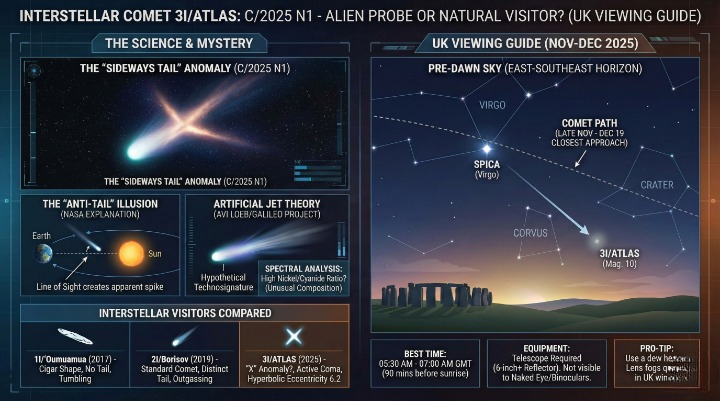
Standard comets have tails that point away from the Sun, pushed by solar wind. However, recent images show 3I/ATLAS sporting a secondary emission pointing roughly perpendicular to its path—a “sideways jet.”
Professor Avi Loeb, head of the Galileo Project, noted in his recent research notes Avi Loeb Medium/arXiv that this structure mimics the exhaust plume of a maneuverable craft. He argues that natural outgassing rarely creates such precise, symmetrical lateral jets.
NASA’s Counter-Argument: The “Anti-Tail” Illusion
NASA and the wider scientific community offer a more grounded explanation. In a press release on November 19, the NASA Science Mission Directorate attributed the “X” shape to a phenomenon called an Anti-Tail.
This is an optical illusion. As Earth crosses the orbital plane of the comet, we are looking through the “sheet” of dust trailing the comet edge-on. It creates a spike that appears to point toward the Sun (or sideways), purely due to perspective. It’s a rare alignment, but it explains the geometry without requiring alien engines.
The Chemical Puzzle
More intriguing is the spectral analysis. Early readings suggest an unusually high ratio of Nickel to Cyanide. While comets often contain metals, this specific ratio is unlike local Oort Cloud comets. Does this imply an artificial alloy, or simply that 3I/ATLAS was born in a star system with a different chemical makeup than ours? The jury is still out.
UK Viewing Guide: How to See 3I/ATLAS (Nov-Dec 2025)
You want to see it for yourself. Good news: You can. Bad news: You need to wake up very early, and it will be cold.
Visual Reality Check: Do not expect the glowing neon spaceship you see in clickbait thumbnails. Through a backyard telescope, 3I/ATLAS will appear as a faint, grey, fuzzy “cotton ball” moving slowly against the background stars.
Best Time to Look
-
Window: Late November through December 19, 2025 (Closest Approach).
-
Time: 90 minutes before sunrise. In the UK, this means you need to be set up and adapted to the dark by 05:30 AM to 07:00 AM GMT.
Where to Look (Star-Hopping Strategy)
The comet is currently moving from the constellation Virgo toward Corvus and Crater.
-
Face East-Southeast: You need a clear horizon. Buildings or trees will block the view as the comet is relatively low in the sky (about 20-30 degrees altitude).
-
Find Spica: Look for the bright blue-white star Spica in Virgo. It is the brightest object in that part of the pre-dawn sky.
-
The Drop: From Spica, scan approximately 10 degrees (one fist-width at arm’s length) down and to the right.
-
Consult a Chart: I highly recommend using the British Astronomical Association finder charts for the exact nightly coordinates, as the comet moves significantly each morning.
Equipment Needed
-
Naked Eye: No. At Magnitude 10, it is too faint.
-
Binoculars: Unlikely, unless you have giant 20x80s and a very dark sky site (Bortle 3 or lower).
-
Telescope: Yes. A 6-inch (150mm) reflector or larger is required to resolve the coma.
-
Camera: If you have a DSLR with a 200mm+ lens and a star tracker, a 60-second exposure might reveal the green hue of the coma that your eye can’t see.
Pro-Tip for UK Observers: The greatest enemy isn’t the aliens; it’s the dew. In late November, your telescope lens will fog up within 20 minutes. Wrap a hand warmer around the lens barrel with a rubber band if you don’t have a dedicated dew heater.
FAQs
Is Comet 3I/ATLAS dangerous to Earth?
No. According to the ESA Planetary Defence Office, the comet will pass about 270 million kilometers from Earth at its closest approach on December 19, 2025. That is further away than Mars. It poses zero impact risk.
Why does 3I/ATLAS have a sideways tail?
It is likely an optical illusion known as an anti-tail. As Earth passes through the plane of the comet’s orbit, we see the dust trail edge-on, making it appear as a spike pointing in a weird direction. However, some researchers like Avi Loeb are investigating if it could be a “non-gravitational” jet.
Is 3I/ATLAS an alien spaceship
Extraordinary claims require extraordinary evidence. Currently, the “alien” theory is based on anomalies (speed, shape, trajectory) that can be explained by natural physics, even if they are rare. Most astronomers believe it is a nitrogen or water-ice comet from another solar system, not a probe.
Can I see Comet 3I with the naked eye in the UK
No. The comet is roughly Magnitude 10. For context, the human eye can see down to Magnitude 6 in perfect darkness. You will need a telescope with at least a 6-inch aperture to see it.
When is the closest approach of Comet 3I/ATLAS?
The comet will be closest to Earth on December 19, 2025. This is generally the best time for viewing, as it will be at its brightest, though it will still require a telescope.
What is the difference between Oumuamua and 3I/ATLAS?
Oumuamua (2017) had no visible tail and was tumbling (spinning). 3I/ATLAS has a clear coma (gas cloud) and tails, behaving more like a “normal” comet, despite its extreme speed and origin.
Did NASA confirm 3I/ATLAS is artificial?
No. On November 19, 2025, NASA released data stating the object is consistent with an interstellar comet experiencing outgassing (ice turning to gas). They have found no radio signals or evidence of technology.
Final Thoughts
Whether Interstellar Comet 3I/ATLAS is a derelict alien buoy or a shard of ice from a dying star, its presence is a gift. It reminds us that our solar system is not a closed bubble. We live in a busy cosmic intersection, and occasionally, traffic passes through.
For those of us in the UK, the next few weeks offer a fleeting chance to witness this traveler. So, brew a strong coffee, grab your telescope, and look East. Even if it’s just a dirty snowball, it has traveled billions of years across the galaxy just to say hello.
Did you manage to capture an image of the “X” anomaly? Share your observation logs or photos in the comments below!
About the Author