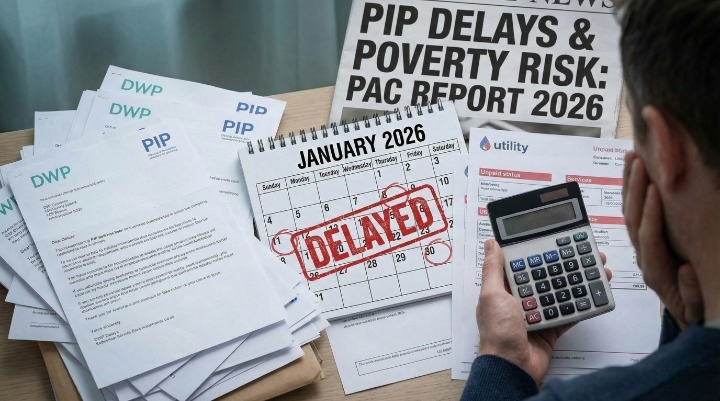
PIP Payment Delays & Poverty Risk: 2026 Crisis Update
If you are currently waiting months for a Personal Independence Payment (PIP) decision, you are not alone—and the financial strain you are feeling is not “all in your head.”
On 9 January 2026, the Public Accounts Committee (PAC) released a scathing report revealing that the Department for Work and Pensions (DWP) is failing its own processing targets by a widening margin.2 For thousands of disabled households across the UK, these administrative lags are not just an annoyance; they are a direct driver of debt and destitution.
This guide provides the latest 2026 statistics, explains the “hidden” financial penalties of PIP payment delays, and offers an expert roadmap on how to escalate your claim to avoid the poverty trap.
Why PIP Waiting Times in 2026 Have Hit a Breaking Point
The DWP has long aimed to process 75% of new PIP claims within 75 working days.3 However, the latest data confirms that this target is currently being missed on a massive scale.
The 2026 Statistics: What the DWP Isn’t Telling You
According to the January 2026 PAC report, the reality of the backlog is stark. The Committee found that service levels remain “unacceptably poor,” with processing speeds deteriorating rather than improving over the last 12 months.4
| Metric | DWP Target | Actual Performance (Jan 2026 Report) |
| Clearance Time | 75 Working Days | Only ~51% cleared within target |
| Digital Rollout | 20% of claims online by 2026 | Delayed to 2029 |
| Appeals Backlog | N/A | Quadrupled since 2021 |
Key Takeaway: If you filed your claim in late 2025, there is nearly a 50% chance your claim will exceed the 15-week target, with many complex cases now dragging on for 12 months or more.
Staffing Shortages & The Digital Rollout Delay
Why is this happening? The DWP previously promised that a new online application system would speed up processing by 2026.5 However, officials have now admitted that the full rollout of this digital platform has been pushed back to 2029.6
Simultaneously, assessment providers (Capita and IAS) are facing severe staff shortages. The result is a bottleneck where paper evidence sits in queues for weeks before a case manager even looks at it.
The Real-World Link Between Delays and Poverty Risk
The phrase “PIP payment delays poverty risk” isn’t just a headline; it is a systemic flaw. When your PIP claim is stuck in the queue, you aren’t just missing out on the weekly allowance (up to £184.30 at 2025/26 rates). You are also locked out of a network of “passported” benefits that protect disabled households from deep poverty.
The “Passported Benefits” Trap
The initial PIP delay creates a domino effect. Until you have that award letter in hand, you cannot access:
-
The Warm Home Discount: Vital for covering the higher energy costs associated with running medical equipment or keeping a home warm for mobility conditions.
-
Blue Badge: Without this, parking costs for hospital visits can skyrocket.
-
Motability Scheme: Many claimants are forced to pay for expensive taxis or private cars while waiting for the mobility component.
The Hidden Cost: Universal Credit Health Element (LCWRA)
This is the most critical financial gap that most guides overlook.
If you are on Universal Credit, receiving PIP acts as a primary evidence source for the Limited Capability for Work and Work-Related Activity (LCWRA) element.
-
The Problem: Without a PIP award, proving you are eligible for the LCWRA extra payment (worth over £416/month) becomes significantly harder.
-
The Risk: Many claimants are stuck on the “standard allowance” of Universal Credit for months, missing out on hundreds of pounds of support that—unlike PIP—is not always fully backdated.
Important Note: The Joseph Rowntree Foundation’s UK Poverty 2025 report highlighted that 30% of disabled people are now living in poverty, with the “disablement poverty gap” widening due to these precise administrative delays.7
Navigating Financial Hardship While You Wait
If the delay is pushing you into debt, you cannot afford to wait silently. The DWP has internal mechanisms to prioritize cases where the claimant is at risk, but they will not use them unless you explicitly ask.
How to Request a “Financial Hardship Marker”
You can ask the DWP to add a “complexity marker” or “hardship marker” to your file. This can sometimes fast-track your assessment or decision.
My Expert Strategy for the Call:
-
Call the PIP Enquiry Line: 0800 917 2222.
-
Use the Right Words: Do not just say you are “struggling.” You must clearly state that you are at “risk of severe financial hardship.”
-
Be Specific: Tell the agent if you are facing:
-
Eviction or rent arrears.
-
Disconnection of gas/electricity.
-
Inability to buy essential food or medication.
-
-
The Ask: “I am requesting that my claim be escalated due to financial hardship. Please confirm that a hardship marker has been added to my case file.”
Accessing Local Support: Beyond the DWP
While you wait for the DWP to act, investigate local support that doesn’t require a finalized PIP award:
-
Household Support Fund: Check your local council’s website. Many councils have discretionary funds specifically for residents with disabilities who are waiting for benefits.
-
Council Tax Support: You may be eligible for a reduction in Council Tax even before your PIP is awarded, depending on your income.
-
Crisis Grants: Charities like Turn2us offer non-repayable grants for people in financial distress.
The Timms Review & April 2026 Changes: What’s Next?
Looking ahead, the landscape for PIP is shifting. The Labour government has launched the Timms Review, led by Sir Stephen Timms, with a full report due in Autumn 2026.8 While we wait for the major reforms, two immediate changes could impact your claim starting April 2026.
1. Longer Award Durations (3–5 Years)
To reduce the administrative burden, the DWP is moving towards longer award periods.9
-
From April 2026: The standard award duration for claimants aged 25+ is expected to increase to 3 years for new claims and 5 years for re-awards.10
-
The Benefit: If you win your claim now, you likely won’t have to go through this stressful reassessment process again until 2029 or 2030.
2. The Shift to Face-to-Face Assessments
The percentage of face-to-face assessments is set to rise from roughly 6% to a target of 30%.11
-
Why this matters: Face-to-face assessments often have longer booking lead times than telephone assessments. If you are offered a face-to-face appointment, take it. trying to reschedule for a telephone slot can add another 4-6 weeks to your wait.
7 Expert FAQs for PIP Claimants in 2026
How long is the current average wait for PIP in 2026?
While the target is 16 weeks, many complex cases in high-demand areas (like the North West) are taking 20 to 26 weeks. Appeals are taking significantly longer, often up to 12 months.12
Will my PIP payments be backdated?
Yes. If your claim is successful, PIP is backdated to the date you started your claim (usually the date you made the initial phone call). This results in a lump sum payment. However, the financial damage caused by debt interest during the wait is not reimbursed.
Can I speed up my PIP claim if my health gets worse?
Yes. If your condition deteriorates significantly, or if you become terminally ill (under the Special Rules for End of Life), you must notify the DWP immediately. Special Rules claims are fast-tracked and usually decided within 2 weeks.
What if I miss the deadline to return my form due to health reasons?
Call the DWP immediately. In 2026, they are generally accepting of extension requests if you explain that your disability prevented you from completing the form on time, but you must call before the deadline passes.
Does the Jan 2026 PAC report change my rights?
The report itself doesn’t change the law, but it gives you ammunition. When speaking to your MP about delays, citing the “January 2026 Public Accounts Committee findings on unacceptable service” makes your complaint harder to ignore.
Should I involve my MP?
Absolutely. If you have waited longer than 20 weeks, write to your MP. They have a direct “hotline” to the DWP that can often unstuck a claim that has been sitting in a pile.
Is the ‘Health Transformation Programme’ affecting my claim?
It might be. If you live in one of the trial areas using the new single IT platform, your claim might be processed differently. However, the rollout is slow, and most 2026 claims are still on the legacy system.
Final Thoughts: Don’t Suffer in Silence
The PIP payment delays poverty risk is a systemic failure, not a personal one. The 2026 data clearly shows that the system is struggling to cope with demand, leaving vulnerable people in a precarious position.13
However, you have power. By understanding the delays, requesting hardship markers, and knowing exactly what “passported” support you are missing, you can take control of your financial survival while you wait.
Your Next Step:
Start a “Wait Log” today. Record every date you called the DWP, who you spoke to, and what was promised. If your delay exceeds 20 weeks, take this log to your local MP and ask them to intervene citing the PAC 2026 failures.
Disclaimer: This article provides information based on the latest 2026 reports and government guidance. It does not constitute legal advice. For specific support with your claim, please contact Citizens Advice or a qualified welfare rights advisor.
About the Author