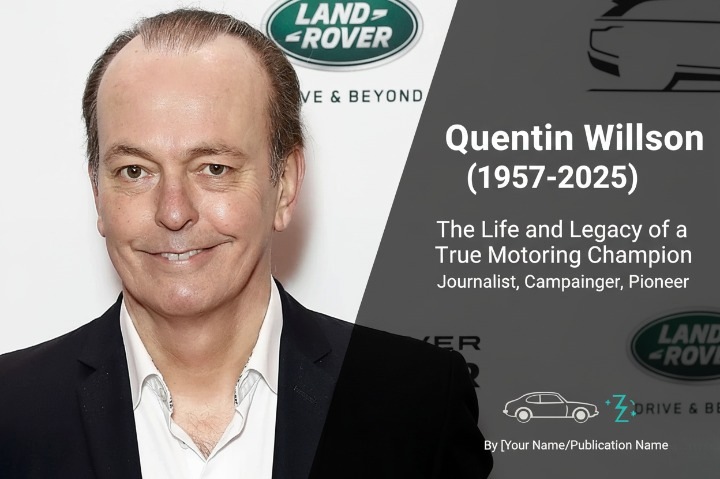
Quentin Willson (1957-2025): The Life and Legacy of a True Motoring Champion
For millions of UK motorists in the 1990s, buying a used car was a terrifying prospect. It was a world of dodgy dealers, hidden histories, and the constant fear of buying a “lemon.” But every week, one trusted, dapper voice cut through the noise on Top Gear, demystifying the process and arming consumers with invaluable advice. That voice belonged to Quentin Willson.
Following the sad news of his passing on November 8, 2025, at the age of 68 from lung cancer, tributes have poured in from colleagues and fans alike.
But beyond the headlines, what is the true legacy of the man who defined an era of motoring journalism? This article explores the three pillars of Willson’s impact: his role as the original used car buyer’s champion, his tireless campaigning for motorists, and his often-overlooked status as a true EV pioneer.
A Motoring Journalist Remembered: Tributes for Quentin Willson
Passing at 68: “A Massive Hole in the Industry”
Quentin Willson passed away peacefully after a brief battle with lung cancer, as confirmed by a family statement released via PA Media. His death was met with genuine sadness across the motoring and media worlds.
Alec Peachey of Transport + Energy, a specialist industry publication, captured the sentiment perfectly, stating Willson’s passing leaves “a massive hole in the industry.” He was widely regarded as a genuine expert and a powerful advocate for drivers.
Tributes from Jeremy Clarkson, James May, and Motoring Peers
Tributes from his former colleagues highlighted his unique position. Jeremy Clarkson shared on social media that Willson was “a lovely man” and “a great motoring journalist,” sentiments echoed by James May.
His Fifth Gear co-host, Tiff Needell, also shared his respects, reminding the public of their long shared history on screen. These tributes paint a picture of a man who was not only a respected professional but also a well-liked figure, even by those who later took Top Gear in a very different direction.
A Statement from His Family
His family’s statement described him as a “beloved husband, father, and grandfather” who passed away surrounded by his loved ones. They noted his “immense” pride in his work, which championed the rights of motorists and consumers for decades.
The Face of 1990s Top Gear: A Consumer-First Approach (1991-2001)
For an entire decade, Quentin Willson was the face of Top Gear. He joined the show in 1991, long before it became the global entertainment juggernaut it is today.
Why His Used Car Advice Was Gospel
Willson’s segments were “must-watch” television for anyone with a driving licence. He had an uncanny ability to spot a bargain, identify a lemon, and communicate complex issues—like depreciation and reliability—in a way anyone could understand. He was the nation’s trusted guide to the second-hand market.
Defining the Original Top Gear Format vs. The Clarkson Era
The original Top Gear format (1977-2001) was, at its heart, a consumer advice programme. Willson was the anchor of this philosophy.
While Jeremy Clarkson, who joined in the late 80s, was already developing his bombastic style, Willson provided the practical, sensible core. His focus was always on the driver’s wallet and safety. This consumer-first approach stands in sharp contrast to the entertainment-led “infotainment” format that would later, and famously, be rebooted by Clarkson, Hammond, and May.
From The Car’s the Star to Britain’s Worst Driver
His television career was prolific and demonstrated his range. After leaving Top Gear in 2001, he was a key presenter on Channel 5’s rival show, Fifth Gear.
His other notable credits include:
- The Car’s the Star (BBC)
- Britain’s Worst Driver (Channel 5)
- All the Right Moves
- The Classic Car Show (Channel 5)
An Expert’s View: Why Willson’s Advice Mattered
Before Willson, most motoring journalism was about 0-60 times and top speeds. He was the first to relentlessly focus on depreciation, reliability, and “checking the dipstick.” He translated opaque industry knowledge into simple, actionable steps, effectively creating the ‘consumer champion’ playbook that is still used today. He empowered the average person, and that was his true genius.
The Three Pillars of Quentin Willson’s Legacy
While many remember him for television, his most significant work was arguably off-screen. His legacy rests on three powerful pillars.
Pillar 1: The Used Car Buyer’s Champion
Willson’s primary legacy is the empowerment he gave to the average car buyer. He taught a generation to look for full-service histories, to check for panel gaps, and to understand that a car’s “total cost of ownership” was more important than its sticker price.
Pillar 2: The Relentless Campaigner (FairFuelUK & FairCharge)
In the 2010s, Willson co-founded the FairFuelUK campaign. This was a powerful lobbying group that fought against rising fuel duty.
According to his own official biography, the campaign was enormously successful, saving UK motorists a staggering £100 billion in potential tax rises. He then applied this same energy to the electric transition by founding FairCharge, a campaign dedicated to making EV ownership more affordable by lowering VAT on public charging and promoting smarter energy policies.
Pillar 3: The Unlikely EV Pioneer (Who Drove a GM EV1 in 1996)
While competitors often buried this fact, Willson was not a late convert to electric vehicles. He was a true visionary.
He was one of the very first UK journalists to drive the groundbreaking General Motors EV1, all the way back in 1996. He owned his first EV in 2009. His advocacy for EVs came from a place of deep, long-term Experience. He saw the electric future decades before it was fashionable and used his public platform to argue for a sensible, affordable transition for all.
Who Was Quentin Willson? A Life Beyond the Camera
Born in 1957, Quentin Willson’s life was always connected to the automotive world, though his path to journalism wasn’t immediate.
Early Life and Start in Journalism
He spent his early career in the motor trade, managing car dealerships. This gave him the “front-line” Experience that made his advice so practical and credible. He understood the business from the inside. He eventually made the leap to journalism, writing for numerous papers and magazines before his Top Gear debut.
A Respected Classic Car Expert
Beyond his consumer advice, Willson was a deeply respected classic car expert. He had an encyclopedic knowledge of vintage models and was a familiar face at major concours and classic car events. He hosted The Classic Car Show and was an eloquent authority on the subject.
Family and Personal Life
Quentin Willson was a private man outside of his public-facing work. He was married and a father of three. His family’s statement made clear that he was, above all, a beloved family man.
FAQs
What happened to Quentin Willson?
Quentin Willson passed away on November 8, 2025, at the age of 68.
What was Quentin Willson’s cause of death?
His family confirmed that he died peacefully after a short illness with lung cancer.
When was Quentin Willson on Top Gear?
He was a main presenter on the original Top Gear for a decade, from 1991 until 2001.
Why did Quentin Willson leave Top Gear?
Willson left Top Gear in 2001. The BBC briefly cancelled the show before relaunching it in 2002 with the new entertainment-focused format led by Jeremy Clarkson. Willson and others from the original team, including Tiff Needell, moved to Channel 5 to create Fifth Gear.
Who hosted Top Gear in the 1990s?
The main presenters during the 1990s included Quentin Willson, Jeremy Clarkson (until 1999), and Tiff Needell.
What is the FairCharge campaign?
FairCharge is a campaign founded by Quentin Willson to make electric vehicle ownership more affordable for everyone. Its main goals include lowering the 20% VAT on public charging to match the 5% VAT on home charging.
Did Quentin Willson and Jeremy Clarkson get along?
Yes. While they represented very different styles of motoring journalism (consumer advice vs. entertainment), Clarkson shared a warm tribute, calling Willson “a lovely man” and “a great motoring journalist.”
What other TV shows was Quentin Willson known for?
He was best known for Top Gear and Fifth Gear, but also hosted The Car’s the Star, Britain’s Worst Driver, and The Classic Car Show.
More Than a Presenter
Quentin Willson was far more than just a Top Gear presenter. He was a practical guide for millions of used car buyers, a fierce campaigner who saved UK motorists billions at the pump, and a quiet visionary who saw the electric future decades before it was fashionable.
His true legacy is the empowerment he gave to the average person. He proved that motoring journalism could be more than just entertainment; it could be an essential public service.
What are your favourite memories of Quentin Willson’s work? Share your tributes and thoughts in the comments below.
About the Author