How to Register as Self-Employed in the UK for Students (2026 Guide)
Did you know that earning just £1,001 from a side hustle, whether it’s selling on Etsy, private tutoring, or freelance coding, officially makes you a ‘Business Owner’ in the eyes of HMRC?
With the UK government’s recent push toward digital tracking, keeping your side income “under the radar” is no longer a viable strategy. In 2026, the data sharing between digital platforms and tax authorities is seamless. However, registering as self-employed doesn’t have to be a source of stress. In fact, for most students, it’s the best way to protect your earnings and ensure you aren’t hit with unexpected fines later.
This guide walks you through the 2025/26 and 2026/27 tax year rules, how to claim your allowances, and, most importantly,how to avoid the “Visa Trap” that catches thousands of international students every year.
The £1,000 Threshold: Do You Actually Need to Register?
The first question every student asks is: “Do I really have to tell the tax man about my small side hustle?”
The answer depends on your gross income (your total earnings before you take away any costs).
Understanding the Trading Allowance
HMRC provides a £1,000 Trading Allowance every tax year. If your total self-employed income is £1,000 or less between 6 April and 5 April, you enjoy “Full Relief.” You don’t need to report this income or register with HMRC. It is essentially invisible.
However, once your gross income hits £1,001, you must register as a sole trader.
| Total Annual Earnings | Requirement |
| £0 – £1,000 | No action required. You are covered by the Trading Allowance. |
| £1,001+ | Must register for Self Assessment and get a UTR number. |
Pro-Tip: If your expenses (like materials for Etsy or software) are higher than £1,000, you might choose to ignore the Trading Allowance and claim “Actual Expenses” instead. This allows you to report a loss, which can sometimes be used to reduce tax on future earnings.
[URGENT] Are You an International Student? Read This First
If you are in the UK on a Student Visa (formerly Tier 4), this section is more important than your tax bill.
Most Student Visas contain a strict condition: No Self-Employment. While you are usually allowed to work up to 20 hours per week as an employee for a company, you are legally prohibited from being a “sole trader,” “freelancer,” or starting a business.
According to the official UKCISA guidance, engaging in self-employment while on a Student Visa is a breach of your visa conditions. This can lead to your visa being cancelled and a potential ban from the UK. If you are an international student, do not register as self-employed until you have switched to a Graduate Visa or another route that permits business activity.
How to Register for Self-Assessment: Step-by-Step (2026)
If you’ve crossed the £1,000 mark and are a UK/EU student with the right to work, follow these steps to stay compliant.
Step 1: Create your GOV.UK One Login
In 2026, the old Government Gateway is being fully replaced by the GOV.UK One Login. You’ll need a valid email address and a way to verify your identity (usually a UK passport or driving licence).
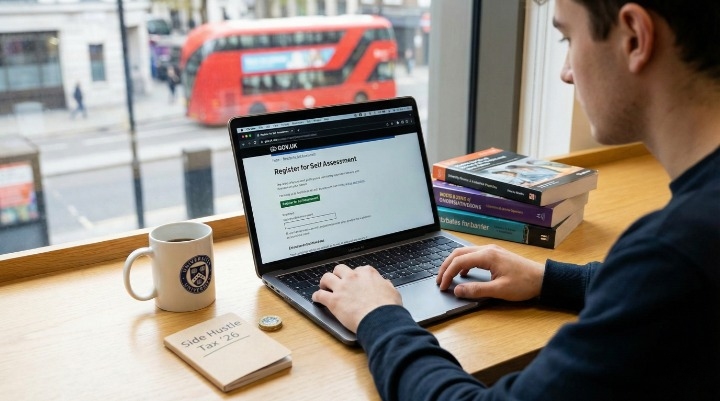
Step 2: Register for Self-Assessment
Once logged in, search for “Register for Self Assessment.” You will need to provide:
-
Your National Insurance (NI) number.
-
The date you started your business.
-
A brief description of what you do (e.g., “Freelance Graphic Design”).
Step 3: Receive your UTR Number
After submitting the form, HMRC will mail a 10-digit Unique Taxpayer Reference (UTR) to your term-time or home address. Keep this safe. You cannot file a tax return or pay tax without it. It usually arrives within 10 working days.
Student Tax Allowances & National Insurance (2025/26)
The good news? Most students pay £0 in tax because of the generous UK allowances.
-
Personal Allowance: You don’t pay any Income Tax on the first £12,570 you earn in a tax year. This includes your self-employed profits AND any wages from a part-time job combined.
-
National Insurance (NI): For the 2025/26 tax year, the rules have changed.
-
Class 2 NI is no longer a mandatory weekly fee for most.
-
Class 4 NI is only paid if your profits exceed £12,570. If you earn between £6,845 and £12,570, you are “treated as having paid” NI, which protects your state pension record without you spending a penny.
-
What “Allowable Expenses” Can Students Claim?
You only pay tax on your profit, not your turnover. To lower your tax bill, you can subtract “allowable expenses” from your income.
-
Tutoring: Textbooks, stationery, and travel to a student’s house.
-
Etsy Sellers: Raw materials, packaging, and postage fees.
-
Freelancers: Subscription software (Adobe, Canva), a portion of your internet bill, and website hosting.
Experience Note: A common mistake is trying to claim for your “Uni Laptop.” HMRC only allows you to claim for equipment used exclusively for business. If you use the same laptop for your 3,000-word history essay, you can only claim a percentage of the cost based on business vs. personal use.
The Student Loan Repayment Trap
This is the “silent tax” that catches many student entrepreneurs. If you are on a Plan 2 or the new Plan 5 student loan, your repayments are calculated based on your total income.
HMRC combines your self-employed profits with your part-time job wages. If the total is above the threshold (currently around £27,295 for Plan 2 or £25,000 for Plan 5), you will have to pay 9% of the amount over that limit toward your loan. This is often calculated and paid as part of your annual Self-Assessment tax return.
Deadlines & Penalties to Circle in Your Calendar
HMRC is strict with dates. Missing a deadline results in an automatic £100 fine, even if you owe £0 in tax.
-
5 October 2026: Deadline to register as self-employed if you started trading in the 2025/26 tax year.
-
31 October 2026: Deadline for paper tax returns (not recommended).
-
31 January 2027: Deadline to file your online return and pay any tax owed.
Making Tax Digital (MTD) 2026: Does it Affect You?
From April 2026, HMRC is introducing “Making Tax Digital” for Income Tax.
-
If your self-employed turnover is over £50,000, you must use compatible software and send quarterly updates.
-
For most students earning a few thousand pounds, you do not need to worry about MTD yet. You can continue using the standard once-a-year online return.
FAQs
Can I be self-employed and have a part-time job?
Yes. HMRC will add both incomes together. Your £12,570 Personal Allowance applies to the total.
How does HMRC find out about my side hustle?
Since January 2024, platforms like Vinted, eBay, and Etsy are required to share seller data directly with HMRC if you exceed certain sales volumes.
Do I need a separate business bank account?
Legally, no (as a sole trader). Practically, yes. It makes tracking your “Allowable Expenses” 100x easier when they aren’t mixed with your Friday night pizza orders.
Final Thoughts
Registering as self-employed is a rite of passage for the modern student entrepreneur. It validates your business and keeps you on the right side of the law. Start by keeping a simple spreadsheet of every pound coming in and every receipt going out. If you stay organised, the 31st of January will just be another day, not a deadline to fear.
About the Author