How to Register With a GP Without Proof of Address (UK 2025 Guide)
Being asked for a utility bill you don’t have when you just need to see a doctor can feel like an impossible barrier. You may be stressed, ‘sofa surfing,’ or in a situation with no fixed address and worried about being refused care.
This is a common problem, but the rules are on your side.
This guide will walk you through your exact rights, the step-by-step registration process, and the exact words to use to get registered and access healthcare.
Your Rights: Can a GP Refuse to Register You Without Proof of Address?
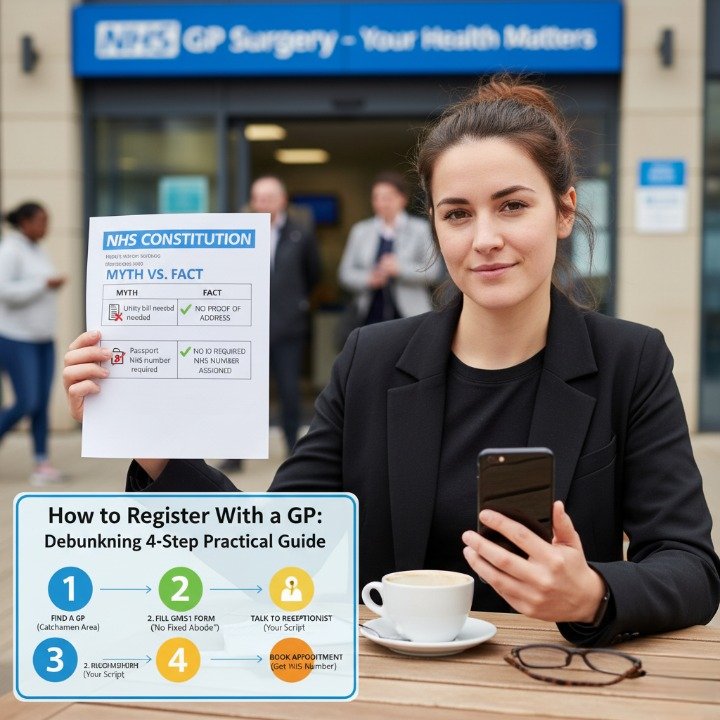
Let’s clear this up immediately. No. According to official NHS.uk guidance, a GP surgery cannot refuse to register you because you do not have proof of address.
This is a common misunderstanding, sometimes even by practice staff, but the national policy is clear. You also do not need to provide proof of ID (like a passport or driver’s license) or proof of your immigration status.
Your right to access primary care is based on you being in the UK, not on your housing situation. This right is outlined in the NHS Constitution, which states that the NHS is available to all “ordinary residents.”
Despite these clear rules, many people are turned away due to outdated training or misinformation. Knowing the facts is the best way to ensure you get the care you need.
The “Myth vs. Fact” Table: Debunking Registration Barriers
To help you feel confident, let’s debunk the most common myths a receptionist might tell you.
| Myth | Fact (Based on Official NHS & Healthwatch Guidelines) |
| “You need a utility bill or tenancy agreement.” | False. This is the biggest myth. You do not need any proof of address to register with a GP. |
| “You need a passport or driver’s license.” | False. You do not need to provide proof of ID. It can be helpful if you have it (as it helps find your NHS number), but it is not a requirement. |
| “You need an NHS number to register.” | False. You will be assigned a new NHS number if you don’t have one or if your old one can’t be found. You get the number after you register. |
| “You can’t register if you are an asylum seeker.” | False. Your immigration status does not affect your right to register with a GP. |
| “You can’t register if you have ‘no fixed abode’.” | False. Your housing situation does not matter. You can register even if you are homeless or staying with friends temporarily. |
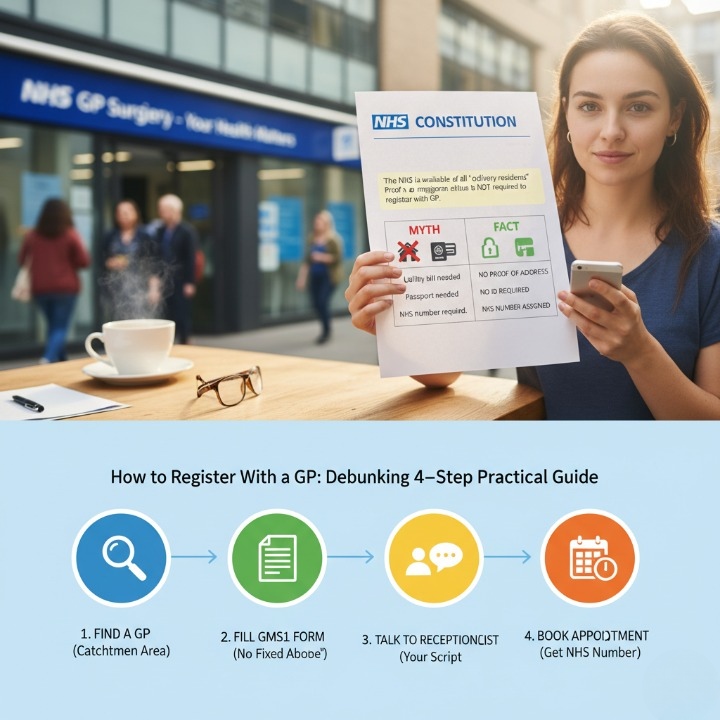
How to Register With a GP: A 4-Step Practical Guide
Knowing your rights is the first step. Now, here is the practical process for getting registered.
Step 1: Find a GP Surgery in Your Practice Catchment Area
A GP surgery has a defined “practice catchment area,” which is the local geographic area it serves. You need to register with a surgery that covers the area where you are currently staying.
This is the only “address” check they can really do. You don’t need to prove you’re in the area with a bill, but you do need to be in the area.
-
Use the official NHS “Find a GP” service.
-
Enter the postcode of where you are staying (even if it’s a shelter, hostel, or friend’s sofa).
-
The tool will show you a list of local surgeries. Choose one and go to their website or call them.
Advocate’s Pro-Tip: Some surgeries now have digital GP registration on their websites. This can be an easier way to register as it avoids a face-to-face conversation where you might be incorrectly refused. If this option is available, use it.
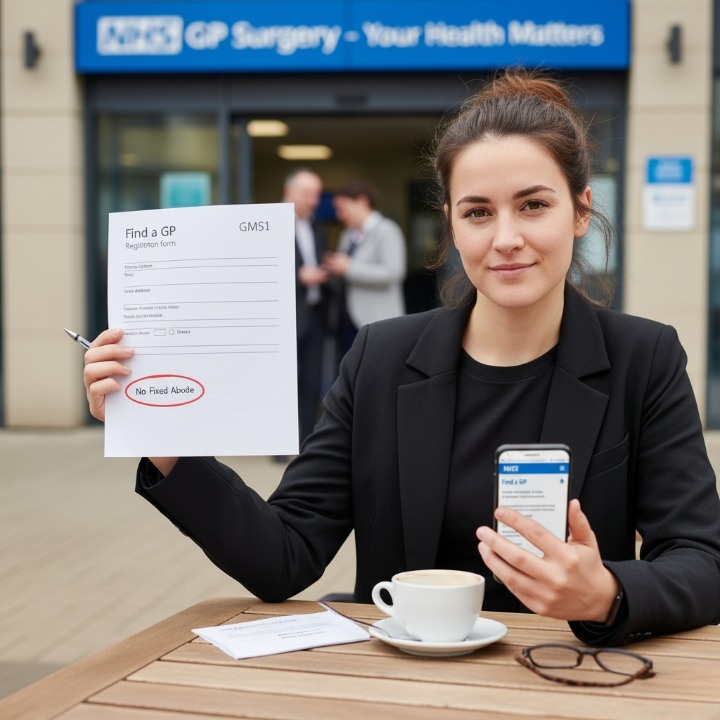
Step 2: How to Fill in the GMS1 Form With “No Fixed Abode”
The standard registration form is called a GMS1 form (or “Family Doctor Services Registration Form”). You can get this from the surgery’s reception or often download it from their website.
This form is where people get stuck. Here is how to handle the “Address” section if you have no fixed address.
-
Your Name, DOB, etc.: Fill these in as normal.
-
“Help us trace your previous medical records”: If you have an NHS number, great. If not, leave it blank. If you know the address of your last GP, add it.
-
“Home Address” Section: This is the critical part. You have options:
-
Use a temporary address: If you are staying with a friend, family member, or at a shelter or hostel, you can use this address.
-
Use ‘No Fixed Abode’: You can, in fact, write ‘No Fixed Abode’ in the address field.
-
Use the surgery’s address: This is a common and perfectly acceptable solution. You can write “c/o [GP Surgery’s Name and Address]” in the address field. This tells the system that you are in the area and that any correspondence should be held for you at the practice.
-
Step 3: What to Say to the GP Receptionist (Your Script)
This is often the most stressful part. You are prepared, you have your form, and you know your rights. If you hand over the form and are immediately asked for a utility bill, don’t panic.
Remain calm and polite. Use this script:
What to say if asked for proof of address:
“I would like to register, please. I don’t have a fixed address or proof of address with me, but I understand from the official NHS guidelines that I can still register.
Could you please help me? I am happy to use a temporary address or the surgery’s address on the GMS1 form so I can get registered.”
This approach does three things: it shows you know the rules, it’s non-confrontational, and it offers a solution (using the surgery’s address), which makes the receptionist’s job easier.
Step 4: What Happens Next? (Getting Your NHS Number & Booking)
Once the surgery accepts your form, what happens next?
-
Registration: The practice will process your GMS1 form. This can take anywhere from 24 hours to a few days.
-
NHS Number: Once you are registered, the system will either find your existing NHS number or generate a new one for you. This number is yours for life. The practice will be able to give you this number.
-
Booking: As soon as you are registered, you can book an appointment. You are now a patient of that practice.
You don’t need to wait for a “registration card” (which most surgeries no longer use) to book an appointment. You can usually call the next day to confirm you are on the system.
What to Do If a GP Surgery Refuses to Register You
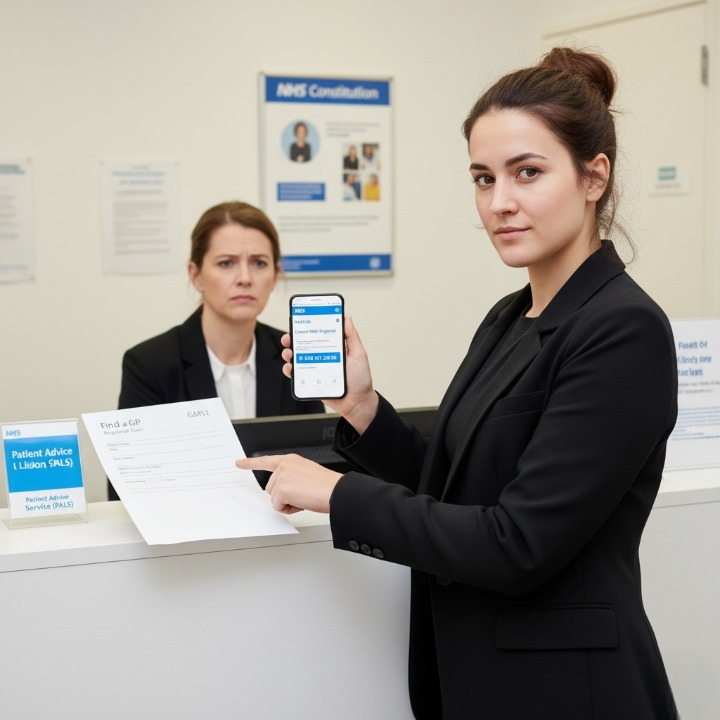
What if you do all this, and the receptionist still says “no”? This is where you must stand firm, politely. You are not just being “difficult”; you are advocating for your right to healthcare.
The Most Common Barrier: Outdated Reception Training
Remember: often, a GP receptionist isn’t trying to be difficult; they may just be following outdated training. They might have been told “we must get a utility bill” years ago, and no one has updated them on the correct national policy.
Your goal is not to win an argument but to politely help them find the correct information.
Your 3-Step Action Plan for a Refusal
If you are refused, take these steps in order.
- Stay Calm & Ask for the Practice Manager:Do not raise your voice. Politely say: “I understand that’s what you believe the rule is, but I have checked the official NHS guidance which states I don’t need proof of address. Could I please speak to the Practice Manager?” The Practice Manager is responsible for the surgery’s policies and is almost always aware of the correct NHS registration rules.
- Ask for the Reason in Writing:If the Practice Manager is not available or also refuses, you make this formal request: “The NHS requires you to provide a reason for refusal in writing within 14 days. Could you please do that for me?” This single question often solves the problem, as they know they cannot legally write “refused due to no proof of address.”
- Contact the NHS England Customer Contact Centre:If they still refuse, it’s time to escalate. You should call the NHS England Customer Contact Centre.
- Phone: 0300 311 22 33Tell them, “I am trying to register with a GP without proof of address, and [Surgery Name] is refusing me.” They will advocate on your behalf.
Who Else Can Help? (PALS & Healthwatch)
You are not alone in this. Two other groups can help:
-
PALS (Patient Advice and Liaison Service): Almost every NHS trust has a PALS team. They are there to help solve problems with NHS services. You can find your local PALS by searching the NHS website.
-
[Healthwatch]: This is the independent patient champion for health services in England. Your local Healthwatch can give you advice and step in to help you if you are being unfairly denied registration.
Registering for Specific Groups & Circumstances
The “no proof of address” rule applies to everyone, but some groups face unique challenges.
Registering if You Are an Asylum Seeker or Refugee
You have the right to register with a GP. Your immigration status is not a barrier. You do not need to provide proof of status or an ID. If you are in accommodation (like a hotel or centre), you can use that address on your GMS1 form.
Registering for the Traveller Community
Members of the Traveller community can register with a GP even if they are only in an area for a short time. You can register as a “temporary resident” or as a full patient using a temporary address or the “no fixed abode” option.
Registering as a “Temporary Resident”
What if you are just staying in an area for a short time (e.g., sofa surfing at a friend’s for a few weeks)?
-
If you plan to be in the area for less than 3 months: You can register as a “temporary resident.” This allows you to get care from that GP practice without leaving your “permanent” GP (if you have one).
-
If you plan to be in the area for more than 3 months: You should register as a permanent patient.
For those with no fixed address, it is almost always better to register as a permanent patient. This ensures you are fully on their list and can access all their services, like referrals and chronic condition management.
FAQs (About GP Registration)
Can a GP surgery refuse to register me if I don’t have proof of address?
No. They cannot refuse you on these grounds. They can only refuse if their patient list is full or you live outside their catchment area, and they must give you this reason in writing.
What can I use as proof of address if I don’t have bills?
You don’t need proof of address. If you are ‘sofa surfing’ or in a hostel, you can use that address. If you have no address at all, you can ask to use the surgery’s address on the form.
Can I register with a GP if I am homeless?
Yes. You have the same right to register as anyone else. You can use the address of a day centre, shelter, or the GP practice itself.
Do I need an NHS number to register with a new GP?
No. Having one makes the process faster as they can find your records, but it is not a requirement. You will be assigned one if you don’t have one.
What documents do I actually need to register with a GP in the UK?
Officially, you do not need any documents. You just need to fill out the GMS1 form. Having ID or an NHS number can make it easier, but a surgery cannot refuse you if you don’t have them.
What do I do if a GP receptionist won’t register me?
Politely ask to speak to the Practice Manager. If they also refuse, ask for the refusal reason in writing (which they must provide) and contact the NHS England Customer Contact Centre or your local Healthwatch.
Can I use a temporary address to register with a GP?
Yes. You can register using a temporary address, such as a friend’s house, hostel, or shelter.
How do I get an NHS number if I have no fixed address?
You get an NHS number automatically after you register with a GP. The act of registering is what generates the number for you.
You Have a Right to Healthcare
Registering with a GP without a fixed address is your right. You do not need ID, an NHS number, or a utility bill.
The key is to know that the GMS1 form is all you need. You can use a temporary address, a friend’s address, or even the surgery’s own address. If you are unfairly refused, know that you can ask for the Practice Manager and escalate your case to NHS England.
Accessing healthcare is the first and most important step to looking after yourself. Knowing your rights is not about confrontation; it’s about confidently and calmly getting the care you are entitled to.
Take the first step today. Use the official NHS tool to find a GP surgery in your area.
About the Author