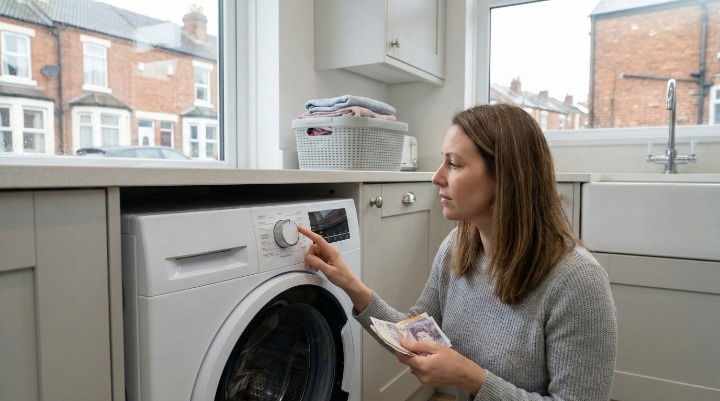
UK Washing Machine Guide 2026: Save £100 & Buy Better
Buying a washing machine used to be simple. You picked a brand you recognised, checked the price tag, and arranged delivery. Today, the landscape has changed. With new energy regulations, washing machine brands to avoid, and complex features like “AI-wash,” the process can feel overwhelming.
In 2026, 96% of UK households own a washing machine. Yet, data from the Energy Saving Trust suggests nearly one in three households are unknowingly overpaying on electricity and water bills due to inefficient appliances or poor usage habits.
This washing machine guide UK cuts through the noise. We will navigate the 2026 A-G energy ratings, explain why drum size matters more than you think, and reveal the maintenance secrets that can double your machine’s lifespan. Whether you need a budget-friendly Logik washing machine or a high-end Siemens washing machine, this guide ensures you buy better.
Decoding the 2026 UK Energy Ratings: A to G Explained
In March 2021, the UK government overhauled the energy rating system, abolishing the confusing “A+++” labels. If you are shopping for a Bosch Series 6 washing machine or a similar model today, you will see a simple scale from A to G.
Why ‘A’ is the New Gold Standard
Under the old system, almost every new machine was A+ or better, making comparisons impossible. The new regulations, enforced by the Office for Product Safety and Standards, reset the bar.
- Grade A: The pinnacle of efficiency. These machines use significantly less water and electricity per cycle.
- Grade D-E: Standard efficiency. These are often cheaper upfront but cost more to run over time.
- Grade F-G: The least efficient models.
According to 2025 data from the Energy Saving Trust, choosing an A-rated model over a D-rated one saves the average UK household approximately £100 over the appliance’s 11-year lifespan.
The Hidden Cost of ‘D’ Rated Machines
Many budget brands, like a standard Bush washing machine, might carry a lower energy rating. While the initial price is attractive, the running costs add up.
| Energy Rating | Approx. Cost Per Cycle (2026) | 11-Year Energy Cost |
| A | £0.22 | £530 |
| C | £0.26 | £630 |
| E | £0.30 | £726 |
| G | £0.35 | £847 |
Source: Estimates based on average UK kWh prices (2025/26).
Pro-Tip: Always scan the QR code on the energy label. This takes you to the official product database (EPREL), showing you exactly how much water the machine uses per “Eco 40-60” cycle.
Ho to Choose the Right Drum Capacity
Size is the second most critical factor. British homes are notoriously compact, so getting the balance between physical dimensions and wash capacity is vital.
7kg to 12kg: Which Size for Your Household?
A common mistake is assuming a bigger drum is always better. A large washing machine (10kg+) is excellent for duvets, but if you run it half-empty, you are wasting resources.
- 6-7kg: Ideal for individuals or couples.
- 8.0 kg washing machine: The UK “sweet spot.” Perfect for a family of 3-4. It handles everyday loads efficiently without consuming excess water.
- 9kg+: Best for large families (5+ people) or those who wash king-size duvets regularly.
My Experience: I often see homeowners buy a 12kg machine and then struggle to fill it. To check if you are overloading or underloading, use the “Hand Span Rule.” You should be able to fit a hand’s width between the top of your laundry and the top of the drum. If you can’t, it’s overloaded. If there is a massive gap, you are wasting energy.
Integrated vs. Freestanding
Standard dimensions differ. A freestanding machine is typically 85cm tall and 60cm wide. If you are fitting a machine into a kitchen unit, remember that integrated models are slightly shorter (usually 82cm) to allow for the worktop.
Always measure your doorway before ordering. It sounds obvious, but delivery drivers return thousands of units annually simply because they won’t fit through the kitchen door.
Advanced Features: Is Smart Tech Worth the Premium?
Manufacturers love jargon. From Hoover Dynamic Next washing machine “One Touch” tech to Samsung’s “Ecobubble,” it is hard to know what is useful and what is a gimmick.
Auto-Dosing (i-DOS / TwinDos)
This is a feature worth paying for. Systems like Bosch’s i-DOS or Miele’s TwinDos automatically dispense the exact amount of detergent needed based on the weight of your laundry.
Why does this matter?
Most UK residents use too much detergent. This leads to excess foam, which forces the machine to run extra rinse cycles, wasting water and electricity. Auto-dosing eliminates this error.
AI Sensors: Performance vs. Marketing
Smart sensors detect fabric type and soil level. A 2025 industry report suggests these sensors can reduce cycle times by 15%. However, if you are on a budget, a Grundig washing machine with standard sensor drying (which stops when clothes are dry) offers 90% of the benefit for a fraction of the price.
Essential Maintenance: Dealing with UK Hard Water
Maintenance is where most users fail. If you live in London or the South East, hard water is your machine’s silent killer. Limescale builds up on the heating element, forcing the machine to work harder and eventually causing burnout.
The Monthly ‘Service Wash’ Strategy
You don’t need a technician for this.
- Empty the drum.
- Add a cup of soda crystals or a dedicated machine cleaner.
- Run the hottest cycle available (usually 90°C).
This kills bacteria and dissolves limescale. If you spot black mould on the rubber door seal, scrub it with a white vinegar solution.
Where Do I Put Fabric Conditioner in the Washing Machine?
This is a frequent question. Open your drawer:
- Compartment I: Pre-wash detergent (rarely used).
- Compartment II: Main wash detergent (powder or liquid).
- Flower/Star Symbol: Fabric conditioner.
Caution: Never fill above the “Max” line. If you do, the conditioner drains immediately into the drum before the rinse cycle, leaving greasy marks on your clothes.
Consult Your User Manual
Every machine has quirks. An Indesit washing machine user manual will tell you specifically how to clean the pump filter on your model, which is essential if the machine stops draining.
installation & Moving Guide
Whether you are moving house or replacing an old unit, handling the plumbing correctly prevents leaks and floods.
How to Disconnect a Washing Machine
- Power Down: Switch off the socket and unplug the machine.
- Water Supply: Locate the blue valve on the pipe behind the machine. Turn it clockwise to shut off the cold water supply.
- Drain Hose: Carefully pull the grey drain hose out of the standpipe. Have a bucket ready, water will spill out.
- Inlet Pipe: Unscrew the blue water inlet pipe from the tap.
- Transit Bolts: Crucial Step. If you are moving the machine, you must reinsert the transit bolts (the long screws that came with the machine) into the back. These lock the drum in place. Moving a machine without them can destroy the suspension.
If you are unsure how to disconnect a washer machine safely, paying for a professional disconnection service (usually around £20-£30) is cheaper than repairing a flooded kitchen.
Your UK Consumer Rights & Warranties
Before you buy, you must understand your legal protection.
The Consumer Rights Act 2015
Retailers often push expensive extended warranties. However, under the UK Consumer Rights Act 2015, goods must be of “satisfactory quality, fit for purpose, and as described.”
- 0-30 Days: You have an automatic right to reject a faulty machine for a full refund.
- 0-6 Months: If a fault develops, the law assumes it was there at the time of purchase. The retailer (not the manufacturer) must repair or replace it. You do not need to prove anything.
- After 6 Months: The burden of proof shifts to you.
Washing Machine Brands to Avoid
Reliability surveys from consumer groups often flag brands with poor long-term electronics or difficult-to-source spare parts. Generally, generic “white label” brands found on marketplace sites often lack the UK-based support network of established players like Beko, Bosch, or Samsung. Always check for a UK service centre address before buying.
Best Washing Machines UK 2026: Top Recommendations
Based on current specs, energy ratings, and reliability.
Best for Reliability: Bosch Series 6
A solid mid-range choice. It features the 1600 spin washing machine speed, which removes more water, reducing drying time. The EcoSilence drive is perfect for open-plan living.
Best Budget Option: Logik or Bush
A Logik washing machine is a staple of UK student accommodation and starter homes. While they lack advanced AI features, they offer reliable cleaning for a low price. Similarly, a Bush washing machine offers decent drum sizes (often 7-8kg) for under £250.
Best Premium: Siemens / Miele
If budget allows, a Siemens washing machine offers superior build quality and usually comes with a longer manufacturer warranty (often 5 years).
Conclusion
Buying the right washing machine in 2026 isn’t just about getting stains out of shirts. It is about balancing the upfront cost with the 11-year running cost.
By choosing an A-rated model, matching the drum size to your actual usage (remember the 8.0 kg washing machine sweet spot), and performing a monthly service wash, you protect your investment.
Your Next Step: Go measure the space where your machine will live. Then, check the water hardness in your area. These two small actions will decide whether your new machine lasts five years or fifteen.
FAQs
What is the best washing machine brand UK 2026?
Bosch and Miele consistently top reliability surveys from Which? and other consumer bodies. Beko is highly rated for budget reliability.
How to use a washing machine properly to save energy?
Stick to the “Eco 40-60” cycle. It is designed to be the most efficient wash for standard mixed cottons and synthetics. Wash at 30°C for lightly soiled clothes to save 40% on electricity.
How do I disconnect a washing machine if the valve is stuck?
Do not force it. Spray a little WD-40 on the valve handle and wait. If it won’t budge, turn off your home’s main stopcock before attempting to unscrew the hose.
Why is my washing machine vibrating violently?
It is likely unlevel. Use a spirit level and adjust the feet at the bottom. Alternatively, if it’s new, check you removed the transit bolts.
Is a 1600 spin washing machine better than a 1400 spin?
Yes, slightly. It extracts more water, meaning your clothes dry faster. However, it can be noisier and creasing may be worse on delicate items.
Can I repair a machine myself?
For simple tasks like cleaning the filter or unblocking a hose, yes. Consult your Indesit washing machine user manual (or relevant brand guide). for electrical faults, always hire a pro to avoid voiding your warranty.
About the Author







i promise Dr.Wealthy if my husband come back i will share testimony about him
My name is Davena, I’m from California in the USA. I want to use this opportunity to thank my great doctor who really made my life a pleasurable one today. This great man Dr.Wealthy brought my husband back to me, i had three lovely kids for my husband, about four years ago my husband and I had been into one quarrel or the other until he finally left me for one lady. I felt my life was over and my kids thought they would never see their father again. I tried to be strong just for the kids but I could not control the pains that tormented my heart, my heart was filled with sorrows and pains because I was really in love with my husband. Every day and night i think of him and always wish he would come back to me, until one day i met a good friend of mine that was also in a situation like me but her problem was her ex-boyfriend who she had an unwanted pregnancy for and he refused to take responsibility and dumped her. she told me that mine was a small case and that i should not worry about it at all, so i asked her what was the solution to my problems and she gave me this great man email address. i was doubting if this man was the solution, so i contacted this great man and he told me what to do and i did them all, he told me to wait for just two day and that my husband will come crawling on his kneels just for forgiveness so i faithfully did what this great man asked me to do and for sure after two days i heard a knock on the door, in a great surprise i saw him on his kneels and i was speechless, when he saw me, all he did was crying and asking me for forgiveness, from that day, all the pains and sorrows in my heart flew away, since then i and my husband and our lovely kids are happy. that’s why i want to say a big thank you to Dr.Wealthy. This great man made me understand that there is no problem on earth that has no solution so please if you know that you have this same problem or any problem that is similar, i will advise you to come straight to this great man. you can email him at:wealthylovespell@gmail.com