UK Home Ownership Rules 2025: Stamp Duty, Leasehold, and Renters’ Rights Explained
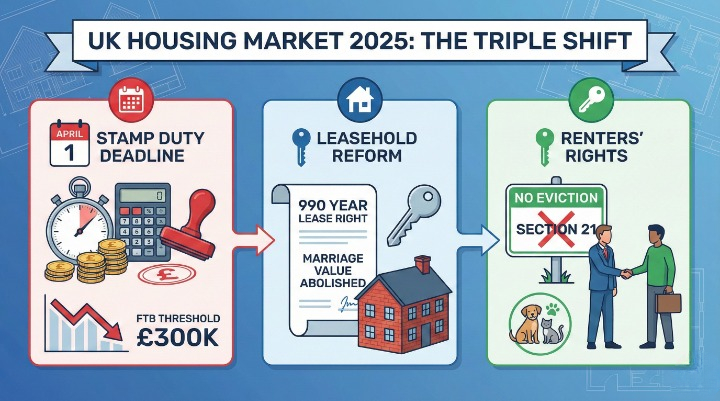
If you plan to move home in 2025, the goalposts are about to move. The UK property market is facing a “triple threat” of legislative shifts: a tax hike deadline, a leasehold revolution, and the biggest shake-up to renting in a generation.
For many buyers and sellers, the upcoming changes aren’t just small print, they are financial cliff edges. The most urgent pressure comes from the April 1st deadline, where the cost of buying a home could jump by thousands of pounds overnight. But beyond taxes, new laws are reshaping what it means to own a leasehold flat or be a landlord.
This guide filters out the noise. We won’t just tell you what the UK home ownership rules 2025 are; we will give you the timeline and strategy you need to protect your money before the laws change.
The Stamp Duty “Cliff-Edge”: Changes Coming April 2025
The temporary Stamp Duty Land Tax (SDLT) relief introduced in 2022 is ending. On April 1, 2025, the tax thresholds will revert to their previous, less generous levels.
This isn’t speculation. The government has confirmed that the “sunset clause” on these cuts will trigger as planned. If you are in the middle of buying a property, the completion date is everything. It doesn’t matter when you exchanged contracts; if you complete on April 2nd, you pay the higher rate.
The End of Temporary Relief Explained
Currently, you pay no Stamp Duty on the first £250,000 of a property’s value. From April 1st, this tax-free “nil-rate” band drops back down to £125,000.
This change affects almost everyone moving up the ladder. A standard home mover purchasing a property for roughly the UK average price will see their tax bill rise immediately.
Impact on First-Time Buyers (FTB)
First-time buyers are hit hardest by these UK home ownership rules 2025.
-
Current Rule: You pay £0 tax on properties up to £425,000.
-
From April 1, 2025: You pay £0 tax only on properties up to £300,000.
If you are buying a starter home in London or the South East, where prices often sit between £300k and £425k, you are effectively losing a £6,250 discount.
The “Cost of Delay” Calculator: Why March 31st Matters
To show you exactly what is at stake, we’ve calculated the difference. This table illustrates the cash loss if your completion slips from March to May.
Table: The Cost of Missing the Deadline
| Buyer Type | Property Price | Tax Due (Before April 1) | Tax Due (From April 1) | Extra Cost |
| Home Mover | £250,000 | £0 | £2,500 | £2,500 |
| Home Mover | £450,000 | £10,000 | £12,500 | £2,500 |
| First-Time Buyer | £350,000 | £0 | £2,500 | £2,500 |
| First-Time Buyer | £425,000 | £0 | £6,250 | £6,250 |
Note: These calculations are based on standard residential rates sourced from the GOV.UK SDLT Manual. They do not include the 3% surcharge for additional properties.
If you are a first-time buyer targeting a £425k flat, missing the deadline costs you over £6,000. That is money that could have furnished your new living room.
Leasehold and Freehold Reform Act: The 2025 Rollout
While buyers worry about tax, leaseholders are watching the Leasehold and Freehold Reform Act 2024. Although passed into law, many provisions are set to commence in 2025. These changes are designed to make ownership fairer and more secure.
The 990-Year Lease Extension Right
Historically, extending a lease was a headache. You effectively had to pay to add 90 years to your term. Under the new rules, you will have the statutory right to extend your lease by 990 years at a “peppercorn” (zero) ground rent.
This effectively makes leasehold ownership “as good as freehold” for most people. You won’t need to worry about the clock ticking down ever again.
Abolishing Marriage Value
This is the biggest financial win for leaseholders.
Under the old system, if your lease dropped below 80 years, extending it became massively expensive because of “Marriage Value”—a calculation that splits the potential profit of the extension between you and the freeholder.
The new Act abolishes Marriage Value. If you have a “short lease” (e.g., 70-75 years), the cost to extend it is about to drop significantly.
Pro Tip: If your lease is currently hovering around 81 or 82 years, act now. Do not let it drop below 80 before these rules go live, just in case of delays. However, if your lease is already under 80 years (e.g., 70 years), speak to a solicitor. It might be financially smarter to wait until the Marriage Value ban is fully in force in 2025 to save thousands.
Ban on New Leasehold Houses
The sale of new leasehold houses will be banned in England and Wales. Note that this applies to houses, not flats. If you are buying a new-build house in 2025, you should expect to own the freehold from day one.
The Renters’ Rights Act: What Landlords and Tenants Must Know
The rental market is undergoing its own transformation with the Renters’ Rights Bill (expected to be enacted as the Renters’ Rights Act). The government has made it clear: 2025 is the year tenants get more power.
The End of Section 21 “No-Fault” Evictions
The headline change is the abolition of Section 21. Landlords will no longer be able to evict tenants without a specific reason.
Instead, all tenancies will move to a “periodic” structure (rolling monthly contracts). Landlords can still reclaim their property, but they must use defined grounds under Section 8—such as wanting to sell the property or move a family member in. According to Shelter, this provides vital security for millions of private renters.
Bidding Wars and Pet Requests
Finding a rental has been a nightmare of over-bidding recently. The new rules aim to stop this:
-
Bidding Wars Banned: Landlords and agents will be legally forbidden from encouraging or accepting bids above the advertised rent.
-
Pets: Tenants will have the right to request a pet, and landlords cannot unreasonably refuse. Landlords can, however, require the tenant to purchase pet insurance to cover potential damage.
The Landlord’s Dilemma: Sell or Stay?
For Buy-to-Let investors, these UK home ownership rules 2025 present a tough choice. Stricter compliance often means lower margins.
Landlord Decision Matrix: Should you sell in 2025?
-
** SELL IF:** Your yield is low, and you rely on Section 21 for flexibility. The capital gains tax landscape is also changing, so exiting now might lock in profits.
-
** STAY IF:** You have long-term, reliable tenants. The demand for rental property is at record highs. With many landlords leaving the sector, those who stay may see strong rental growth (within market rates).
Data from Propertymark suggests a wave of landlords are already listing properties for sale to beat the legislative changes.
Market Strategy: Navigating the 2025 Housing Landscape
Understanding the rules is step one. Step two is using them to your advantage.
The “Chain Reaction”: How Rental Laws Affect Buyers
Everything is connected. The Renters’ Rights Act is pushing some landlords to sell up. This “exodus” puts more small flats and terraced houses onto the market—the exact type of property First-Time Buyers want.
If you are a buyer, look for “chain-free” properties being sold by exiting landlords. You might find a seller who is motivated to complete quickly, helping you beat the Stamp Duty deadline.
Realistic Conveyancing Timelines (Warning)
Here is the hard truth nobody tells you: April 1st is closer than you think.
The Conveyancer’s Warning:
In the UK, the average time from “Offer Accepted” to “Completion” is 12-16 weeks.
If you buy in January: You are in the “Danger Zone.” You need a proactive solicitor and a short chain to finish by March 31st.
If you buy in February: It is highly unlikely you will beat the tax hike unless you are a cash buyer with no chain.
Do not assume the legal process will speed up for you. Local authority searches in some councils are taking 4-6 weeks alone. Plan for the higher tax rate so you aren’t shocked if you miss the cut-off.
FAQs
When do the Stamp Duty rules change in 2025?
The current temporary relief ends on 31st March 2025. The new (higher) tax rates apply to any completion that happens on or after 1st April 2025.
How will the Renters’ Rights Bill affect landlords?
Landlords will lose the ability to use “no-fault” Section 21 evictions and cannot ban pets without a good reason. However, they will have strengthened grounds to repossess properties if they intend to sell or move in themselves.
Is leasehold being abolished in 2025?
No, the leasehold system remains, but it is being reformed. The Leasehold and Freehold Reform Act improves rights (like 990-year extensions) and bans new leasehold houses, but existing leasehold flats will continue to exist.
What is the new stamp duty threshold for first-time buyers?
From April 2025, the threshold drops from £425,000 to £300,000. If your property costs more than £300,000, you will pay 5% tax on the amount above that figure.
Can I extend my lease to 990 years now?
You need to check if the specific provision of the Act has “commenced” (come into force). While the Act is law, different parts are being switched on in stages throughout 2025. Consult a solicitor for the live status.
Will house prices drop in 2025 due to new rules?
It is possible. The combination of higher Stamp Duty (reducing buyer budget) and more landlords selling (increasing supply) could soften prices, especially for flats.
When will Section 21 evictions be banned?
The government intends to implement the ban as soon as the court system is ready to handle the new Section 8 process, expected likely by summer or late 2025.
Do I have to accept pets under the new Renters’ Rights Act?
You cannot unreasonably refuse. If a pet would cause issues (e.g., a large dog in a tiny flat with no garden), you may still have grounds to say no, but a blanket “No Pets” policy is no longer allowed.
Conclusion
The UK home ownership rules 2025 represent a pivotal moment for the market. We are moving from a period of temporary incentives to a new era of stricter regulation and higher baseline taxes.
The market isn’t crashing, but it is becoming more complex. For first-time buyers, speed is your greatest asset right now. For leaseholders, patience might save you a fortune. And for landlords, it’s time to professionalize or exit.
Don’t wait until March to look at your finances. Know your position today.
Ready to see if you can afford to move? [Use Net Worth & Affordability Calculator] to crunch the numbers before you book your next viewing.
About the Author