Household Support Fund Payment Schedule 2025/2026: Dates, Eligibility & How to Claim
The massive Cost of Living payments from the DWP—those £900 direct bank transfers—have officially ended. But for millions of households across England, support hasn’t stopped; it has just moved.
The government has confirmed the Household Support Fund (HSF) extension, running from 1 April 2025 to 31 March 2026.
However, unlike previous national schemes, there is no single “payment day” for everyone. The money is now sitting with your local council, and they decide when to release it. This creates a confusing “postcode lottery” where a family in Birmingham might get paid in July, while a household in Leeds waits until December.
This guide cuts through the noise. We will break down the expected Household Support Fund payment dates 2025, how to find your specific council’s “hidden” application page, and the strategy you need to secure this cash before the pot runs out.
What is the Household Support Fund Extension (2025/2026)?
The Household Support Fund is a pot of money given by the Department for Work and Pensions (DWP) to local authorities in England. Its purpose is to help vulnerable households pay for essentials like energy bills, food, and water.
According to GOV.UK Household Support Fund Guidance, the latest extension covers the full financial year, ending strictly on 31 March 2026.
Key facts you need to know:
-
It is not a loan: You do not have to pay this money back.
-
It is not taxable: It does not count as income for tax credits.
-
It does not affect other benefits: You can claim this alongside Universal Credit or PIP without penalty.
While the DWP provides the cash, your local council sets the rules. One council might offer £500 in cash to anyone on Housing Benefit, while the neighbouring council might offer £100 in supermarket vouchers only to those not on benefits.
When Are the Household Support Fund Payment Dates 2025?
This is the most common question, and the answer depends entirely on where you live. Because councils receive the funding in tranches, they typically release payments in “rounds” or “windows” to ensure the money lasts through winter.
Based on the confirmed schedules of major councils like Manchester City Council and Redcar & Cleveland, most authorities follow a seasonal pattern to align with school holidays and higher heating usage.
The “Postcode Lottery”: Why Dates Vary
Some councils pay automatically, while others require an application.
-
Example: Manchester City Council has previously structured payments for families on Free School Meals to hit during school holidays (e.g., July, October, December).
-
Example: Redcar & Cleveland confirmed “split payments,” meaning eligible households received half the amount in summer and the remaining balance in winter, rather than a lump sum.
Expected Payment Schedule (General Windows)
If your council hasn’t published their specific dates yet, use this general schedule to know when to check their website:
| Funding Round | Expected Payment Window | Purpose |
| Round 1 (Spring/Summer) | May 2025 – July 2025 | Often targeted at families during the long Summer holidays for food support. |
| Round 2 (Autumn) | October 2025 | Usually aligns with October Half-Term. Focus shifts to early heating costs. |
| Round 3 (Winter) | December 2025 – February 2026 | The largest payout window. Targeted at high energy bills and Christmas hardship. |
⚠️ Important Warning: Many councils operate on a “First Come, First Served” basis for the application-based portion of the fund. Once the money for the Summer round is gone, the portal closes until Autumn. Do not wait.
Eligibility: Who Qualifies for the New Funding?
A major misconception is that you must be on Universal Credit to get this help. That is false. The DWP guidance explicitly encourages councils to support those who are “struggling but not eligible for other benefits.”
1. Automatic Payments (The “Passive” Group)
You usually do not need to apply if you are in specific vulnerable groups. Your council will contact you or pay you directly.
-
Pensioners: Those receiving Pension Credit (Guarantee Credit) often get automatic vouchers or BACS transfers.
-
Families: Households receiving Free School Meals or Housing Benefit often get automatic supermarket vouchers during school breaks.
2. Application-Based Claims (The “Active” Group)
This is where most people miss out. If you are on a low income but miss the strict benefit thresholds, you likely need to apply manually.
You may be eligible if:
-
You have “No Recourse to Public Funds” (NRPF).
-
You are working but struggling with energy arrears.
-
You receive disability benefits (PIP/DLA) but your income is stretched by care costs.
Note: Being on benefits does not guarantee payment, and not being on benefits doesn’t disqualify you. It all comes down to your local council’s specific criteria for 2025/26.
How Much is the Household Support Fund? (Cash vs. Vouchers)
Don’t assume you will see a £500 deposit in your bank account. Approximately 40% of councils distribute this aid via vouchers to ensure the money is spent on essentials.
-
Cash Transfers (BACS): Some councils (like Birmingham in previous rounds) have offered direct payments of £200 to £300 into bank accounts.
-
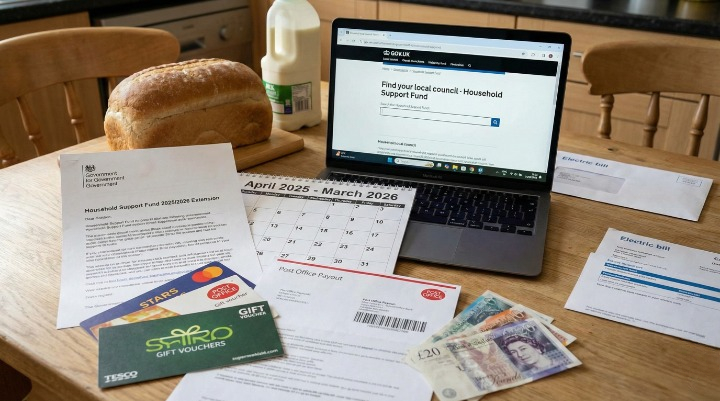
Post Office Payout vouchers: You receive a barcoded letter to take to the Post Office, redeemable for cash.
-
Supermarket Vouchers: Digital codes for Tesco, Asda, Sainsbury’s, or Aldi.
-
Energy Vouchers: PayPoint or Payzone codes specifically to top up prepayment meters.
Pro-Tip: If you receive a letter from your council regarding the Household Support Fund, open it immediately. Many people mistake these for circulars or junk mail, only to find out later they threw away a £200 Post Office voucher that had an expiry date.
How to Find Your Local Council’s Application Page
Most council websites are difficult to navigate. They often bury the HSF page under generic “Cost of Living” tabs.
Use this Search Operator Trick to bypass the confusion and go straight to the official page.
The 3-Step Lookup Hack
-
Open Google.
- Copy and paste this exact text, replacing the bracketed section with your town or county:
site:gov.uk [Your Council Name] household support fund application
-
Click the first result. The
site:gov.ukpart forces Google to show only official government pages, filtering out news articles and spam.
Example: If you live in Leeds, type: site:gov.uk Leeds household support fund application
[Find your local council here] (Use this GOV.UK tool if you aren’t sure which council you fall under).
Step-by-Step Guide: How to Apply Successfully
Because these funds are limited, application portals can close within hours of opening if demand is high. You need to be ready before you click “Apply.”
Step 1: Gather Your Evidence Stack
Most portals time out after 20 minutes. Have these digital copies (photos or PDFs) ready on your phone or laptop:
-
Proof of Identity: Driving license or Passport.
-
Proof of Address: A Council Tax bill or utility bill dated within the last 3 months.
-
Proof of Income: Your most recent payslip or Universal Credit statement.
-
Bank Statement: A recent statement clearly showing your name, account number, and sort code (so they know where to send the money).
-
Evidence of Hardship: A photo of an overdue energy bill or a screenshot of your bank balance showing low funds.
Step 2: Apply Early in the Day
Traffic to these portals peaks at lunchtimes and evenings. Try to access the site between 8:00 AM and 10:00 AM for the best chance of the page loading correctly.
Step 3: Check for “Discretionary Housing Payments” (DHP)
If you are applying for HSF because you can’t pay rent, check the application form for a section on Discretionary Housing Payments. Some councils combine these applications. If not, ask about DHP separately—it’s a different pot of money specifically for rent shortfalls.
FAQs
Is the Household Support Fund being extended to 2025?
Yes. The government confirmed the extension runs from 1 April 2025 to 31 March 2026. This ensures support covers the full financial year.
Will I get the Household Support Fund automatically?
Only if you are in a specific group targeted by your council (usually Pension Credit recipients or those on Free School Meals). Most other households, especially working families, must make a manual application.
How long does it take to get the Household Support Fund payment?
Once your application is approved, BACS payments typically take 14 to 28 days to clear. Vouchers are often faster, arriving via email or post within 7–10 days.
Can I get the Household Support Fund if I work full-time?
Yes, provided you meet your council’s “low income” definition or can prove financial hardship (e.g., energy debts). You do not strictly need to be on benefits to claim.
Is the Household Support Fund taxable?
No. It is a grant, not a benefit or income. It does not need to be declared on a Self-Assessment tax return.
What if my council says they have “Run Out of Funds”?
Councils receive funding in chunks. If the website says the scheme is closed, ask when the next round opens (usually near the next school holiday). Alternatively, ask them about their Local Welfare Assistance Scheme, which is a separate emergency fund.
Conclusion
The Household Support Fund remains a vital lifeline for 2025 and 2026, but it rewards those who are proactive. Unlike the automatic Cost of Living payments of the past, this money requires you to check your local rules and, in many cases, fight for your slot in the queue.
Your Action Plan:
-
Use the
site:gov.uksearch trick to find your council’s page today. -
Check if their “Summer” or “Winter” window is open.
-
If the portal is open, apply immediately with your evidence ready.
Don’t assume you aren’t eligible just because you work or aren’t on Universal Credit. If you are struggling with essentials, this fund is designed for you.
About the Author