Cheese And Dementia Risk: The 2025 Research That Changes Everything for UK Seniors
For decades, the advice has been simple: cut the fat to save your heart and brain. We have swapped butter for margarine, whole milk for skimmed, and begrudgingly left the cheese board alone. But if you have been staring at the dairy aisle in Tesco, confused by conflicting headlines, you are not alone.
A groundbreaking study published this week (December 2025) in the medical journal Neurology has turned standard dietary advice on its head. The research suggests that cheese and dementia risk are indeed linked, but not in the way you might think. Far from being a villain, full-fat cheese and cream might actually be powerful allies in protecting your brain as you age.
Before you rush to buy a wheel of Stilton, we need to look at the details. This isn’t a free pass to eat unlimited pizza. It is a nuanced look at how the “dairy matrix” supports brain health, particularly for those over 45.
The “50g Rule”: What the 2025 Lund University Study Found
Researchers at Lund University in Sweden tracked over 25,000 people for twenty-five years. Their goal was to see if high-fat dairy products increased the risk of cognitive decline.
The results were striking. The study found that people who consumed high amounts of full-fat dairy, specifically cheese and cream, had a significantly lower risk of developing dementia compared to those who avoided them.
13% Lower Risk: The Power of Full-Fat Cheese
The “sweet spot” identified in the data is roughly 50 grams per day. Participants who ate this amount of full-fat cheese showed a 13% lower risk of all-cause dementia compared to those who ate little to no cheese.
Crucially, this benefit was not seen in consumers of low-fat or skimmed dairy products. If you have been forcing yourself to eat rubbery “light” cheddar, you might be missing out on the protective benefits found only in the full-fat variety.
Why Your Daily Splash of Double Cream Matters
It wasn’t just cheese. The study also highlighted cream. Consuming around 20g of full-fat cream daily was associated with a 16% reduced risk of dementia. For us in the UK, that’s roughly the amount you might put in a generous coffee or pour over a small serving of fruit.
Key Takeaway: The protective association was linked specifically to high-fat, fermented dairy. Skimmed milk and low-fat options did not show the same brain-boosting potential.
Vascular Dementia vs. Alzheimer’s: Where Cheese Wins
Dementia is an umbrella term, and this study made a critical distinction between its different forms. The connection between cheese and dementia risk appears strongest when looking at vascular health.
Slashing Vascular Dementia Risk by 29%
The most significant finding was related to vascular dementia, which is caused by reduced blood flow to the brain. High consumers of full-fat cheese saw a massive 29% reduction in risk.
This supports the theory that certain saturated fats, when consumed within a complex food matrix like cheese, may actually support blood vessel integrity rather than harm it. This challenges the old view that all saturated fats clog arteries and damage the brain.
The APOE e4 Nuance: Is it for Everyone?
We must be intellectually honest here. This news is fantastic for many, but not everyone. The researchers noted that the protective benefits were not statistically significant for carriers of the APOE e4 gene, a common genetic risk factor for Alzheimer’s disease.
If you have a strong family history of Alzheimer’s or know you carry this gene, this specific dietary change might not have the same impact. Always consult your GP or a nutrition specialist before radically altering your diet based on headlines alone.
The “Dairy Matrix”: Why Full-Fat Beats Low-Fat for Brain Health
Why does full-fat cheese help while low-fat cheese doesn’t? Scientists call this the “Dairy Matrix.”
When you eat a piece of mature Cheddar, you aren’t just eating saturated fat. You are eating a complex structure containing:
-
Bioactive Peptides: Proteins that may lower blood pressure.
-
Vitamin K2: Essential for keeping calcium in your bones and out of your arteries.
-
Sirtuins: Proteins that influence cellular health and longevity.
-
Probiotics: Gut-friendly bacteria found in fermented cheeses.
When manufacturers remove fat to create “light” versions, they often destroy this matrix, removing fat-soluble vitamins and altering how your body digests the proteins.
The “Uncooked” Secret
Here is a detail many news outlets missed: the Swedish study participants primarily ate their cheese uncooked. They sliced it onto bread or crackers rather than melting it onto pizza or burgers.
Melting cheese at high temperatures can alter its structure. To replicate the study’s results, try to consume your cheese in its natural state, on a cracker, in a salad, or alongside an apple.
The UK Cheese Guide: What to Put on Your Board
You don’t need to hunt for exotic Swedish cheeses to get these benefits. Our local British varieties are excellent sources of the fermented, high-fat dairy highlighted in the research.
Best Picks: Mature Cheddar, Brie, and Stilton
-
Mature Cheddar: Rich in Vitamin K2 and bioactive peptides. Look for “Farmhouse” varieties which are often fermented longer.
-
Stilton (Blue Cheese): Contains specific moulds that may have anti-inflammatory properties.
-
Brie/Camembert: High in Vitamin K2 and healthy fatty acids.
The Cream Tea Connection
While we shouldn’t view a cream tea as a health food, the clotted cream itself (in moderation) fits the high-fat dairy profile mentioned in the study. A small dollop isn’t the dietary sin we once thought it was.
Pro-Tip: The Matchbox Guide
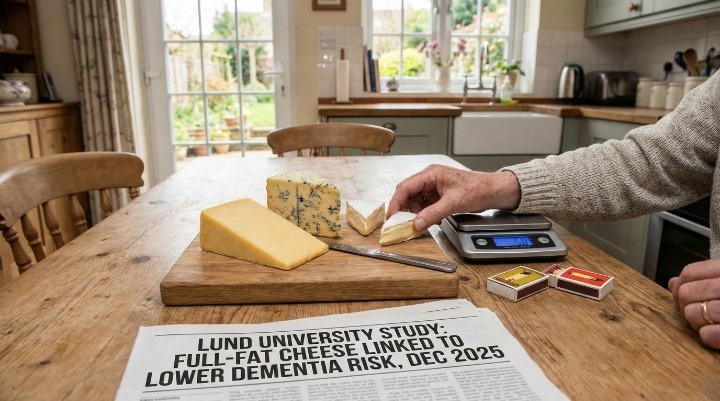
It is easy to overeat cheese. The study found benefits at 50 grams. What does that look like?
-
Hard Cheese (Cheddar): Imagine the size of two standard matchboxes stacked together.
-
Soft Cheese (Brie): A wedge roughly the size of a standard bar of soap cut in half.
-
Cream: Two tablespoons.
[Image suggestion: A wooden board showing exactly 50g of cheddar next to two matchboxes for scale.]
How to Balance Cheese with Heart Health
It is natural to worry about cholesterol. However, the Lancet Commission has long identified modifiable risk factors for dementia, and diet is just one piece of the puzzle.
The key is swapping, not adding. If you increase your cheese intake, try to reduce other sources of less healthy fats, like processed meats or vegetable oils high in Omega-6.
My Experience: I used to avoid the cheese course at dinner parties, thinking I was being “good.” Now, I enjoy a few high-quality pieces of unpasteurised cheese with confidence. The mental shift from “restriction” to “nourishment” makes a huge difference in how you enjoy your food.
FAQs
Is cheese good for dementia patients?
Current research suggests it may help prevent decline, particularly vascular dementia. For those already diagnosed, high-fat dairy can be a good source of concentrated energy and protein, but it will not reverse the condition.
What is the best cheese for brain health?
Fermented, high-fat cheeses are best. Aged Cheddar, Gouda, Brie, and blue cheeses like Stilton offer the best “dairy matrix” benefits.
Does full-fat dairy cause memory loss?
No. The 2025 study specifically links full-fat dairy to better cognitive outcomes compared to low-fat dairy.
How much cheese should I eat a day for my brain?
The study suggests 50g (roughly two matchboxes) is the optimal amount for risk reduction.
Can Cheddar cheese prevent Alzheimer’s?
“Prevent” is a strong word. It is associated with a lower risk, especially in people without the APOE e4 gene. It is a tool for reduction, not a cure.
Is clotted cream bad for my heart?
In large quantities, yes. But in small amounts (around 20g), the study found it was linked to better brain health without necessarily harming heart health, likely due to the specific types of fatty acids it contains.
What did the 2025 Lund University study conclude about dairy?
It concluded that high intake of full-fat dairy is associated with a lower risk of dementia, challenging guidelines that promote low-fat dairy for everyone.
Conclusion: A Cheesy New Lease on Life?
The relationship between cheese and dementia risk is a perfect example of why nutrition science is always evolving. We now know that the “low-fat is always best” mantra was too simplistic.
This 2025 research gives us permission to enjoy one of life’s great pleasures, a good piece of cheese, while knowing it might be doing our brains a favour. The secret lies in the quality (full-fat, fermented) and the quantity (the 50g rule).
So, next time you are at the shops, walk past the “light” versions. Pick up a block of proper British Cheddar, enjoy it in moderation, and know that you are fuelling your brain with the nutrients it needs to age well.
Are you looking for more UK-centric health updates? [Read guide on Cycle Syncing for Longevity] or subscribe to our newsletter for the latest science-backed wellness tips.
About the Author