August 2026 Solar Eclipse UK: The Ultimate Sunset Viewing Guide
On the evening of August 12, 2026, the United Kingdom will witness its most significant astronomical event in a generation. It has been over two decades since the legendary 1999 eclipse brought the country to a standstill. Now, a deep partial solar eclipse August 2026 UK event promises to turn a summer evening into an eerie, silvered twilight.
While thousands of “eclipse chasers” will flock to Iceland or Spain for totality, you do not need to leave the country to experience something profound. From the cliffs of Cornwall to the streets of Belfast, the sun will be obscured by up to 96%.
But this event comes with a catch. Unlike the midday eclipse of 1999, the 2026 spectacle happens at sunset. The sun will be hanging dangerously low on the horizon. If you are standing in the wrong spot, behind a neighbour’s house, a hedgerow, or a block of flats, you will miss it entirely.
This guide is your strategic blueprint. We will cover the exact timings for your city, the best “low-horizon” viewing locations, and the critical gear you need to safely watch the sun vanish into the Atlantic.
Is the 2026 Eclipse Total in the UK?
Let’s manage expectations immediately. The short answer is no. The specific “Path of Totality”, the narrow corridor where the moon completely blocks the sun and plunges the world into night, does not cross the UK mainland.
According to NASA’s Solar System Exploration division, the path of totality for the 2026 eclipse arcs from the Arctic, down through Eastern Greenland, across western Iceland, and ends at sunset in northern Spain (places like Bilbao and Mallorca).
The “Deep Partial” Experience
However, do not let that discourage you. The UK will experience a Deep Partial Eclipse. This is radically different from the minor 10-20% eclipses we often see mentioned in the news that pass unnoticed.
-
90% – 96% Obscuration: In viewing hotspots like Cornwall and West Wales, only a tiny sliver of the sun will remain visible.
-
The Atmosphere: You will not get the “pitch black” midnight effect of totality. Instead, you will experience a rapid, unnatural dimming of daylight. The light often turns a metallic, silvery grey. Shadows sharpen, the temperature drops noticeably, and birds often stop singing, confused by the sudden onset of “night.”
Expert Insight: Even at 96% coverage, the remaining 4% of the sun is powerful enough to cause eye damage. The sky will remain bright enough to see your surroundings, but the quality of light will feel distinctly “wrong” or otherworldly.
August 12, 2026 Eclipse Time UK: Localized Schedules
Timing is everything. This is a fast-moving event occurring during the evening rush hour. The eclipse begins roughly an hour before maximum coverage, but the main spectacle lasts only a few minutes.
According to data from the Royal Observatory Greenwich (ROG), the peak viewing window across the UK is remarkably consistent, generally hitting just after 19:10 BST (British Summer Time).
Here is the breakdown for major UK locations. Notice how the coverage (obscuration) increases significantly as you move South and West.
| Location | Eclipse Begins | Maximum Eclipse | Max Coverage (Obscuration) | Eclipse Ends |
| Penzance (Cornwall) | 18:17 BST | 19:13 BST | 96.5% | 20:07 BST |
| Cardiff | 18:16 BST | 19:13 BST | 93.3% | 20:07 BST |
| Belfast | 18:14 BST | 19:11 BST | 92.9% | 20:06 BST |
| Glasgow | 18:14 BST | 19:10 BST | 91.2% | 20:04 BST |
| Manchester | 18:16 BST | 19:12 BST | 91.4% | 20:06 BST |
| London | 18:17 BST | 19:13 BST | 91.0% | 20:06 BST |
| Edinburgh | 18:15 BST | 19:10 BST | 90.4% | 20:04 BST |
[Check your exact town’s timing on TimeAndDate.com]
The “Golden Window”
Set an alarm for 19:00 BST. This gives you 10 to 15 minutes to get your glasses ready, settle your camera settings, and let your eyes adjust before the peak moment occurs between 19:10 and 19:15.
Best Places to See the Solar Eclipse 2026 in the UK
Because this eclipse happens in the evening, the sun will be in the West. The further west you travel, the longer the sun stays above the horizon, and the higher the percentage of obscuration.
1. The Cornwall Coast (The 96% Club)
Cornwall is the undisputed King of the 2026 eclipse in Britain. It offers the highest coverage and the best angles over the ocean.
-
Land’s End: The most obvious choice. You get an uninterrupted view of the Atlantic horizon. Expect heavy crowds here; local authorities will likely implement traffic management plans similar to 1999.
-
St Michael’s Mount: Watching the crescent sun set behind this historic island castle could be the photograph of the decade.
-
The Lizard Peninsula: Offers equally good views (approx 96.3%) with potentially fewer crowds than Land’s End.
2. The West Wales Peninsula (Pembrokeshire)
If Cornwall feels too distant or expensive, Pembrokeshire is a fantastic alternative.
-
St Davids Head: The rugged cliffs here face directly west. With 93% obscuration, the visual difference from Cornwall is negligible to the naked eye.
-
Worm’s Head (Gower): A dramatic location where you can frame the eclipse against the serpentine rock formation.
3. Northern Ireland (North Coast)
For those in Northern Ireland, the Giant’s Causeway offers a spectacular foreground. With nearly 93% coverage, the hexagonal basalt columns under a silvered, dim sky will create a moody, cinematic atmosphere.
4. High-Altitude Options: The Peak District & Snowdonia
If you cannot get to the coast, go up. Being inland carries a risk: hills or buildings blocking the setting sun.
-
Snowdon (Yr Wyddfa): The summit offers a clear western horizon over the Irish Sea.
-
Mam Tor (Peak District): A high vantage point that clears the surrounding topography, ensuring you see the sun until the last possible moment.
The “Horizon Trap”: Why Your Garden Might Fail You
This is the single most important section of this guide.
Most people assume they can walk into their back garden and look up. For the solar eclipse August 2026 UK event, that is a recipe for disappointment.
The Geometry Problem:
At 19:15 BST in mid-August, the sun will be very low in the sky.
-
In London, the sun’s altitude will be approximately 10 degrees.
-
In Cornwall, it will be roughly 11 degrees.
-
In Scotland, it sits even lower, around 8 degrees.
The “Rule of Thumb”:
Extend your arm fully and make a fist. One fist width at arm’s length covers about 10 degrees of the sky. If you place the bottom of your fist on the horizon, the sun will be sitting just at the top of your knuckles.
If there is a two-story house, a mature oak tree, or a dense hedgerow to your West, the eclipse will happen behind it.
Expert Scouting Tip: Do not wait until August 2026. In August 2025, go to your planned viewing spot at 7:15 PM. Look West. If you cannot see the sun clearly, that spot is useless for the eclipse. You need a “sea horizon” or a high elevation point.
Photographer’s Guide: Capturing a Sunset Eclipse
Photographers have a unique opportunity here. Usually, solar eclipses happen high in the sky, requiring you to tilt your neck back. In 2026, the action is eye-level.
Essential Gear
-
Solar Filter (ND100000): You absolutely must have a certified solar filter for your lens. Without it, you will fry your camera’s sensor in seconds.
-
Sturdy Tripod: You will be shooting in low light conditions as the sun fades. Stability is key.
-
Telephoto Lens: To get a decent size sun in the frame, you need at least a 200mm lens. 400mm or 600mm is ideal for capturing details like sunspots or the jagged edge of the moon.
The “Crescent Silhouette” Shot
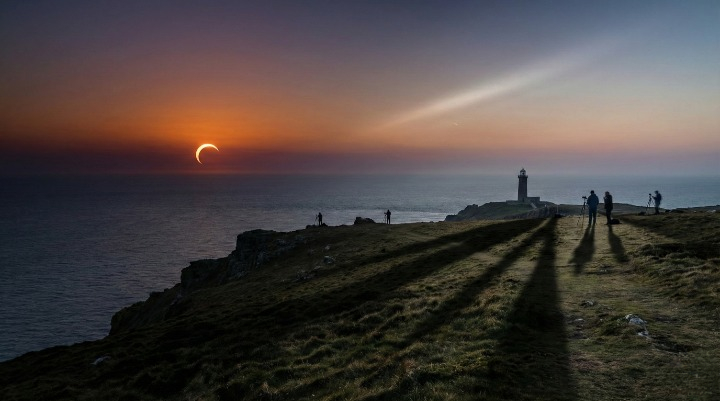
Because the sun is low, you can incorporate landmarks. The “money shot” for 2026 is the Crescent Silhouette. This involves positioning yourself so that a distant object (a lighthouse, a tor, or a standing stone) appears in front of the dimmed, crescent-shaped sun.
-
Plan ahead: Use apps like PhotoPills or The Photographer’s Ephemeris to align your shot perfectly with the sun’s trajectory on August 12.
How to Watch Safely (ISO 12312-2 Guidelines)
Safety guidelines from the National Solar Observatory remain strict regardless of the sun’s position.
1. Eclipse Glasses
You must use glasses certified to ISO 12312-2. Do not use regular sunglasses, smoked glass, or old exposed film. These do not block the invisible infrared radiation that burns the retina.
2. The Kitchen Colander Trick
If you are hosting a garden party or viewing with children, grab a pasta colander from the kitchen. Stand with your back to the sun and hold the colander up. The holes will act as dozens of “pinhole cameras,” projecting tiny crescent shapes onto the ground or a white sheet of paper. It is a safe, fun, and surprisingly effective way to watch the eclipse progress.
Travel Planning: Avoiding the “Eclipse Tax”
The “Eclipse Tax” is a real phenomenon where hotels triple their prices during astronomical events.
-
Book Now: If you plan to visit Cornwall or Pembrokeshire, book your accommodation at least 12 months in advance (August 2025).
-
Stay Mobile: Consider a campervan or camping. Weather in the UK is fickle. Being mobile allows you to drive away from cloud cover on the morning of the event.
-
The Overseas Option: If 96% is not enough and you demand totality, look at Northern Spain. Cities like Bilbao, Zaragoza, and Burgos are directly in the path. Weather prospects in Spain are statistically better than in the UK, but the heat will be intense.
Conclusion
The solar eclipse August 2026 UK event is set to be a defining moment for British skywatchers. It combines the rarity of a deep partial eclipse with the dramatic beauty of a summer sunset.
While we miss out on totality, witnessing a 96% obscured sun sinking into the Atlantic from the Cornish cliffs is a bucket-list experience in its own right. The key is preparation. Check your angles, scout your horizon, and secure your viewing spot early.
Unlike the midday darkness of 1999, the 2026 eclipse offers a “Crescent Sunset”, a unique, atmospheric spectacle that we won’t see again for decades. Get your kit ready, hope for clear skies, and look West.
FAQs
What time is the solar eclipse 2026 UK?
The eclipse begins around 18:15 BST, reaches its maximum peak between 19:10 and 19:15 BST, and concludes shortly after 20:00 BST.
Can I see the 2026 eclipse from London?
Yes. London will experience approximately 91% obscuration. However, you must find a high viewing spot or an open park with a clear view of the western horizon to see it over the city skyline.
When was the last total solar eclipse in the UK?
The last total solar eclipse visible from the UK mainland was on August 11, 1999. The next total eclipse on the UK mainland will not occur until September 2090.
Do I need special glasses for a partial eclipse?
Yes. Even at 96% coverage, looking directly at the sun without ISO 12312-2 certified glasses can cause permanent eye damage.
Where is the best place in the UK for the 2026 eclipse?
The absolute best locations are in West Cornwall (Land’s End, Penzance) and the Isles of Scilly, where obscuration reaches over 96%.
Will it get dark during the 2026 eclipse?
It will not turn pitch black like midnight. Instead, the light levels will drop significantly, resembling a deep twilight or a heavy storm rolling in, creating a silvery, metallic light.
Is the 2026 eclipse a “Blood Moon”?
No. A “Blood Moon” refers to a total lunar eclipse where the moon turns red. The August 2026 event is a solar eclipse, where the moon blocks the sun.
About the Author