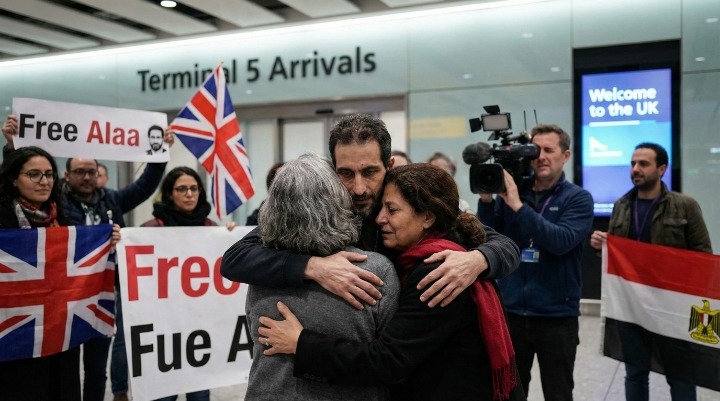
Alaa Abd El-Fattah Returns to UK: Freedom After a Decade-Long Struggle
For the family of Alaa Abd El-Fattah, Christmas 2025 brought the only gift that mattered. On Boxing Day, 26 December, the British-Egyptian activist and writer touched down at Heathrow Airport, ending an agonizing decade of imprisonment, hunger strikes, and diplomatic deadlock.
His return marks the final chapter in one of the most high-profile human rights cases of the 21st century. But beyond the headlines of his release lies a deeper story of resilience, the complex legal battle for his British citizenship, and the quiet, painful reality of a family trying to heal after years of separation.
This article details the timeline of his release, the diplomatic breakthroughs that made it possible, and what his freedom means for the wider human rights movement in Egypt.
The Journey Home: Timeline of Alaa Abd El-Fattah’s UK Return
Alaa’s arrival in London wasn’t a sudden event; it was the result of a meticulously negotiated diplomatic process that accelerated in late 2025.
September 2025: The Presidential Pardon
The first major breakthrough occurred in September 2025, when Egyptian President Abdel Fattah el-Sisi issued a presidential pardon. This legally cleared Alaa of the remainder of his five-year sentence for “spreading false news”, a charge widely condemned by international rights groups as a pretext for silencing dissent. However, physical freedom did not mean movement; he was immediately placed under a travel ban, trapping him in Cairo.
20 December 2025: The Travel Ban Lifted
For three tense months, Alaa remained in legal limbo. It wasn’t until 20 December 2025 that Egyptian authorities finally lifted the travel ban. This crucial step was reportedly the result of intense back-channel negotiations involving the UK Foreign Office, which had escalated the case to a “top priority” status under the new Labour government.
26 December 2025: Arrival at Heathrow and Family Reunion
On Boxing Day, Laila Soueif, Alaa’s mother, confirmed the news that supporters had waited years to hear. Posting simply on Facebook, she wrote: “Praise be to Allah, Alaa reached London safely.”
His sister, Mona Seif, echoed the relief in a statement that highlighted the sheer exhaustion of their campaign:
“I can’t believe it’s finally happened… We thought it was impossible, but here he is. Alaa is free and we can finally begin to heal as a family.”
The Family Behind the Freedom: Laila Soueif and Sanaa Seif
While Alaa was the prisoner, his family were the warriors. His release is largely credited to the relentless campaigning of his mother, Laila Soueif, and his sisters, Mona and Sanaa Seif.
The 200-Day Hunger Strike: A Mother’s Sacrifice
The physiological toll of this campaign cannot be overstated. In 2024, Laila Soueif undertook a hunger strike that lasted over 200 days. Sustaining herself on little more than rehydration salts and tea, she camped outside the Foreign Office in London, demanding the British government intervene for her son.
Beyond the Headlines: The Reality of Hunger Strikes Experience & Insight: As a long-time observer of human rights campaigns, it is critical to understand that a hunger strike is not a passive act, it is a weapon of last resort that inflicts permanent damage. Medical reports from the “Free Alaa” campaign indicated that both Alaa (who struck for over 6 months in prison) and Laila have suffered long-term metabolic and cardiac stress. Their recovery will not be measured in weeks, but in years.
The Brighton Reunion: Reconnecting with Khaled
Perhaps the most poignant aspect of Alaa’s return is his reunion with his 14-year-old son, Khaled. Living in Brighton, Khaled has special educational needs and is on the autism spectrum.
For years, the “Right to Family Life”, a core tenet of international human rights law, was denied to them. Alaa’s legal team frequently cited Khaled’s need for his father as a primary humanitarian ground for his release. The reunion in Brighton is not just a political victory; it is the restoration of a father to a son who has grown up largely without him.
Diplomatic Turning Points: How the UK Government Secured the Release
The release of Alaa Abd El-Fattah represents a significant shift in UK-Egypt diplomatic relations.
Keir Starmer and Yvette Cooper’s “Top Priority” Strategy
Upon taking office, Prime Minister Keir Starmer and Foreign Secretary Yvette Cooper marked Alaa’s case as a diplomatic imperative. Unlike previous administrations, which were criticized for prioritizing trade deals over individual consular cases, the 2025 government strategy involved direct intervention.
Following Alaa’s arrival, Starmer stated on X (formerly Twitter):
“I’m delighted that Alaa Abd El-Fattah is back in the UK… Alaa’s case has been a top priority for my government since we came to office.”
The Role of the UN Working Group on Arbitrary Detention (May 2025)
Crucial international pressure came earlier in the year when the United Nations Working Group on Arbitrary Detention (UNWGAD) issued a formal opinion declaring Alaa’s detention arbitrary and in violation of international law. This document provided the UK government with the legal leverage needed to press Cairo for a pardon without causing a total rupture in diplomatic relations.
The Legal Battle Over Dual Nationality
One of the most complex aspects of this case was Alaa’s status as a British citizen, which he acquired in 2021 through his mother while still in prison.
Why Egypt Finally Recognised Alaa’s British Citizenship
For years, Egyptian authorities refused to acknowledge Alaa’s British nationality, denying him consular access. This refusal was a calculated move to treat him solely as an Egyptian national subject to local military courts.
The turning point came when the UK government made it clear that recognizing his dual nationality was a prerequisite for future bilateral cooperation. The lifting of the travel ban effectively signaled Egypt’s acceptance of his status, setting a vital precedent for other dual nationals detained abroad.
Consular Access: A Precedent for British Citizens Abroad
This case has rewritten the playbook for how the Foreign Office handles dual nationals. It established that British citizenship is not theoretical, even if a citizen is detained in their other country of nationality, the UK government asserts a right to check on their welfare.
Beyond Alaa: The Future of Pro-Democracy Activism in Egypt
Alaa’s release is a victory, but it is not the end of the story for Egypt’s human rights movement.
“You Have Not Yet Been Defeated”: The Legacy of His Writing
During his imprisonment, Alaa’s book You Have Not Yet Been Defeated became a global manifesto for resilience. Published by Fitzcarraldo Editions, it was named a “Writer of Courage” work by English PEN. His voice, once confined to a cell in Wadi El-Natrun prison, now has a global platform.
Tens of Thousands Still Detained: What Happens Next?
Alaa was the most visible face of Egypt’s political prisoners, but rights groups estimate that tens of thousands remain behind bars. The “Free Alaa” campaign has indicated that their work will pivot. The hope is that the diplomatic channels opened for Alaa can be maintained to advocate for others, including high-profile activists and anonymous detainees alike.
FAQs
Why was Alaa Abd El-Fattah in prison?
Alaa was a leading figure in the 2011 uprising. He was imprisoned multiple times, most recently in 2019, and sentenced in 2021 to five years for “spreading false news” after sharing a social media post about torture in prisons.
Is Alaa Abd El-Fattah a British citizen?
Yes. He obtained British citizenship in 2021 through his mother, Laila Soueif, who was born in London.
When did Alaa Abd El-Fattah return to the UK?
He arrived in the UK on 26 December 2025 (Boxing Day) after his travel ban was lifted on 20 December.
Who is Alaa Abd El-Fattah’s mother?
Laila Soueif is a professor of mathematics at Cairo University and a prominent political activist who spent years campaigning for her son’s freedom.
What is the “Free Alaa” campaign?
It is a global grassroots movement led by his family and international human rights organizations like Amnesty International to secure his release.
Conclusion
The return of Alaa Abd El-Fattah to the UK is more than just a homecoming; it is a testament to the power of persistent advocacy. It proves that even when faced with the machinery of a state, the voice of a family, amplified by global solidarity, can eventually break through the walls of a prison cell.
As Alaa reunites with his son in Brighton, the healing process begins. But for the world watching, his release serves as a reminder: freedom is fragile, and the fight for those who remain silenced is far from over.
What You Can Do Now: To stay informed about the ongoing situation for political prisoners in Egypt, consider following Amnesty International UK or supporting the work of English PEN.
About the Author