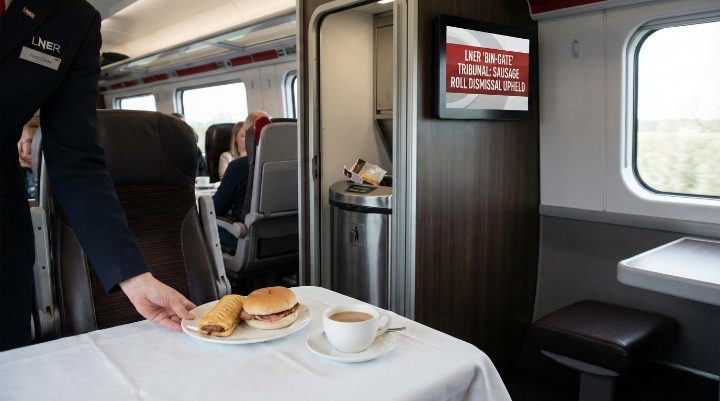
Peter Duffy Sausage Rolls: Why LNER Sacked the ‘Bin-Gate’ Host
Imagine settling into a First Class seat on a premium LNER service from York to London. You have paid a significant premium for the experience, which includes complimentary dining. You order breakfast. The host brings you a sausage roll, seemingly fresh from the oven.
What you do not know, and what CCTV would later reveal, is that your breakfast had been retrieved from a waste bin just minutes earlier.
This scenario is not a hypothetical horror story. It is the central fact of the employment tribunal case P Duffy v London North Eastern Railway Ltd (Case No: 2502343/2023). The case has gripped the UK press, earning the nickname “Bin-Gate.” While the headlines focus on the shock factor of “Peter Duffy sausage rolls,” the legal and safety implications run much deeper.
This article examines exactly what happened on that May 2023 service, why an experienced host believed serving bin-food was “gold standard” service, and why the Employment Tribunal ultimately ruled that good intentions are no defence for gross misconduct.
The Incident: What Happened on the York to London Service?
To understand the severity of the dismissal, we must look at the specific timeline of events on 7 May 2023. Peter Duffy was working as a Customer Experience Host on the 06:56 service from York to London King’s Cross. This is a flagship route, often populated by business travellers and tourists expecting high standards.
The Moment First Class Supplies Ran Out
Rail catering logistics are notoriously difficult. On this particular morning, the stock levels were miscalculated. As the train departed York, the First Class galley ran out of the hot breakfast option, specifically, the sausage rolls and bacon rolls that are a staple of the LNER morning menu.
For a host, this is a high-stress situation. First Class passengers can be demanding, and hosts are trained to solve problems. However, the standard protocol in this scenario is clear: apologize, offer an alternative (such as cold items or biscuits), or advise passengers to claim compensation later.
Peter Duffy chose a different path.
CCTV Evidence: The Truth Behind the Bin Retrieval
During the internal investigation and subsequent tribunal, LNER presented CCTV footage from the on-board kitchenette. This evidence was damning.
The footage showed Mr Duffy approaching the waste bin where defective or surplus food had been discarded. He was seen removing two sausage rolls and a bacon roll from the bin. The footage then captured him placing these items onto a baking tray and putting them into the oven to be reheated.
Critically, the items were not still in their sealed packaging. They had been discarded. By retrieving them, plating them, and reheating them, Duffy bypassed every fundamental rule of food hygiene.
Note: The tribunal heard that other staff members were present in the galley. Witnesses reported hearing laughter at the time, which LNER argued suggested the act was not a panicked mistake, but potentially a mockery of the passengers who were about to eat trash.
Why Did He Do It? The “Gold Standard” Defense
The most baffling aspect of the Peter Duffy sausage rolls scandal is the host’s justification. Duffy was not a rogue employee trying to poison passengers. By all accounts, he believed he was solving a problem.
“Going Too Far for the Customer”
During his disciplinary hearing, Duffy made a statement that became central to his unfair dismissal claim. He admitted to the act but framed it as extreme customer service.
“I have just gone too far for the customer,” he told investigators. He argued that his motivation was solely to prevent the passengers from being disappointed by the lack of food. In his view, he was striving for a “gold standard” of service, a term often used in corporate training to encourage going the extra mile.
However, this defense highlighted a dangerous disconnect. In the service industry, “going the extra mile” means finding a fresh alternative, not salvaging waste.
Health Factors: Transient Global Amnesia & Anxiety
In his Employment Tribunal claim, Duffy’s defense team introduced medical evidence. They cited that Duffy suffered from health issues, specifically anxiety and a condition known as Transient Global Amnesia.
Transient Global Amnesia is a sudden, temporary episode of memory loss that can’t be attributed to a more common neurological condition like epilepsy or a stroke. Duffy argued that the stress of the situation, combined with his health conditions, impaired his judgment.
However, Employment Judge Aspden, presiding over the Newcastle tribunal, had to weigh this against the clear actions seen on CCTV. The judge noted that the process of retrieving, plating, and cooking the food required a sequence of deliberate, conscious actions that did not align with a sudden loss of awareness.
The Tribunal Ruling: Why LNER Acted Reasonably
The tribunal judgment (delivered in early 2026 following the late 2025 hearings) was decisive. Duffy’s claim for unfair dismissal was rejected. The ruling provides a crucial lesson in UK employment law regarding safety-critical roles.
Gross Misconduct vs. Subjective Intent
The core of the legal battle was whether LNER’s decision to sack Duffy was within the “band of reasonable responses.”
Duffy’s team argued that because his intent was to help, dismissal was too harsh. They suggested a final written warning would have sufficed.
The Judge disagreed. The ruling emphasized that Gross Misconduct does not always require malice. Recklessness that endangers life or safety is sufficient. By serving food from a bin, Duffy exposed LNER to:
-
Public Health Risks: Bacterial contamination from the bin.
-
Allergen Risks: Cross-contamination from other waste items.
-
Reputational Suicide: The potential fallout if a passenger fell ill.
The tribunal concluded that LNER could no longer trust Duffy to make safe decisions, regardless of his intentions.
FSA Standards and the “Foil Wrapping” Argument
One of the technical points raised in Duffy’s defense was that the sausage rolls were likely still on their foil base or partially wrapped when in the bin, implying they hadn’t touched “dirty” waste directly.
According to the Food Standards Agency (FSA) and the Food Hygiene (England) Regulations 2006, this distinction is irrelevant.
-
Waste Status: Once an item enters a designated waste receptacle, it is legally “waste.”
-
The 2/4 Hour Rule: Food safety relies on strict time and temperature controls. Food in a bin has no temperature log.
-
Cross-Contamination: A bin contains pathogens from everything else thrown in it, used tissues, unfinished meals, and floor sweepings.
[Food Standards Agency – Food Law Code of Practice]
The Judge accepted LNER’s position: a professional food handler must treat the bin as a “point of no return.”
LNER Supply Chain Failures: Why Was There No Food?
While Peter Duffy bore the responsibility for his actions, the incident sheds light on a broader issue within UK rail: supply chain reliability.
Capacity Planning and Rail Tech
Why does a premier service run out of breakfast before it even leaves North Yorkshire?
LNER, like many Train Operating Companies (TOCs), uses predictive modelling to load trains. This system, often called Capacity Requirement Planning, estimates how many First Class ticket holders will actually travel and how many will eat.
-
The Variable: On the day in question, passenger uptake was higher than the algorithm predicted, or the physical loading at the depot was short.
-
The 2026 Solution: Since this incident, LNER and other operators have begun integrating more advanced AI-driven stock management systems that adjust loading manifests in real-time based on ticket sales.
However, technology fails. When it does, the “human in the loop” (the host) must follow the Service Quality Standards. These standards explicitly state that in the event of a shortage, the correct procedure is communication and compensation, not improvisation with waste.
Commuter Corner: What to Do If Your First Class Food Runs Out
If you are a regular commuter, you have likely faced the “sorry, we’ve run out” announcement. Learning about the Peter Duffy sausage rolls incident might make you grateful they ran out rather than “finding” more, but you are still out of pocket.
Your Rights to Refunds and Vouchers
Here is a practical guide on how to handle catering failures on UK rail:
Traveler’s Tip: The ‘Complimentary’ Trap Most First Class tickets (especially Advance tickets) include food as a “complimentary” perk, not a contractual right. The National Rail Conditions of Travel generally do not mandate a partial refund just because the toast was cold or the bacon ran out.
However, you can still claim:
-
Delay Repay: If the service was poor and the train was delayed, claim Delay Repay immediately.
-
Customer Promise Vouchers: If the advertised Wi-Fi or Catering is completely unavailable, complain directly to the TOC (LNER, Avanti, GWR). Most have a “service failure” policy where they will issue an e-voucher (usually £5–£20) as a goodwill gesture.
-
The “Rail Ombudsman”: If a TOC refuses to acknowledge a significant failure (e.g., a First Class carriage with no water or food for 3 hours), you can escalate to the Rail Ombudsman.
HR Takeaways: Gross Misconduct and the Implied Term of Trust
For HR professionals and business owners, the Peter Duffy v LNER case is a textbook example of the “Implied Term of Mutual Trust and Confidence.”
Every employment contract in the UK contains this unwritten clause. It means the employer must treat the employee fairly, and the employee must not act in a way that destroys the employer’s trust in them.
The Tribunal Takeaway: Duffy’s dismissal was upheld not just because he breached a hygiene rule, but because he broke the “Trust and Confidence.”
-
The Logic: If an employee thinks serving bin-food is acceptable “customer service,” what other dangerous decisions might they make in the future?
-
The Lesson: You cannot train “common sense.” When an employee demonstrates a fundamental lack of judgment regarding safety, dismissal is often the only viable option to protect the business and the public.
FAQs
Who is Peter Duffy the LNER worker?
Peter Duffy was a Customer Experience Host for LNER who worked on the East Coast Main Line. He became the subject of national news and an employment tribunal after being sacked for serving food retrieved from a bin to passengers in 2023.
What did Peter Duffy serve from the bin?
CCTV footage confirmed that Duffy retrieved two sausage rolls and a bacon roll from a waste bin in the train’s galley. He then plated and reheated them before serving them to First Class passengers.
Why was Peter Duffy sacked by LNER?
He was dismissed for Gross Misconduct. LNER stated that his actions breached food safety laws, endangered passenger health, and destroyed the company’s trust in his ability to perform his duties safely.
Did Peter Duffy win his unfair dismissal claim?
No. The employment tribunal in Newcastle, led by Judge Aspden, dismissed his claim. The judge ruled that LNER’s decision to fire him was reasonable given the severity of the hygiene breach.
What is transient global amnesia in employment law?
Transient Global Amnesia (TGA) is a medical condition involving sudden memory loss. Duffy used this as a defense, claiming he wasn’t fully aware of his actions. In employment law, medical conditions must be weighed against the employee’s actions. In this case, the judge found his actions (plating, cooking) were too complex to be explained solely by TGA.
Is it legal to serve food that was in a bin if it’s wrapped?
No. Under the Food Hygiene (England) Regulations 2006, food placed in a waste receptacle is considered waste. It is potentially cross-contaminated by other items in the bin. Serving it is a criminal offence under food safety laws.
How do I complain to LNER about food hygiene?
You can contact LNER directly via their customer service email or website. If you witness a serious food hygiene breach, you should also report it to the Food Standards Agency (FSA) or the environmental health department of the local council where the train operator is based.
Conclusion
The saga of the Peter Duffy sausage rolls is a bizarre chapter in UK railway history, but it serves as a serious warning. It highlights the immense pressure on frontline staff to deliver “gold standard” service, and how that pressure can lead to catastrophic lapses in judgment.
The tribunal’s ruling affirms a simple but vital standard: Safety comes first. No amount of good intention justifies retrieving food from a bin. For LNER, the dismissal was a necessary step to protect its passengers. For commuters, it is a reminder that while we all complain about rail catering, a “sold out” sign is infinitely preferable to the alternative.
If you work in a safety-critical role or the food industry, let this be your case study. If you are a passenger, perhaps check the kitchen next time you smell fresh pastry on the East Coast Main Line.
Stay informed on your commuter rights and UK travel news, subscribe to our Rail Updates Newsletter below.
About the Author