Police Officer Work Licence: UK Requirements & Certification Guide (2026)
If you are transitioning from private security to law enforcement, you likely have one burning question: Do I need a specific police officer work licence to join the force?
In the private sector, an SIA (Security Industry Authority) licence is your bread and butter. It proves you are vetted, trained, and legally allowed to work. But policing operates under a completely different legal framework.
Here is the short answer: No, you do not need an SIA licence.
However, that does not mean you can walk in without credentials. Instead of a commercial work licence, you must earn the Office of Constable. This authority is granted through attestation and the possession of a Warrant Card.
This guide breaks down exactly what “licensing” really means for UK police officers in 2026, from mandatory driving permits to the strict vetting standards that replace the SIA card.
The “SIA Licence” Myth: Why Police Officers are Exempt
Many applicants assume that because police officers deal with conflict management, door supervision, and public safety, they require the same licensing as private security guards. This is legally incorrect.
Understanding the Private Security Industry Act 2001
The Private Security Industry Act 2001 is the legislation that governs private security in the UK. It mandates that individuals working in specific sectors, like door supervision or CCTV operation, must hold a valid licence from the Security Industry Authority (SIA).
However, Section 4 of this very Act provides a specific exemption. It states that the requirement to hold a licence does not apply to a constable acting in the course of their duty.
The Office of Constable vs. Private Security
Police officers are not “employees” in the traditional sense; they are servants of the Crown who hold the Office of Constable.
When you join the police, you do not sign a standard employment contract. Instead, you swear an oath (attestation) before a magistrate. This legal process grants you your powers, such as arrest, search, and seizure, which are far more extensive than those of a licensed security guard.
Your “licence” is your Warrant Card.
Note: If you currently hold an SIA licence and join the police, you generally cannot work a second job in private security. Police regulations strictly control “business interests,” and working as a doorman or guard while serving is almost universally prohibited due to conflicts of interest.
Mandatory 2026 Eligibility: What is Your Real “Licence” to Apply?
While you don’t need an SIA card, you do need specific documentation to even be considered. Think of these as your “entry permits.” Without them, your application will be rejected automatically.
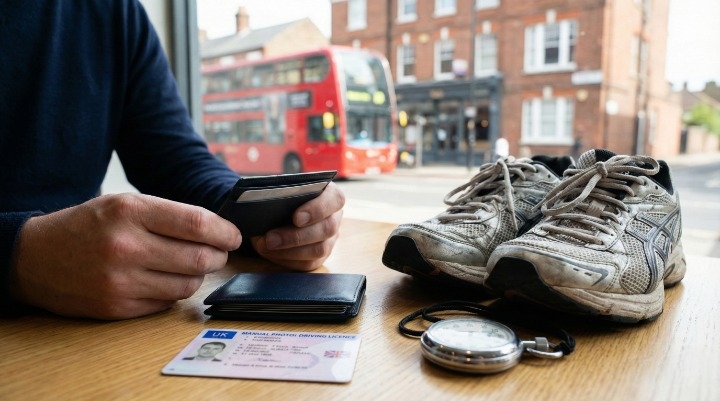
The Driving Licence Mandate: Manual Category B
For most forces in 2026, a full UK driving licence is non-negotiable.
The Standard:
You generally need a Manual Category B car licence. Automatic-only licences are rarely accepted because police fleets consist largely of manual vehicles.
Penalty Points:
This is where many candidates fail. Forces are strict about your driving history.
- Acceptable: Up to 6 penalty points are usually tolerated, provided they are not for serious offences.
- Automatic Rejection: If you have 6 or more points, or a recent conviction for drink/drug driving, you will likely be ineligible.
[Check your driving licence penalty points on GOV.UK]
Residency & Nationality: The 3-Year Rule
You cannot simply move to the UK and join the police immediately. To satisfy strict vetting procedures, you must have a “checkable history.”
- Nationality: You must be a British citizen, an EC/EEA national, or a Commonwealth citizen with indefinite leave to remain. There are no restrictions on your country of origin, provided you have the legal right to stay and work in the UK without time limits.
- Residency: You generally need to have lived in the UK continuously for the last three years. This allows the vetting teams to perform a Counter Terrorist Check (CTC) and Security Check (SC).
Recruiter’s Lens:
Why the 3-year rule? It isn’t about xenophobia; it’s about data. If you have lived abroad recently, UK intelligence agencies cannot easily verify your background, financial history, or associates. Without that data, they cannot issue security clearance.
2026 College of Policing Entry Routes: The Certification Path
The days of simply applying and training on the job are gone. In 2026, all entry routes are professionalised under the PEQF (Policing Education Qualifications Framework). You must enter via one of these three distinct paths.
1. PCEP (Police Constable Entry Programme)
This is the newest route, rolled out to replace the old IPLDP.
- Who it is for: Those who want a more direct focus on vocational training.
- Duration: Typically 2 years.
- Qualification: You do not earn a degree, but you complete a rigorous training curriculum that meets national standards.
2. PCDA (Police Constable Degree Apprenticeship)
- Who it is for: Non-graduates who want to earn a degree while working.
- Duration: 3 years.
- Qualification: You finish with a fully funded BSc (Hons) in Professional Policing Practice.
- Work-Life Balance: You split your time between operational duties (80%) and academic study (20%).
3. DHEP (Degree Holder Entry Programme)
- Who it is for: Candidates who already hold a degree in any subject.
- Duration: 2 years.
- Qualification: You earn a Graduate Diploma in Professional Policing Practice.
Comparison of Entry Routes
| Feature | PCEP | PCDA | DHEP |
| Prerequisites | A-Levels (or equivalent) | A-Levels (or equivalent) | Undergraduate Degree |
| Duration | 2 Years | 3 Years | 2 Years |
| Outcome | Vocational Qualification | BSc (Hons) Degree | Graduate Diploma |
| Salary | Paid from Day 1 | Paid from Day 1 | Paid from Day 1 |
[College of Policing – Entry Routes 2026]
Beyond the Paperwork: The Physical and Medical “Licensing” Standards
Paperwork gets you to the door; physical fitness gets you through it. The police do not issue a physical “work licence,” but failing these standards results in the immediate withdrawal of your job offer.
Passing the JRFT (Job Related Fitness Test)
You must pass the “bleep test” (multi-stage shuttle run).
- The Standard: Level 5.4.
- The Reality: This involves running 15-metre shuttles at increasing speeds. It equates to roughly 3 minutes and 35 seconds of running.
While Level 5.4 is the national minimum, specialist units (like firearms or dog handling) require much higher levels (often 10.5+).
Eyesight and BMI: The Non-Negotiable Metrics
Eyesight:
You must meet the visual acuity standards for response driving.
- Distance: 6/12 in either eye and 6/6 binocularly (with or without glasses/contacts).
- Near Vision: 6/9 binocularly.
- Colour Vision: Monochromats are rejected. Mild colour deficiency is often acceptable, but severe cases will restrict you from certain roles.
BMI (Body Mass Index):
Your BMI should ideally be between 18 and 30.
- Over 30: If you are muscular, a body fat calculation may be used instead.
- Under 18: You may be deferred until you gain weight to ensure you can handle the physical demands of officer safety training.
The Vetting Process: Proving You are “Fit and Proper”
This is the most intrusive part of the process. Unlike an SIA check which looks primarily at criminal records, police vetting looks at everything.
Management Vetting (MV) and Security Check (SC)
You will undergo two main levels of vetting:
- Recruitment Vetting (RV): Checks your criminal record, police intelligence databases, and local intelligence.
- National Security Vetting (NSV): Checks for vulnerability to blackmail, terror links, and espionage.
Financial Integrity
You cannot enforce the law if you are financially vulnerable to corruption.
- Bankruptcy: You generally must be discharged for three years before applying.
- CCJs (County Court Judgments): Outstanding CCJs will likely lead to rejection. They must be satisfied (paid off).
- Debt: Manageable debt (mortgage, student loans) is fine. Unmanageable debt or defaulted accounts are red flags.
Common Mistake: Hiding debt is worse than having debt. If you fail to declare a defaulted loan and the vetting team finds it (and they will), you will be rejected for dishonesty.
Common Pitfalls: Why 40% of Applicants Fail at the Certification Stage
Even with the right qualifications, many candidates fail because they overlook the “character” aspect of the licence to practice.
Tattoos and Appearance
Forces have relaxed their rules, but strict lines remain.
- Face/Neck/Hands: Tattoos here are often prohibited or require specific review.
- Content: Any tattoo that is discriminatory, offensive, or violent is an automatic fail.
Social Media Footprint
Vetting officers will look at your Facebook, Twitter (X), and Instagram.
- Comments supporting radical groups? Rejected.
- Photos of drug use? Rejected.
- Discriminatory “jokes”? Rejected.
Ensure your digital footprint reflects the Code of Ethics before you even download the application form.
Conclusion
To answer the primary question: There is no specific “police officer work licence” document. You do not need an SIA card, nor do you apply for a trade permit.
Your authority comes from the Office of Constable, validated by your Warrant Card and your oath.
However, obtaining that authority requires passing a gauntlet of certifications that are far stricter than any commercial licence. You must possess a clean Manual Category B driving licence, meet the residency requirements, pass the Level 5.4 fitness test, and survive SC vetting.
Policing is not just a job; it is a discipline. If you are ready to trade your SIA badge for a Warrant Card, start by checking your eligibility against the 2026 College of Policing standards today.
[Join The Police – Official Recruitment Portal]
FAQs
Can I be a police officer without a driving licence?
Generally, no. Most forces require a full manual UK driving licence at the point of application or appointment. Some metropolitan forces may offer limited exceptions, but this is rare.
Do I need an SIA licence to join the police?
No. Police officers are legally exempt from the Private Security Industry Act 2001 when on duty. Your Warrant Card provides your authority.
How many points can I have on my licence for the UK police?
Most forces accept up to 6 penalty points. If you have 6 or more, or a recent serious motoring conviction, you will likely be ineligible.
What is the 3-year residency rule for UK police?
You must have lived in the UK continuously for the three years prior to your application to allow for sufficient security vetting and background checks.
Can I join the police with a criminal record or caution?
It depends on the offence. Serious convictions (violence, dishonesty, drugs) result in automatic rejection. Minor offences or old cautions are reviewed on a case-by-case basis.
Is there an upper age limit for UK police in 2026?
There is no strict upper age limit (usually up to 57), provided you can pass the fitness and medical tests and provide a reasonable period of service before retirement.
What is Independent Patrol Status (IPS)?
IPS is the milestone you achieve after completing your initial training and portfolio. It certifies that you are safe and competent to patrol alone without a tutor constable.
About the Author