EU Entry Exit System Problems: Navigating the “Schengen Stall” in 2026
The queues at Lisbon Airport hit seven hours in December 2025. At the Port of Dover, initial trials for private cars suggested processing times of six minutes per vehicle, a staggering increase from the seconds it took for a visual passport check. Since the EU Entry/Exit System (EES) officially launched in October 2025, the theoretical “seamless border” has collided with operational reality.
For UK travellers, the transition has been anything but smooth. While the European Commission hails the system as a security upgrade, the experience on the ground tells a different story. Airlines are reporting “persistent excessive waiting times,” and the logistical friction at juxtaposed controls is creating what industry insiders are calling the “Schengen Stall.”
This is not just another bureaucratic update. It represents the biggest shift in border processing for British citizens in decades. Whether you are a holidaymaker heading to Spain or a haulier crossing the Channel, the rules of engagement have changed. This guide cuts through the official press releases to expose the current eu entry exit system problems, the new “flexibility” measures for Summer 2026, and how you can navigate the chaos without losing hours of your life.
The April 2026 Deadline vs. The “Summer Suspension” Loophole
The official roadmap stated that the “progressive rollout”, which began in late 2025, would conclude with full operational capacity by 10 April 2026. However, as we approach this deadline, the goalposts are moving again.
Why the April 10th “Full Launch” is Technically Slipping
The European Commission’s original plan was to have every Schengen border crossing point fully automated by April. That target is currently at risk. Reports from International Airport Review in early 2026 highlight that several member states are still struggling with hardware integration. The “central system” that processes biometric data is robust, but the “national interfaces”, the local servers at airports in places like Rome, Frankfurt, and Madrid, are prone to crashing under high load.
For UK travellers, this means inconsistency. You might breeze through a fully functional e-gate in Amsterdam one week, only to face a manual processing desk in Athens the next because their scanners are offline. This fragmentation is one of the core eu entry exit system problems currently frustrating the aviation sector.
The New 90+60 Day Grace Period
Recognising the potential for gridlock during the upcoming peak season, the EU made a significant concession on 2 February 2026. Member states are now authorised to trigger a “flexibility mechanism.”
This allows border authorities to suspend mandatory biometric checks for a period of 90 days if queue times become unmanageable. Crucially, this can be extended by a further 60 days.
Operational Reality: This does not mean the EES is cancelled for summer. It means that if you are stuck in a 4-hour queue at Palma de Mallorca, the border guards have the legal right to stop scanning fingerprints and revert to visual checks to clear the hall. Do not rely on this happening; it is a “break glass in case of emergency” measure, not standard procedure.
Top 5 EES Problems Affecting UK Travelers Right Now
The transition period has exposed specific weaknesses in the infrastructure. Based on data from ACI EUROPE and IATA (International Air Transport Association), these are the primary friction points you need to anticipate.
1. “Chronic Understaffing” at Border Control
Technology was supposed to replace manual labour, but the EES currently requires more staff, not less. During the enrolment phase, where you must register your face and four fingerprints for the first time, a border guard must supervise the process.
The Guardian reported in January 2026 that many EU airports simply do not have the manpower to oversee hundreds of kiosks simultaneously. When a kiosk flags an error (which happens frequently), a guard must intervene. With staffing levels at 2024 baselines, this creates a bottleneck where passengers are waiting for help rather than moving through the border.
2. Biometric Teething Issues: The “Cold Finger” Failure
It sounds trivial, but it is causing real delays. Biometric scanners used in the EES are highly sensitive.
- Lighting: At outdoor kiosks (common at land borders), bright sunlight can cause facial recognition cameras to fail.
- Temperature: Skiers returning from the Alps in early 2026 reported that cold fingers often fail to register on fingerprint scanners, requiring multiple attempts.
Each failed attempt adds 30-60 seconds to the process. Multiply that by 300 passengers on a jumbo jet, and you have a recipe for missed connections.
3. The “Frontex App” Disconnect
A promised mobile app, designed to let travellers pre-register their biographical data before they fly, is still not universally accepted. While the app exists, many national border forces have not yet integrated it into their local systems. This means you might spend time filling out your details on your phone, only to be told by a border guard in France that they cannot see your data and you must do it again at the kiosk.
4. Dual-System Delays
We are currently in a “hybrid” phase. Some lanes are EES-enabled; others are traditional. British passport holders often find themselves in the wrong queue because signage is unclear.
- The Trap: You queue for 20 minutes in an “E-Gate” lane, only to find out it is for EU citizens only.
- The Fix: Look specifically for signage that says “Third-Country Nationals” or “Visa Exempt”. Do not follow the EU flag, even if you are used to doing so.
5. The Hub Heat Map (February 2026)
Based on passenger reports and airport data, here is where the friction is highest:
| Hub | Status | Avg. Peak Wait | Notes |
| Lisbon (LIS) | Critical | 3–4 Hours | Ongoing technical deficiencies; frequent revert to manual checks. |
| Paris (CDG) | Severe | 2–3 Hours | High volume of transit passengers complicating biometric flows. |
| Amsterdam (AMS) | Moderate | 60–90 Mins | Better kiosk availability, but staffing shortages persist. |
| London St Pancras | Variable | 45–90 Mins | Eurostar terminals are space-constrained; queues often spill outside. |
The “Dover Dilemma”: Impact on UK Land & Sea Borders
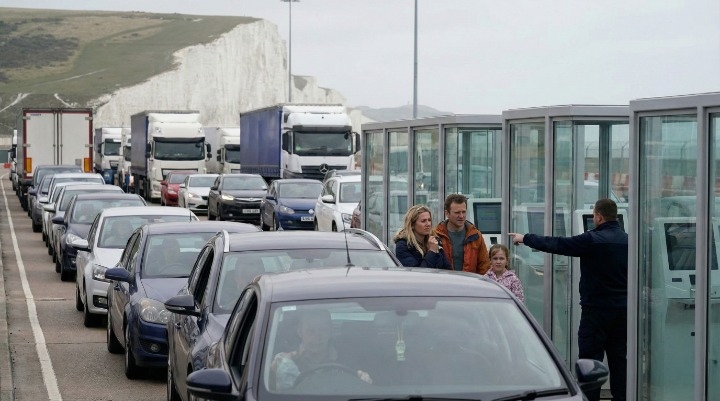
The Port of Dover presents a unique geographical challenge. Unlike an airport, where passengers are pedestrians, Dover processes vehicles. The “juxtaposed controls” mean French border checks happen on UK soil before you board the ferry.
The 6-Minute Vehicle Hurdle
Official trials conducted by the Port of Dover and Kent Resilience Forum have been sobering.
- Old Process: A border guard glances at passports through a car window. Time: ~45 seconds.
- EES Process: All passengers (except children under 12) must exit the vehicle to use a kiosk or tablet. Time: ~6 minutes per car.
This six-fold increase in processing time is the primary reason why the rollout for private cars at Dover was pushed back to early 2026. The infrastructure, sheds, kiosks, and tablets, is physically limited by the white cliffs and the sea. There is no room to expand.
Pro-Tip: If you are driving to France, ensure every passenger has their passport ready and shoes on. The delay caused by a family of four searching for a lost passport in the boot or putting on trainers is now a major source of friction.
Eurostar & Eurotunnel: Staggered Arrivals
Eurostar has responded to the EES by capping ticket sales on certain peak trains to ensure the terminal at St Pancras does not become overcrowded. They have also invested heavily in “SmartCheck” facial biometrics to speed up the UK side of the exit, but the French entry check remains the bottleneck.
At Eurotunnel (Le Shuttle), the challenge is similar to Dover but slightly better managed due to more space at the Folkestone terminal. They have installed over 100 biometric kiosks in drive-through lanes, but heavy traffic days still see compound delays.
For Logistics & Hauliers: The Automated 90/180 Day Risk
The EES is not just about queues; it is about data. For the logistics sector, the system enforces the Schengen 90/180-day rule with algorithmic ruthlessness.
No More Human Discretion
Previously, a driver who had spent 92 days in the EU might have been waved through by a sympathetic border guard or simply not noticed due to a faded stamp. The EES digital record eliminates this.
- The Mechanism: The system calculates the exact time spent in the Schengen area over the rolling 180-day period.
- The Consequence: If a driver hits 90 days, the barrier will not open. They will be refused entry immediately.
Business Continuity Risks
Haulage firms must now track their drivers’ time in the EU with forensic accuracy. Freightlink warns that many UK operators are unprepared for this. A driver refused entry at Calais creates a massive operational headache, the load is stuck, the truck is stuck, and a relief driver must be deployed.
Industry Insight: Smart fleet managers are now rotating drivers on shorter loops to preserve their “Schengen allowance” for peak periods. Relying on manual logbooks is no longer safe; you need digital tracking that mirrors the EES calculation.
ETIAS 2026: The Next Wave of Disruption
While we grapple with the EES, the next hurdle is already visible on the horizon. The European Travel Information and Authorisation System (ETIAS) is the digital travel permit that will link to your EES profile.
From €7 to €20?
Originally priced at €7, there is growing speculation in Brussels that the fee may need to rise to cover the escalating costs of the delayed EES infrastructure. For now, the official price remains €7, valid for three years.
Q4 2026 Target
The EU has stated that ETIAS will only launch after the EES has stabilised, likely towards the end of 2026. This “consecutive rollout” is designed to prevent a total system collapse, but it means travellers will face two distinct waves of new bureaucracy within a single year.
EES Troubleshooting: How to Minimize Your Wait Time
You cannot change the system, but you can adapt your behaviour. Here is the 2026 survival checklist for UK travellers.
-
The “First-Time” Strategy:
Your first trip requires the full biometric enrolment (fingerprints + photo). This is the “slow” trip. If possible, schedule this for a quiet travel period (e.g., a mid-week crossing in May) rather than the first day of the school summer holidays. Once you are in the system, subsequent verified crossings are faster.
-
Avoid the “Trap” Lanes:
At airports, avoid the lanes closest to the transfer desks, they often get clogged with complex visa cases. Head for the furthest lanes, which are often overlooked by the herd.
-
Keep Your Boarding Pass:
Unlike the old days where your passport was the only key, EES kiosks often require you to scan your boarding pass to link your travel details to your biometric file. Do not bury it in your bag.
-
Check the “Border Pulse”:
Before leaving for Dover or St Pancras, check the operator’s Twitter/X feed for real-time queue warnings. If delays are “severe” (>90 mins), pack extra water and food. The “buffer zones” have limited facilities.
-
Review Your Passport Validity:
The EES will instantly flag passports with less than 3 months remaining or those older than 10 years. The “10-year rule” is now strictly enforced by the machine; there is no wiggle room.
Conclusion
The rollout of the Entry/Exit System has confirmed what many experts feared: the infrastructure was not fully ready for the volume of traffic it handles. The eu entry exit system problems we are seeing in 2026, from the 4-hour queues to the desperate “flexibility” clauses, are the growing pains of a digital border.
For the UK traveller, the era of the “wave-through” is over. The border is now a data-collection point, and crossing it requires the same level of preparation as checking in for a flight.
The summer of 2026 will be the stress test. While the 90-day suspension rule offers a safety valve, it is a sign of fragility, not strength. By understanding the specific bottlenecks at hubs like Dover and Lisbon, and preparing your documents (and your patience) accordingly, you can navigate the Schengen Stall without it ruining your trip.
[Official EU EES Information Portal]
About the Author