South African Gold Fever: How the 1886 Witwatersrand Rush Shaped the Modern World
In 1886, the Witwatersrand basin was a quiet stretch of farmland in the Transvaal Republic. Ten years later, it was the site of the most lucrative real estate on earth. The South African gold fever completely transformed the global economy.
This was not a traditional tale of lucky men panning in rivers. The Witwatersrand rush operated as a massive industrial acquisition. It heavily fueled the London Stock Exchange and ultimately triggered the Second Anglo-Boer War. The desperate need for cheap mining labour also created a deeply segregated system that scarred the region for generations.
Expert Researcher’s Note: Tracking the Wealth in Kew
When researching the true impact of the South African gold fever on the British Empire, the most revealing stories live in the ledgers. If you ever visit the National Archives in Kew, request the Colonial Office records from the mid-1890s. By tracing the shareholder registries of the early mining syndicates, you see exactly how intertwined British political figures were with Transvaal mining profits. It changes the story from a simple “gold rush” into a calculated financial takeover.
What was the South African gold fever?
The South African gold fever refers to the massive 1886 global rush following the discovery of gold in the Witwatersrand basin of the Transvaal Republic. It rapidly transformed Johannesburg into a major metropolis, triggered the Second Anglo-Boer War, and ultimately resulted in South Africa dominating global gold production.
Key Takeaways (TL;DR)
- Massive Output: By 1898, the Transvaal produced 27.5% of the world’s total gold supply.
- London’s Bankroll: British banks and the London Stock Exchange heavily capitalised on the mining boom.
- Imperial Conflict: Tensions over gold wealth and migrant rights directly caused the Second Boer War (1899–1902).
- Systemic Segregation: The mines required cheap, tightly controlled labour, laying the legislative groundwork for apartheid.
The 1886 Discovery at Witwatersrand and the Birth of eGoli
The Geological Miracle of the “Golden Arc”
The gold in South Africa looked very different from the gold found in California or Australia. Prospectors did not find loose nuggets in shallow streams. Instead, the Witwatersrand basin held a massive, deep-level underground reef of gold-bearing conglomerate rock.
Extracting this gold required heavy machinery, deep shafts, and complex chemical processes. Individual prospectors quickly ran out of money. Only massive corporate syndicates with deep pockets could afford to pull this gold from the earth.
George Harrison and the Farms of the Transvaal
The rush officially began when an Australian prospector named George Harrison discovered an outcrop of the gold reef on a farm in 1886 (Source: National Army Museum, 2024). Word spread rapidly across the globe. Thousands of hopeful migrants flooded into the region.
They set up a chaotic tent city called Ferreira’s Camp. This dusty camp exploded into the city of Johannesburg, known locally as eGoli (the City of Gold). The population growth was staggering:
- 1886: A few hundred prospectors in tents.
- 1896: Over 100,000 residents living in a sprawling, modern metropolis.
The London Connection: Fueling the British Empire’s Economy
Transnational Capital and the London Stock Exchange
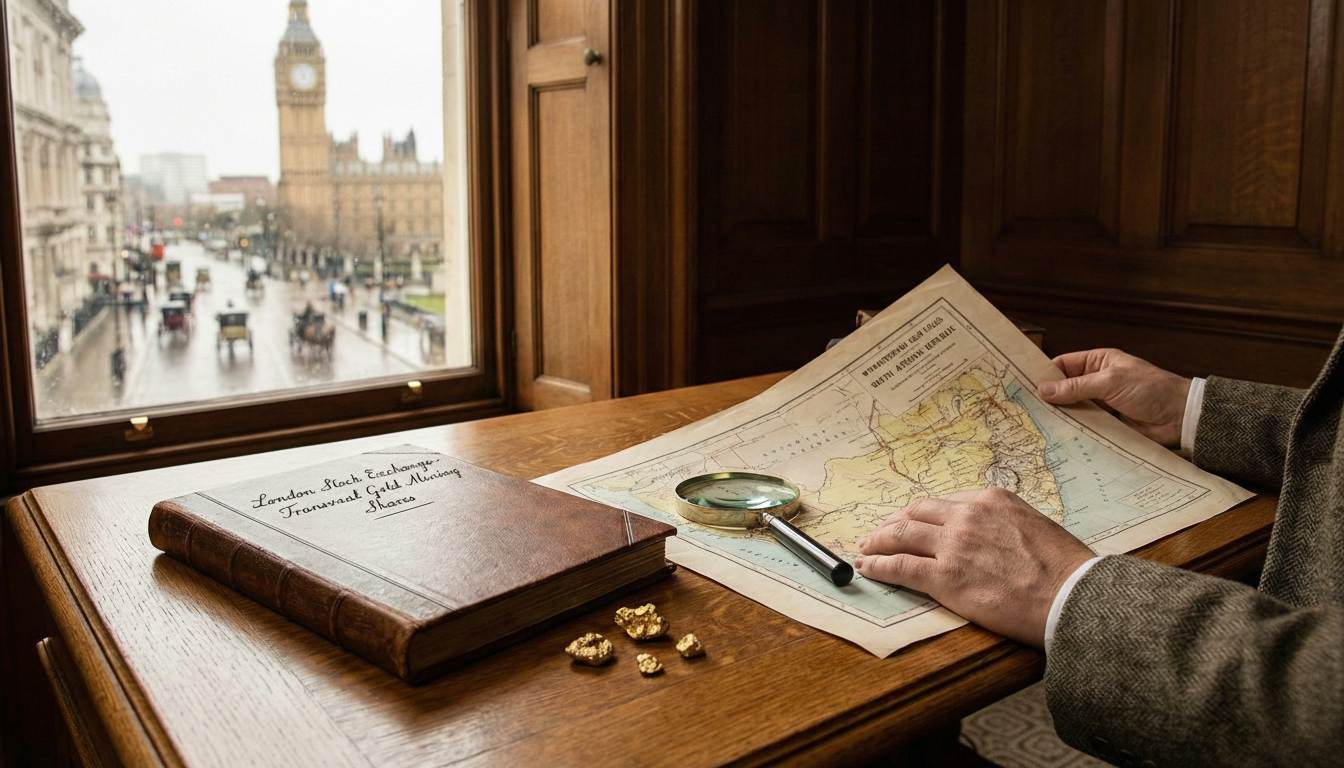
The South African gold fever did not just build Johannesburg. It enriched the British Empire. Extracting deep-level gold required immense capital, and London financiers eagerly provided it.
British investors bought massive shares in South African mining companies. The gold flowed directly back to the Bank of England, stabilising the British gold standard. The profits were vast. By the mid-1890s, the Transvaal operation of the Standard Bank of British South Africa contributed 40% of the bank’s overall profits (Source: University of Edinburgh, 2023).
Cecil Rhodes and the Rise of the Randlords
A small group of wealthy financiers seized control of the Witwatersrand basin. The public called them the “Randlords.” Men like Cecil John Rhodes used British capital to buy out smaller claims and form massive monopolies.
Rhodes founded Consolidated Gold Fields. These monopolies dictated the price of labour and the pace of extraction. By 1898, just twelve years after Harrison’s discovery, the Transvaal region accounted for 27.5% of the global gold output (Source: School of Advanced Study, University of London, 1981).
Geopolitical Fallout: The Uitlanders, Raids, and Imperial War
The Uitlander Influx vs. President Paul Kruger
The influx of foreign miners terrified the local Boer government. The Boers controlled the South African Republic (the Transvaal), led by President Paul Kruger. The Boers called the new British and foreign migrants “Uitlanders” (Outlanders) (Source: National Army Museum, 2024).
Kruger knew the Uitlanders vastly outnumbered his Boer citizens. He heavily taxed the mining industry and refused to give the Uitlanders voting rights. He feared the British would use the migrants to vote the Boer republic out of existence.
The Jameson Raid (1895) and the Second Anglo-Boer War (1899–1902)
British politicians and Randlords wanted total control over the gold. In late 1895, the British South Africa Company orchestrated the Jameson Raid. This was a failed, armed uprising designed to overthrow President Kruger and seize the goldfields (Source: Bodleian Library, University of Oxford / Archives Hub, 2024).
The raid failed miserably, but it destroyed any remaining trust. Geopolitical tensions over the gold wealth and British subject rights escalated sharply. This standoff directly triggered the South African War (Second Boer War), a brutal conflict fought from 1899 to 1902 (Source: White Rose Research Online, 2025).
Global Gold Rushes Compared (Data Snapshot)
To understand why the South African gold fever caused a major war, we must compare it to other famous gold rushes. The type of gold directly dictated the political outcome.
| Gold Rush | Year Started | Type of Deposit | Primary Workforce Structure | Geopolitical Consequence |
| Witwatersrand (South Africa) | 1886 | Deep-level conglomerate | Corporate / Migrant Labour | Second Anglo-Boer War |
| California (USA) | 1848 | Shallow alluvial | Individual Prospectors | Accelerated US Westward Expansion |
| Klondike (Canada) | 1896 | Placer / Riverbeds | Individual Prospectors | Establishment of Yukon Territory |
The Dark Legacy: Labour, Legislation, and Apartheid
The Migrant Labour System and the 1913 Natives Land Act
Deep-level mining was incredibly expensive. To maintain their massive profits, the Randlords needed a massive, artificially cheap labour force. They targeted the indigenous Black population.
The mining companies and the government worked together to force Black Africans into the mines. They introduced heavy taxes that could only be paid in cash, forcing men to leave their farming communities for wage labour in Johannesburg. The government also introduced strict pass laws to control where these men could travel and work. This systemic exploitation laid the direct legislative groundwork for the 1913 Natives Land Act and the later system of apartheid.
Chinese Indentured Labour on the Far East Rand
After the Second Boer War, the mines faced a severe labour shortage. Black workers refused to return to the dangerous mines for reduced wages. The British mining syndicates solved this by importing over 60,000 indentured labourers from China between 1904 and 1910.
The British public reacted with outrage to the poor conditions these Chinese workers faced. The resulting political scandal helped topple the Conservative government in the UK. The government eventually repatriated the Chinese workers, and the mines doubled down on exploiting local African labour.
The Environmental Aftermath of the Transvaal Gold Boom
Acid Mine Drainage and Toxic Dumps
The South African gold fever left a lasting, toxic legacy on the landscape. Early miners dumped crushed waste rock into massive, yellow heaps known as mine dumps. These dumps still surround modern Johannesburg.
Today, the city faces a severe crisis with acid mine drainage. Water floods the abandoned, deep-level shafts, mixing with heavy metals and radioactive elements. This toxic water occasionally breaches the surface, poisoning local water supplies and threatening modern communities.
Conclusion
The 1886 discovery of gold on a quiet Transvaal farm changed the trajectory of the 20th century. The South African gold fever built modern Johannesburg, enriched the British Empire, and firmly established the global gold standard.
However, this wealth came at a devastating cost. The rush caused a brutal imperial war and entrenched a system of racial exploitation that defined South Africa for a century. The gold that stabilised international finance was extracted through systems of inequality that outlasted the mines themselves.
[Check out deep dive into the economic impacts of the British South Africa Company] to explore more about British colonial history.
FAQs
How did the South African gold rush start?
It started in 1886 when an Australian prospector named George Harrison discovered an outcrop of gold-bearing rock on a farm in the Witwatersrand basin.
Where was the largest gold deposit discovered in South Africa?
The largest deposit was found in the Witwatersrand basin, a geological formation stretching across the former Transvaal Republic (near modern-day Johannesburg).
Who were the Uitlanders during the Witwatersrand gold rush?
“Uitlanders” (Outlanders) was the term used by the local Boers to describe the massive influx of British and foreign migrant workers who arrived to mine the gold.
What was the Jameson Raid of 1895?
It was a failed, armed raid orchestrated by British politicians and mining executives to trigger an uprising, overthrow the Boer government, and seize control of the goldfields.
How did gold fever cause the Second Boer War?
The British Empire wanted control over the vast gold wealth and demanded voting rights for the British Uitlanders. The Boer government refused, leading to an escalation that sparked the war in 1899.
Did the South African gold rush cause apartheid?
While apartheid was officially enacted in 1948, the gold mines created its foundation. The mines required cheap, controlled labour, leading to the creation of pass laws and racial segregation policies decades earlier.
What is the environmental impact of Johannesburg’s historical gold mines?
The historical mines have caused severe acid mine drainage, where toxic, heavy-metal-laced water floods abandoned shafts and contaminates local groundwater.
About the Author