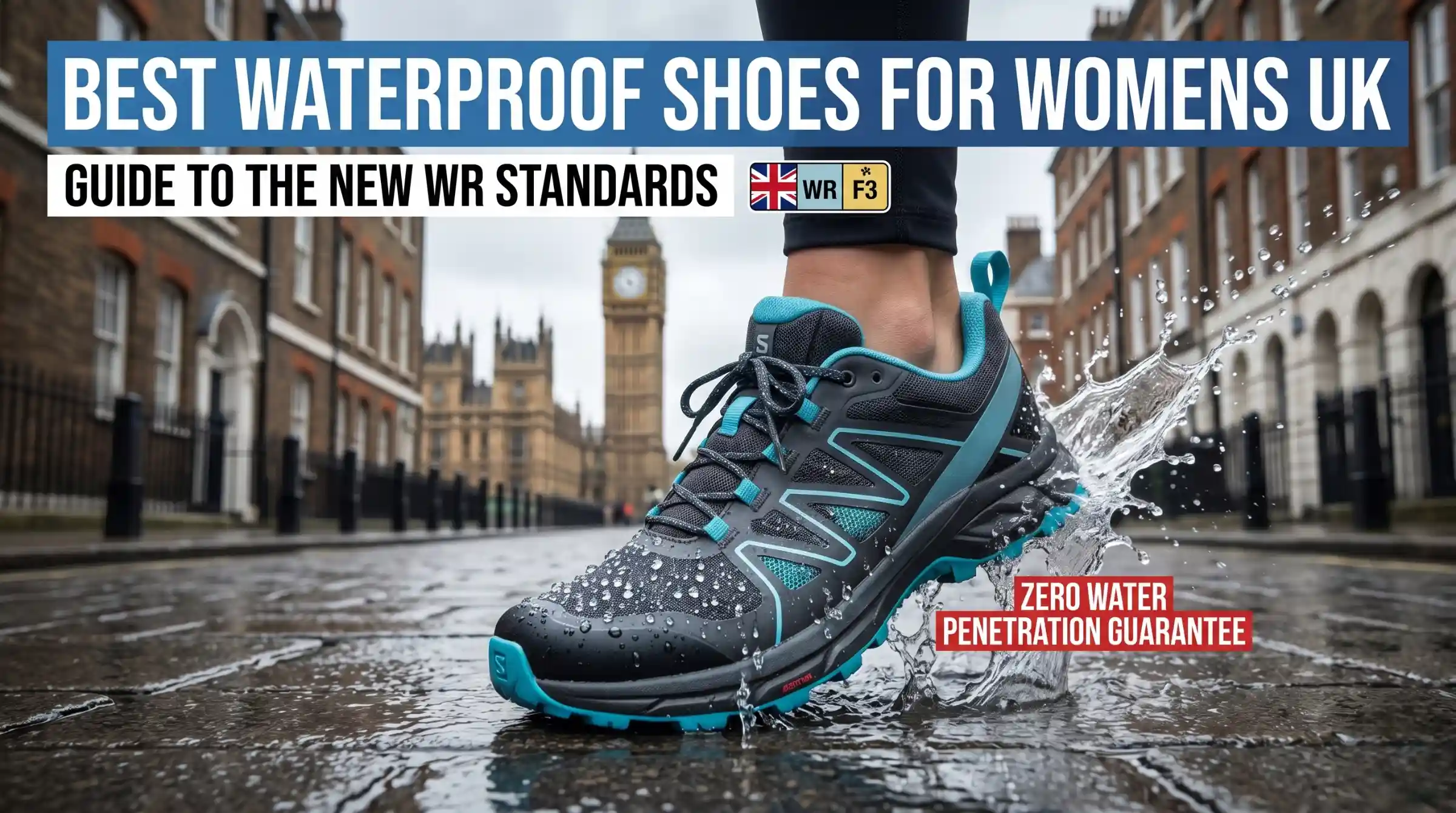
Best Waterproof Shoes For Womens: Navigating the 2026 UK Standards
Walking through the British rain shouldn’t mean spending the rest of the day with damp socks. Yet, most “waterproof” trainers fail exactly when you need them most.
The rules have changed. Following the recent update to UK and European safety footwear standards, the line separating genuinely waterproof shoes from merely water-resistant ones has radically shifted. To stop wasting money on footwear that leaks, UK buyers must understand the difference between the new WPA and WR ratings. You need to recognise the weak points in shoe anatomy and choose materials suited for your specific environment.
Genuinely waterproof shoes for womens must achieve a “WR” (Water Resistance) certification, meaning testing detected zero water penetration. Standard trainers marked “WPA” (Water Penetration and Absorption) or featuring basic DWR coatings are only water-resistant and will eventually leak through stitched seams or fabric panels during prolonged exposure to UK rain.
Key Takeaways
- The UK updated its footwear safety standards in 2022.
- “WR” guarantees zero water entry, while “WPA” means the shoe will eventually leak.
- Seams and laces remain the primary failure points in waterproof shoes.
- High-quality treated suede can handle rain just as well as smooth leather.
- External waterproof membranes protect better in extreme weather than internal ones.
- Proper re-waterproofing requires specific waxes or creams instead of basic sprays.
- Enhanced slip resistance is a vital safety feature for wet pavements.
Quick Start: How to Choose
Use this simple 3-step decision tree to match the shoe to your environment:
- Are you walking through damp streets or light drizzle? A Water-Resistant (WPA) shoe with a basic protective coating is enough.
- Are you walking through wet grass, heavy rain, or puddles for over 30 minutes? You need a Waterproof (WR) shoe with a dedicated membrane and sealed seams.
- Are you fully submerging your feet in deep bogs? Standard waterproof shoes will fail here. You require fully sealed rubber wellingtons.
The New UK Reality: Water-Resistant (WPA) vs. Waterproof (WR)
The standards for keeping feet dry are now stricter. The UK and European safety standard for footwear updated to EN ISO 20345:2022. This shift introduced much tougher definitions for water resistance UK Safety Footwear Standards Guide.
Under the 2022 standard, the old “WRU” (Water Resistant Uppers) label was scrapped. It was replaced by “WPA” (Water Penetration and Absorption). Why? To clarify to consumers that these shoes allow some water inside. They are not fully waterproof.
Pro Tip: Look for WR, not just WPA. If you need guaranteed dryness, look for the official “WR” (Water Resistance) classification. The “WPA” label means the shoe will eventually let some water in.
Shoes previously classified as S2 and S3 with water resistance are now reclassified as S6 and S7. The old 2011 standard actually let up to 3cm³ of water leak inside and still pass the “WR” test. The new regulations fix this major flaw to protect consumers better.
“To achieve an official ‘WR’ (Water Resistance) certification under the latest standards, absolutely zero water penetration must be detected inside the shoe during testing.” (Uvex Safety Guide to EN ISO 20345:2022, 2023).
Common Mistake: Buying WPA shoes for heavy rain. WPA only means the outer material repels light water. It does not mean the shoe is watertight.
Top Verified Waterproof Shoes for UK Weather
Finding a shoe that meets these strict standards takes research. We verified three distinct options built to survive British weather.
For road running, the Brooks Ghost 17 GTX stands out. It pairs extra foam cushioning with a Gore-Tex outer layer to stop water entry (Runner’s World UK, 2026).
For hiking, the Scarpa Rush Trk Pro GTX Women’s Hiking Boots offer high support. They provide excellent grip for traversing wet terrain in the UK (Countryfile, 2025).
For daily commuters, THEESE Women’s Flow State Shoes take a modern approach. They use a seamless, edge-to-edge sealed knit rather than standard stitched seams to prevent leaks completely (WearTheese, 2026).
| Shoe Model | Best For | Waterproof Tech | Material | Seam Style |
| Brooks Ghost 17 GTX | Road Running | Gore-Tex Outer | Synthetic | Stitched/Sealed |
| Scarpa Rush Trk Pro GTX | Hiking/Trails | Gore-Tex Internal | Suede/Leather | Stitched/Sealed |
| THEESE Flow State | Commuting | 100% Waterproof Knit | Knit | Seamless Edge |
The Anatomy of a Truly Waterproof Shoe
Most shoes leak for one simple reason. They are full of tiny holes.
Standard fabric-panelled trainers offer absolutely no inherent water resistance. They only work if actively treated with a water-repellent coating or built with an internal waterproof membrane. Over time, heavy wear and tear degrades standard stitched seams. Because of this, industry standards clarify that 100% waterproofing cannot be permanently guaranteed on normal footwear. The only exception is fully sealed polymer or rubber, like a pair of wellingtons.
Pro Tip: Seams are the weak point. Heavy stitching is a prime area for water ingress. Seek out seamless knit designs or heavily sealed seams if you want lasting protection.
High-level waterproof shoes rely on injection-moulded or heavily glued soles. They pair these with sealed seams and breathable membranes to block rain while letting your foot sweat escape Breathable Waterproof Membranes Explained.
“Waterproof running shoes have an impenetrable membrane sandwiched between the outer fabric and the liner… designed to keep water from entering.” (Runner’s World UK, 2026).
Pro Tip: Accept the breathability trade-off. Adding a waterproof membrane inherently reduces a shoe’s breathability. It also adds a small amount of weight compared to standard summer trainers.
The 4 Key Components of Waterproof Construction
- Breathable Membrane: Technologies like Gore-Tex act as a microscopic shield inside the shoe fabric.
- Sealed Seams: Injection moulding blocks water far better than traditional needle stitching.
- Gusseted Tongue: The tongue must be attached to the sides of the shoe. Otherwise, water simply pours in through the laces.
- Slip-Resistant Outsole: Wet weather means slick pavements. UK protective footwear tests were enhanced in 2022 to specifically target the heel-strike and toe sections for better wet-weather safety.
Evaluating a New Pair of Waterproof Shoes (Checklist)
- [ ] Check the Tongue: Is it gusseted?
- [ ] Check the Seams: Are they minimal, sealed, or non-existent?
- [ ] Check the Sole: Is it injection-moulded to the upper rather than just stitched?
- [ ] Check the Certification: Does the brand explicitly claim “0% water penetration” or list a specific membrane?
- [ ] Check the Fit: Is there room for thick, moisture-wicking socks without restricting your circulation? Tight shoes lead to cold feet.
Mid-Article Summary: Stop the Leaks
- Always verify WR (Water Resistance) over WPA (Water Penetration).
- Check for gusseted tongues and sealed seams before buying.
- Understand that internal membranes always reduce breathability slightly.
Real UK Scenarios: Commuting vs. Countryside
A daily UK commuter needs footwear for walking to the train station in regular drizzle. Heavy, fully sealed rubber boots will cause massive overheating on a crowded train. Instead, a lightweight shoe with an internal breathable waterproof membrane is ideal. It easily handles light rain. However, the commuter must actively re-apply a DWR (Durable Water Repellent) spray every few months to stop the outer fabric from soaking through.
Compare that to a dog-walker in the Scottish Highlands. They frequently traverse long, wet grass. Standard “water-resistant” trainers will allow water to seep through the seams within 15 minutes. Upgrading to a shoe with an official “WR” rating and sealed, injection-moulded soles ensures zero water penetration.
Pro Tip: Mind the ankle gap. No matter how waterproof the shoe itself is, water can still enter through the top collar. For deep puddles or long wet grass, you must pair the shoes with waterproof trousers or gaiters [External Link: Best Waterproof Trousers & Gaiters].
Myths and Truths: Material Choices for Wet Weather
Can suede actually survive the UK rain? Many shoppers avoid it entirely. This is a mistake.
Contrary to common consumer misconceptions, high-quality suede shoes can be as water-resistant as smooth leather. The secret lies in proper treatment and construction.
Pro Tip: Suede isn’t the enemy. Do not avoid a great walking shoe just because it uses suede. If properly constructed and regularly treated with the right repellant, it performs brilliantly.
For extreme weather, UK retailers recommend a different approach. Look for shoes with a patented external waterproof membrane rather than standard multi-layered internal protection. An external membrane prevents the outer shoe fabric from “wetting out” and becoming heavy.
Expert Care: How to Maintain the Waterproofing
Factory waterproof coatings do not last forever. Mud, scuffs, and flexing break down the invisible DWR layer on the outside of your shoes. When this happens, water stops beading up and starts soaking into the top fabric.
You must re-waterproof them. But you have to use the right tools.
“Waxes and creams are the ideal product for re-waterproofing leather hiking boots.” (Countryfile, 2025).
Pro Tip: Re-waterproof leather properly. Always use specific waxes and creams for leather walking shoes. Standard chemical sprays can dry out the natural leather and cause it to crack Guide to Re-Waterproofing Leather Boots.
End Summary
Finding genuine waterproof shoes for womens requires looking past marketing hype. You must understand the physical construction of the shoe, from the WPA and WR safety ratings to the sealing of the seams. By prioritising the right materials for your specific use case, you can conquer the UK weather comfortably.
Next Steps:
- Assess your primary use case (commuting vs. heavy trails) using our quick decision tree.
- Check your current wet-weather shoes for worn-out DWR coatings and re-apply if necessary.
- When shopping, inspect the tongue gussets and seam seals before you even look at the price tag.
FAQs
Are Gore-Tex trainers 100% waterproof?
Gore-Tex membranes are waterproof, but the shoe itself might leak if water enters over the ankle collar or if the seams degrade over time.
What is the difference between water-resistant and waterproof shoes?
Water-resistant (WPA) shoes repel light rain but eventually let water in. Waterproof (WR) shoes block zero water penetration under strict testing.
Can I make my normal trainers waterproof?
You can make them water-resistant using a DWR spray, but you cannot make standard fabric trainers 100% waterproof because the stitched seams will still leak.
Are suede boots okay in the rain?
Yes. High-quality suede is highly water-resistant if it is properly treated and maintained with specialised suede protectors.
Why do my waterproof walking shoes still leak?
Usually, it is due to seam failure, a worn-out DWR outer coating causing the fabric to “wet out”, or water splashing over the low ankle collar.
How long does the waterproofing last on running shoes?
The internal membrane often lasts the lifespan of the shoe (300-500 miles), but the external water-repellent coating needs reapplying every few months.
What is a WR vs WPA safety rating for footwear?
WR stands for Water Resistance (zero penetration). WPA stands for Water Penetration and Absorption (allows some water ingress). These are official EN ISO 20345:2022 standard ratings.
About the Author