How Many Calories In A Pint Of Guinness Beer vs Lager? (UK Guide)
Is Guinness really a meal in a glass? We have all heard the pub myth. You look at that thick, dark foam and assume it is packed with calories. It feels heavy. But the reality is quite different. Navigating UK pub culture while tracking your weight can feel stressful. Yet, despite its heavy reputation, Guinness is actually lighter than many standard pub lagers. It is a surprisingly smart choice for the calorie-conscious drinker.
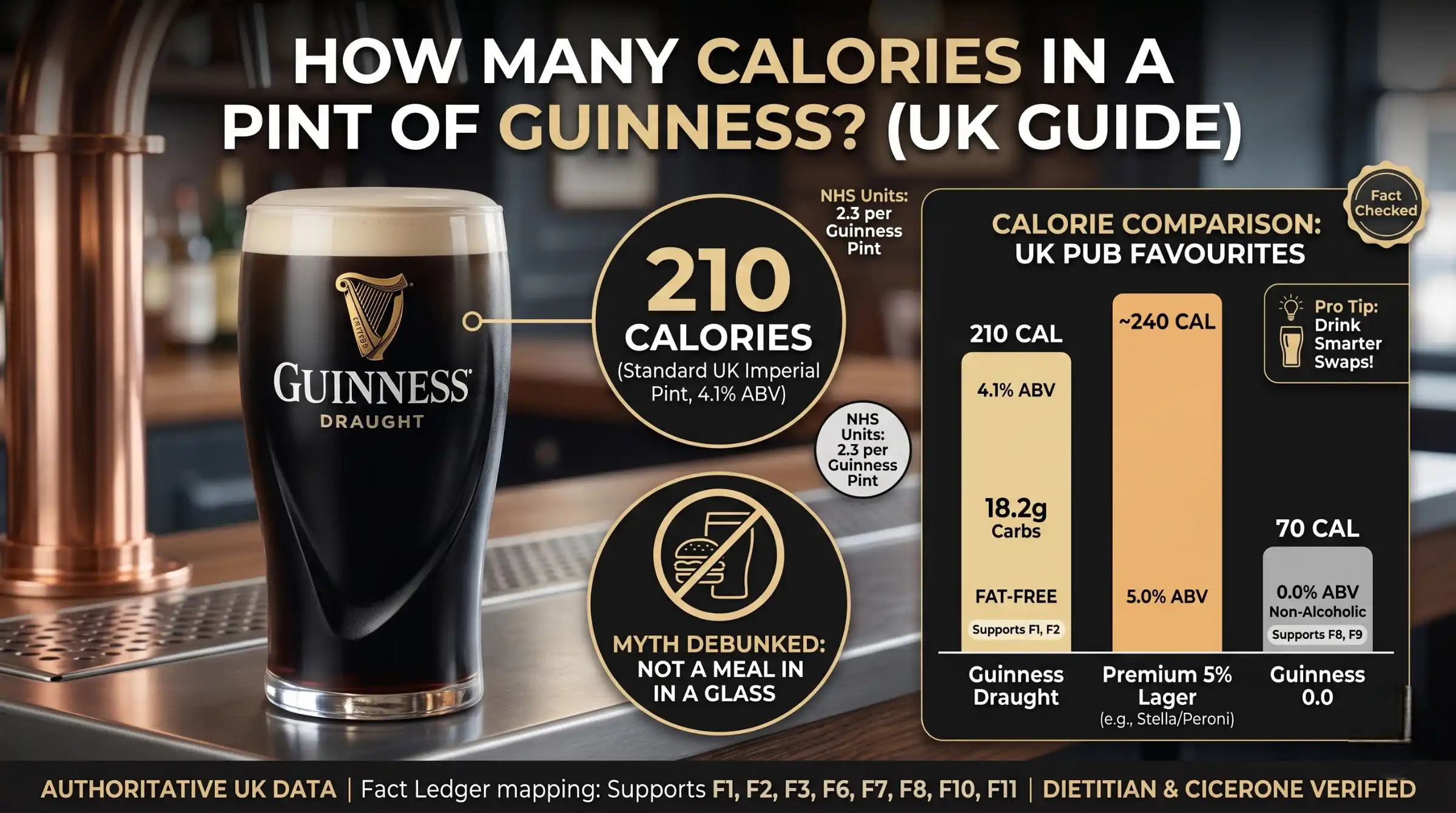
In the UK, a standard imperial pint (568ml) of 4.1% ABV Guinness Draught contains approximately 210 calories. This is noticeably lower than many premium 5% lagers, which typically contain between 220 and 250 calories per pint. Guinness is functionally fat-free and provides roughly 18.2 grams of carbohydrates.
Key Takeaways
- A standard UK pint contains roughly 210 calories.
- It provides about 18.2g of carbohydrates per pint.
- Switching to the 0.0 non-alcoholic version cuts calories to just 70.
- Guinness regularly has fewer calories than a standard 5% premium lager.
- Keep in mind that drinking 6 pints nearly hits the NHS weekly limit of 14 alcohol units.
Quick Start: The Pub-Goer’s Macro Checklist
Are you worried about ruining your diet at the pub? Follow these simple steps before you order:
- Remember the baseline: If you are ever in doubt at the bar, remember the golden rule. One standard UK imperial pint of Guinness Draught is exactly 210 calories.
- Do the “Empty Calorie” check: Have you consumed more than 3 pints of standard Guinness this week? If yes, you have already drunk over 630 empty calories.
- Plan a swap: To maintain a calorie deficit without missing out on socialising, consider changing your next round to a Guinness 0.0. This easy switch saves roughly 140 calories per pint.
The Exact Nutritional Breakdown of UK Guinness Draught
Let us look at exactly what goes into your glass. The primary manufacturer confirms the baseline numbers. “A standard pint (568 ml) of Guinness Draught contains approximately 210 calories.” It really is that simple.
Understanding where these calories come from helps you make better choices. [NHS Guidelines on Alcohol Calories] Alcohol itself is the main driver of weight gain from pub drinks.
Carbs, Fats, and ABV
Always base your math on the UK standard. Here, Guinness Draught is served at 4.1% to 4.2% ABV. Do not confuse it with stronger foreign variants when tracking your intake.
If you are on a keto or low-carb plan, pay attention to the carbs. A single pint uses up roughly 18.2 grams of your daily carbohydrate allowance.
Common mistake: Thinking Guinness is full of fat because it feels creamy. It is actually functionally fat-free. The thick mouthfeel comes from nitrogen gas, not dietary fat. Ignore the old “meal in a glass” myth entirely.
Guinness vs. Premium Lagers: The Calorie Showdown
This is where the dark beer myth falls apart. When placed next to a standard blonde lager, Guinness often wins the diet battle.
A standard pint of Guinness Draught is roughly 210 calories. Meanwhile, a typical premium 5% lager averages 220 to 250 calories per pint. As industry specialists at UK Brewery Tours state, “Guinness contains fewer calories than many premium 5% lagers.”
| Drink Type (UK Pint) | ABV (%) | Calories | Carbs (g) |
| Guinness Draught | 4.1% | 210 | 18.2 |
| Premium 5% Lager | 5.0% | ~240 | ~15.0 |
| Standard 4% Lager | 4.0% | ~170 | ~11.0 |
| Guinness 0.0 | 0.0% | 70 | 15.8 |
Let us look at a real-world pub scenario. Imagine a drinker who normally orders four pints of a 5% premium lager on a Friday night. That is roughly 960 calories. If they switch to four pints of 4.1% Guinness Draught, they consume 840 calories. This simple swap saves 120 calories over the evening without cutting down the volume of liquid they get to enjoy.
Mid-Article Summary
- Guinness Draught contains 210 calories per standard UK pint.
- Premium 5% lagers frequently exceed 240 calories.
- The dark, heavy appearance comes from roasted barley, not extra sugar or fat.
The Science of Empty Calories and Alcohol Units
Why does beer make you gain weight? It is not usually the carbohydrates. It is the alcohol. Alcohol is incredibly calorie-dense. The NHS puts it bluntly. “Calories from alcohol are ’empty calories’ – they have no nutritional value.” They literally just add to your waistline.
Every gram of alcohol carries 7 calories. That adds up fast. If you want to understand your drink, you must look at the alcohol content first. [UK Drinkaware Unit Calculator]
The Hierarchy of Beer Calories
- Alcohol Content: ABV drives the base calorie count. Blame the alcohol, not the dark colour of the liquid.
- Residual Sugars: Carbohydrates play a secondary role in the total energy.
- Serving Size: Having a quick taster? Factor in half-pints. A 100ml measure of standard Guinness holds roughly 34 to 37 calories.
- Frequency: Count your units alongside your calories. Just one pint of 4.1% Guinness equates to approximately 2.3 units of alcohol.
The Ultimate Hack: Guinness 0.0 Calories
Want the pub experience on a strict diet? You have a secret weapon. The non-alcoholic version changes the game entirely.
Choosing the non-alcoholic Guinness 0.0 reduces your intake to approximately 70 calories per pint. Make this swap for aggressive cuts. It secures a massive 65% calorie reduction.
Think about a typical pub-goer. Let us say you drink three pints of Guinness a week. That is 630 calories. You decide to switch to Guinness 0.0. By making this swap, your weekly intake drops instantly to 210 calories. You effectively remove 420 empty calories from your weekly diet. That is the equivalent of a light meal, completely wiped from your ledger without sacrificing your Friday night routine.
Which Stout is Right For Your Diet?
- Strict on calories? Choose Guinness 0.0. It guarantees the absolute lowest calorie option at roughly 70 calories per pint.
- Tracking carbohydrates? Stick to your daily limit. A standard Guinness Draught contains 18.2g of carbs. Factor this in before ordering.
- Watching health limits? Stay under the 14-unit weekly UK health limit. Cap your intake at 6 pints of Guinness Draught per week.
Summary
A pint of Guinness at 210 calories is a perfectly manageable choice for a balanced lifestyle. It is lighter than most premium lagers. You just need to track your overall units and remember the heavy calorie density of alcohol itself.
Next steps:
- Calculate your weekly NHS unit intake to ensure you stay under 14 units.
- Try alternating with Guinness 0.0 on your next pub visit.
- Check out our guide to lower-calorie pub spirits for more diet-friendly options.
FAQs
Is Guinness good for weight loss?
No alcoholic drink actively promotes weight loss. However, at 210 calories per pint, Guinness Draught is a lower-calorie option compared to premium 5% lagers, making it easier to fit into a calorie deficit.
How many carbs are in a pint of Guinness UK?
A standard UK pint of Guinness Draught contains roughly 18.2 grams of carbohydrates.
Are there more calories in Guinness or Stella?
Premium 5% lagers like Stella Artois generally contain more calories. A standard premium lager averages 220 to 250 calories per pint, while Guinness sits at 210.
Why is Guinness so low in calories?
The main source of calories in beer is alcohol. Standard UK Guinness Draught has a relatively low ABV of 4.1% to 4.2%, which keeps the total calorie count down.
How many calories are in a half pint of Guinness?
Based on the standard 210 calories per full pint, a half pint contains approximately 105 calories.
Does Guinness make you put on weight?
Only a calorie surplus causes weight gain. Because Guinness contains “empty calories” from alcohol, drinking it in large quantities without adjusting your food intake will lead to weight gain.
How many calories in a can of Guinness vs a pint?
A standard UK pub pint (568ml) is 210 calories. Supermarket cans are typically smaller (440ml). Using the baseline of 34 to 37 calories per 100ml, a 440ml can contains fewer calories than a full pub pint.
Is Guinness 0.0 completely calorie-free?
No. Guinness 0.0 contains approximately 70 calories per standard pint. It is not calorie-free, but it represents a 65% reduction compared to the alcoholic version.
About the Author