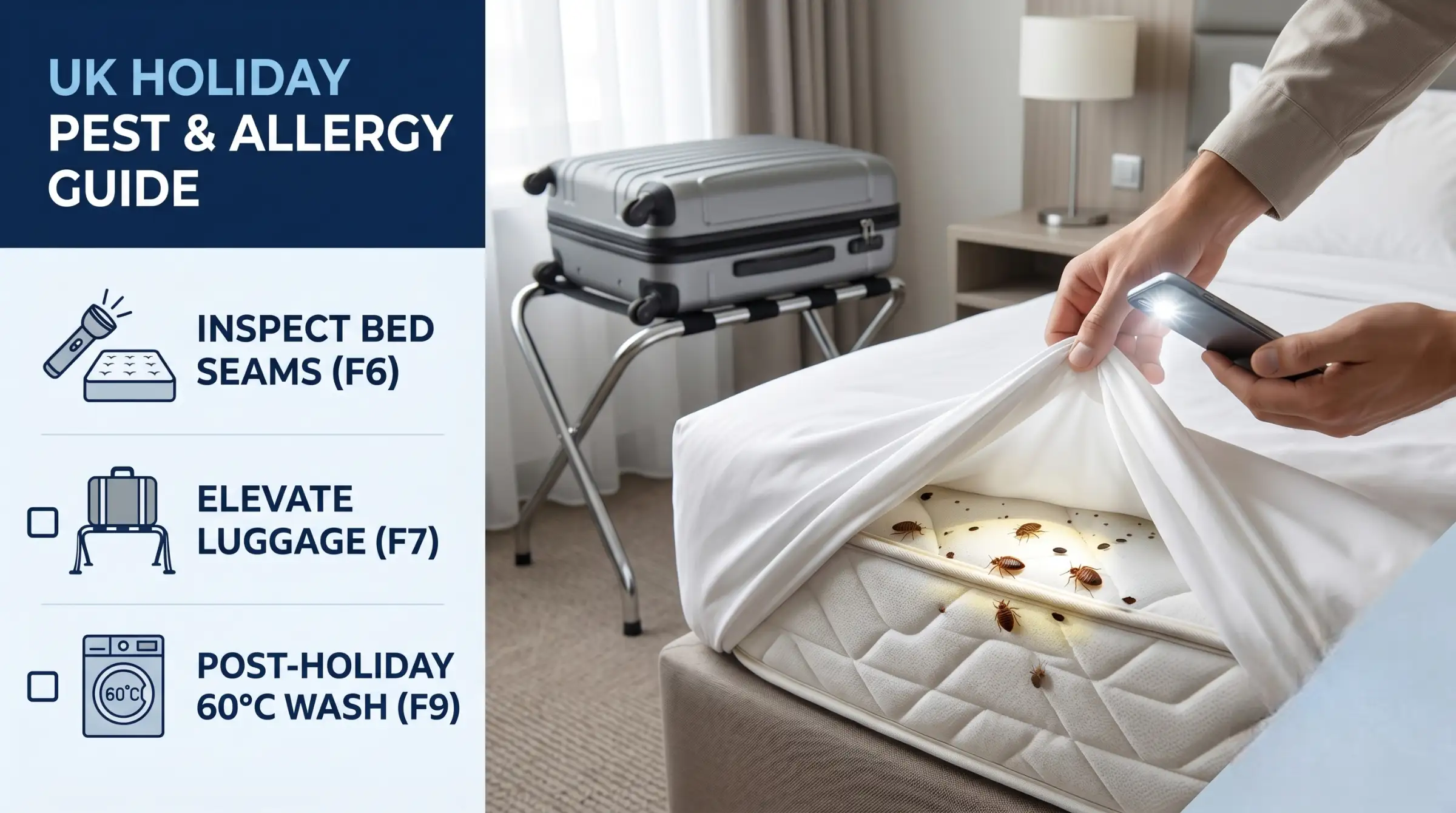
Avoid Bed Mites While on Holiday: The 5-Minute Room Audit
Waking up in a foreign hotel room with red, itchy welts is a nightmare. It ruins holidays. Thousands of UK travellers search for ways to fight “bed mites” every year. But that term is completely wrong. You are actually dealing with a biological mix-up. It is either biting bed bugs or microscopic, allergy-triggering house dust mites. Protecting your family means learning the exact difference between the two. You need to know what to spot and how to manage your luggage from the second you open your hotel door until the moment you run your washing machine back home.
To avoid bed mites while on holiday, never place your luggage on the hotel bed or carpet. Keep suitcases on metal luggage racks. Inspect mattress seams for 5–7mm oval bugs, cast-off skins, or dark spotting. Wash all returning holiday clothing at a minimum of 60°C to eliminate pests and allergens.
Key Takeaways
- “Bed mites” do not actually exist; you are dealing with either bed bugs or house dust mites.
- Bed bugs bite humans and travel in luggage; dust mites trigger respiratory allergies.
- Hard-shelled suitcases drastically reduce the risk of bringing pests back to the UK.
- A fast 5-minute visual inspection of your hotel mattress can prevent a massive home infestation.
- All returning holiday textiles must be washed at 60°C or frozen for eight hours.
Quick Start: Bed Bugs vs. House Dust Mites
| Threat | Size | Impact on Humans | Where they hide |
| Bed Bugs (Cimex lectularius) | 5–7mm (visible) | Bites humans, feeds on blood | Mattress seams, crevices, luggage |
| House Dust Mites (D. pteronyssinus) | ~0.25mm (microscopic) | Triggers asthma and rhinitis | Soft furnishings, pillows, carpets |
The “Bed Mite” Myth: What Are You Actually Reacting To?
Stop searching for bed mites. They simply aren’t a real species. The confusion happens because holidaymakers mix up two very different problems. You need to know your enemy before you can defeat it.
House Dust Mites: The Hidden Allergy Trigger
House dust mites are microscopic creatures. They measure about 0.25mm across and thrive in warm, humid spaces like hotel pillows and carpets. They do not bite humans. Instead, their faecal droppings trigger allergic reactions like nocturnal coughing and rhinitis.
This is exactly why some people wake up sneezing on holiday. It is an environmental hazard. According to Transformation Partners in Health and Care, indoor air quality matters greatly, as a bedroom can sometimes be the most polluted room in the house.
Bed Bugs: The Biting Stowaways
Bed bugs are visible insects. These wingless, oval-shaped pests grow to about 5-7mm long. They hide in narrow spaces and bite humans while they sleep.
They are famous for hitchhiking. They frequently travel back to the UK by hiding in suitcases and clothing. Upgrading your travel bags helps block them. Hard-sided luggage creates a physical barrier that stops pests from infiltrating your belongings, a major weakness found in woven, soft-sided bags.
The 5-Minute Arrival Audit
Do not dump your bags on the bed. That is the quickest way to ruin your trip. Before you unpack a single item, you must audit the room.
Common mistake: Assuming expensive hotels are spotless. Bed bugs do not care about the nightly room rate. They care about fresh blood and dark hiding spots.
Follow this exact checklist the moment you walk through the door:
- Isolate the bags: Place your luggage straight into the bathroom or onto a hard metal rack. Keep it completely off the floor.
- Strip the bed: Pull back the bed sheets. Expose the bare mattress seams and the corner piping.
- Light it up: Grab your smartphone. Turn on the bright LED flashlight to inspect the mattress seams and headboards closely.
- Spot the signs: Look for live 5-7mm bugs, tiny white eggs, cast-off skins, or dark black faecal spotting on the fabric.
- Check the air: Check the overall room for heavy, dusty carpeting or damp odours, which signal high dust mite risks.
If the room passes, move your luggage to a hard storage area. If you spot evidence of bugs, grab your bags and request a room change immediately. You can check Which? Guide to buying suitcases for recommendations on solid, pest-resistant luggage for future trips.
4 Critical Mistakes UK Holidaymakers Make with Luggage
Travellers often sabotage themselves before they even leave the airport. The way you pack dictates your risk level. Avoid these four common traps.
- Using Soft-Sided Fabric Suitcases: Woven fabric provides endless hiding spots. Bugs easily grip the textured surface and lay eggs. Opt for hard-shelled suitcases instead. As travel experts note, “Bed bugs are less likely to make their way through hard surfaces compared to soft-sided bags.” (Staysure, 2025).
- Unpacking Directly onto the Hotel Bed: This is a massive error. You are moving your belongings directly into the primary danger zone. Always utilise a metal luggage rack or a hard wooden table to keep your bags elevated. Never place personal items on upholstered furniture or carpeted floors.
- Mixing Worn and Clean Clothes Without Seals: Pests spread fast. If one item gets contaminated, your whole suitcase is compromised. Seal all worn clothing in airtight plastic bags before packing them for the return journey. This stops cross-contamination.
- Assuming Premium Hotels are Immune: Five-star resorts suffer infestations too. Pests do not care about luxury; they care about human hosts. Checking the mattress seams is mandatory, regardless of how much you paid for the room.
Managing Dust Mite Allergies in Foreign Climates
Changing postcodes changes your allergy triggers. Holidaymakers suffering from dust mite allergies often find their symptoms worsen abroad. This depends heavily on local pollen counts, high climate humidity, and the soft furnishings in their accommodation. Humid air feeds mites. They multiply rapidly in damp coastal regions or poorly ventilated rooms.
Typical scenario example: A traveller with severe allergic rhinitis requests a hotel room situated on a higher floor with hard flooring rather than carpets. They avoid using decorative bed runners. By keeping their luggage elevated and packing antihistamines in their hand luggage, they prevent a severe asthma flare-up despite travelling to a humid climate.
If you have respiratory issues, demand a carpet-free room. Hard floors do not retain dust or moisture the way heavy hotel carpets do.
Mid-Article Summary Box
- Key Checkpoint:
-
-
Identify the threat: Bites mean bugs. Sneezing means dust mites.
-
Elevate luggage: Use metal racks. Never use beds or carpets.
-
Inspect immediately: Check mattress seams and headboards before unpacking anything.
-
Returning to the UK: The Post-Holiday Quarantine Protocol
Your front door is the final line of defence. Bringing contaminated luggage straight into your bedroom guarantees an infestation.
Typical scenario example: A UK family returning from a holiday in Southern Europe inadvertently transports pests in a soft-sided fabric suitcase. Because they dumped the bag on their bedroom carpet instead of unpacking outdoors, the infestation spread instantly. They required expensive professional pest control intervention.
Do not make this mistake. Use our official quarantine protocol.
Post-Holiday Quarantine Protocol
- Step 1: Unpack luggage outdoors, in a garage, or directly onto a hard, easily cleanable floor like a tiled kitchen.
- Step 2: Transfer all textiles—both clean and dirty—straight into the washing machine.
- Step 3: Run the cycle at a minimum temperature of 60°C. Standard cool washes will not work. As industry guidelines confirm, “A cycle at 60 °C for 30 minutes kills all bed bugs and eggs.” (Bedbug Specialist UK, 2024). This thermal threshold eliminates allergens, too.
- Step 4: For delicate items that cannot survive high heat, place them in a tightly sealed plastic bag. Put them in the deep freeze for a minimum of eight hours.
- Step 5: Vacuum the empty suitcase thoroughly. Focus on the interior zips and fabric linings.
- Step 6: Dispose of the vacuum contents in an outside bin immediately. Store the empty luggage away from primary bedrooms.
[NHS advice on treating insect bites]
Summary & Next Steps
Staying pest-free abroad requires strict discipline, not luck. Stop worrying about imaginary “bed mites” and focus on the real biological threats. Bed bugs bite. Dust mites trigger asthma. By elevating your luggage, visually auditing your hotel bed, and sanitising your clothes at 60°C when you return, you block both hazards effectively.
Next Steps:
- Purchase hard-shelled luggage before your next overseas trip.
- Pack a supply of airtight plastic bags and antihistamines in your carry-on.
- Bookmark our 5-Minute Arrival Audit checklist to use the moment you check into your room.
FAQs
Can you get bed bugs from a plane seat?
Yes. Although less common than hotel rooms, pests can easily transfer from another passenger’s clothing or cabin baggage onto fabric aeroplane seats.
What temperature kills bed bugs in a washing machine?
Clothing, bed linen, and fabric items must be washed at a minimum temperature of 60°C for at least 30 minutes to effectively eliminate insects and their eggs.
Do house dust mites bite humans?
No. House dust mites do not bite. They feed on dead skin cells. However, their faecal droppings trigger allergic reactions like rhinitis and nocturnal coughing.
Will freezing my clothes kill hotel pests?
Yes. For delicate items that cannot be washed at high temperatures, deep freezing them for a minimum of eight hours is recommended to kill dust mites and insects.
How do I know if my hotel room has bed bugs?
Visual indicators include live 5–7mm bugs, cast-off skins, small white eggs, and dark brown or black faecal spotting along mattress seams and headboards.
Can I claim compensation for bed bugs on a UK package holiday?
Under UK package travel regulations, if your accommodation is not of a reasonable standard due to an infestation, you may have grounds to claim compensation or request an immediate room change through your tour operator.
Are dust mite allergies worse in hot countries?
Yes. Humid, warm climates create the perfect breeding ground for microscopic allergens. Symptoms often worsen depending on local humidity levels and hotel furnishings.
About the Author