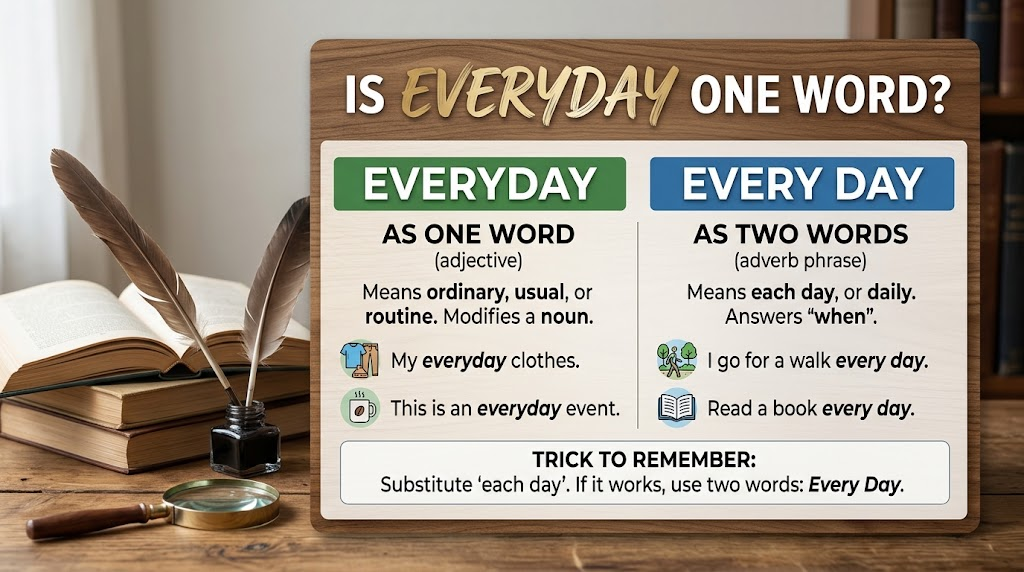
Are you stuck writing a sentence and wondering if you should write “Is Everyday One Word“ or “every day”? You are definitely not alone. This is one of the trickiest grammar traps in the English language. Even expert writers and digital publishers double-check this rule all the time. When you are rushing to finish a blog post or school paper, it is easy to mix them up. The good news is that once you learn the simple secret behind these words, you will never make a mistake again. Let us break down the grammar rules so you can use both terms like a true spelling pro.
Understanding the Big Difference
The main secret to getting this right is knowing their grammar roles. “Everyday” as one single word is an adjective. That means it describes a noun, like shoes, clothes, or tasks. For example, you might wear your everyday sneakers to school. On the other hand, “every day” as two separate words is an adverbial phrase. It means each day or all the time. If you drink matcha green tea, you probably do it every day. Knowing this core difference is your first big step toward absolute writing confidence.
When to Use Everyday (One Word)
Let us look closely at “everyday” when it is written as one single word. Remember that it acts like an adjective, which is a word that describes a person, place, or thing. You should only use this version when it sits right before a noun. Think about things that are normal, ordinary, or meant for daily use. Your backpack, your morning routine, and your favorite coffee mug are all part of your everyday life. If you can swap the word out with “ordinary” or “routine” and the sentence still makes sense, you definitely need the one-word spelling.
Real Examples of Everyday in Sentences
Seeing real examples makes grammar rules much easier to understand. Imagine you are talking about your favorite comfortable shoes. You would say, “These are my everyday running shoes.” Another great example is talking about normal tasks, like doing chores. You might write, “Washing the dishes is just another everyday chore.” In both of these sentences, the word describes a noun right next to it. Whenever you are describing a regular, common item or event, stick firmly to the single-word format without any spaces.
When to Use Every Day (Two Words)
Now let us switch gears and look at “every day” written as two separate words. This version is used to talk about how often something happens. It functions as an adverbial phrase of time. If an action happens daily, repeatedly, or on each single day, you need the two-word version. A great trick to test this is replacing the phrase with “each day.” If the sentence still sounds smooth, keep them separate. Writers often mix this up, but keeping an eye out for time clues will keep your grammar spotless.
Real Examples of Every Day in Sentences
Let us look at how “every day” works in everyday conversation. Suppose you practice playing the piano morning and night. You would say, “I practice the piano every day to get better.” Or think about your health habits, like going for a walk. You could write, “My dog and I go for a long walk every day after lunch.” In these examples, the phrase tells us when or how often the action takes place. If you can substitute “each day” into your sentence, write it as two distinct words.
A Simple Swap Trick to Test Your Spelling
Grammar tricks make writing so much easier and faster. Whenever you feel confused while editing your text, use the replacement test. If you want to use “everyday”, try swapping it with the word “ordinary.” If you want to use “every day”, try swapping it with “each day.” This little mental trick removes all the guesswork. As a digital content manager, I use quick validation tests like this constantly to keep my articles clean, professional, and free of embarrassing typos before they go live on the web.
Common Mistakes People Make
Even smart adults make mistakes with these tricky terms. One common error is writing, “I wear my favorite jacket every day use,” which mixes up the adjective and the adverb roles. Another mistake is writing, “I drink tea everyday,” when you actually mean you do it on each individual day. These tiny typos might seem small, but fixing them instantly makes your writing look polished and trustworthy. Paying attention to these details builds great habits that will help your writing stand out online and in school.
Quick Comparison Table
| Feature | Everyday (One Word) | Every Day (Two Words) |
| Grammar Role | Adjective | Adverbial Phrase |
| Meaning | Ordinary, normal, or routine | Each day, daily, or all the time |
| Replacement Test | Swap with “ordinary” | Swap with “each day” |
| Example Sentence | These are my everyday shoes. | I check my email every day. |
Why Spelling Accuracy Matters for SEO
If you publish content online, spelling matters more than you might think. Search engines and smart AI algorithms look closely at grammar and spelling quality. High-quality writing builds trust with your readers and keeps them on your page longer. When people find clear, helpful answers without confusing typos, they stay engaged. Taking the extra minute to check if “everyday” is spelled correctly helps your pages rank higher and satisfies search engine quality guidelines effortlessly.
Frequently Asked Questions
Is everyday one word or two words?
It can be both! “Everyday” as one word is an adjective used to describe a noun, like an everyday habit. “Every day” as two words means each day, as in doing something every day.
How can I remember the difference easily?
Use the replacement trick. If you mean “ordinary,” use the one-word everyday. If you mean “each day,” use the two-word phrase every day.
Can everyday ever go at the end of a sentence?
No. The single word “everyday” must always come right before the noun it describes. If it sits at the end of a sentence, it must be written as two words (every day).
Is everyday an adverb?
No, the one-word “everyday” is strictly an adjective. The two-word phrase “every day” acts as an adverbial phrase of time.
Does spelling affect my search engine ranking?
Yes, clean grammar and proper spelling improve user experience. Clear, well-edited content aligns directly with modern helpful content standards.
What is a fun way to practice this rule?
Write two sentences in your notebook right now. Use “everyday” to describe your favorite outfit, and use “every day” to describe a fun hobby you enjoy.
Conclusion
Mastering tricky spelling rules does not have to be boring or difficult. Now that you know the exact difference between “everyday” and “every day”, you can write with total confidence. Take a moment right now to check your latest text message or school assignment. Did you spell it correctly? Drop a comment below with your own example sentence, or share this guide with a friend who loves learning fun grammar secrets!
About the Author