Why Do Yoga Classes End With Namaste? The Complete Guide for Beginners
I remember my first few yoga classes. I’d just about survived Savasana, feeling calm and a bit spaced out, when the teacher pressed their palms together and bowed, saying “Namaste.” I nervously mumbled it back, having absolutely no idea what it meant or if I was “doing it right.” Does this sound familiar?
For new yoga practitioners in the UK, this single word can be a small source of confusion or awkwardness. It’s a foreign term used in a very specific context, and its meaning isn’t immediately obvious. You might wonder if you’re supposed to say it back, if you’re pronouncing it correctly, or what it truly signifies.
This guide will walk you through exactly what “Namaste” means, its Sanskrit origins, the deeper spiritual symbolism, and—most importantly, why it’s used to close a yoga class. We’ll also explore the cultural context and help you feel confident and respectful in your response.
What is the Literal Meaning of “Namaste”?
At its simplest, “Namaste” is a traditional greeting from Sanskrit, one of the world’s oldest languages and the classical language of yoga.
It’s a compound word made of two parts:
- “Namah” (pronounced na-mah): which means ‘bow’, ‘adoration’, or ‘to pay homage’.
- “te” (pronounced tay): which means ‘to you’.
So, the most direct, literal translation of “Namaste” is “I bow to you.”
This is not just an ancient term; it’s a common, formal, and respectful greeting used today across India and other parts of South Asia. [anchor text to authority source on Indian culture]. Much like shaking hands in the UK or saying “hello,” it’s a gesture of respect. You’ll notice it’s often used as a greeting, which leads to the main point of confusion for many beginners in the West.
The Deeper Spiritual Meaning in a Yoga Context
While the literal meaning is “I bow to you,” in a yoga class, the word carries a much deeper, more profound significance.
The most common spiritual interpretation is:
“The divine light in me honors the divine light in you.”
This concept stems from the Hindu and yogic belief that there is a divine spark, or soul (known as the Atman), within every living being. When you say “Namaste,” you are acknowledging this shared divinity.
As renowned yoga master Aadil Palkhivala explained in Yoga Journal, the gesture is a recognition that we are all one when we live from the heart. It moves beyond the ego (our sense of “I” and “me”) and connects us to our true selves.
By saying “Namaste,” you are offering respect to your teacher and fellow students, not just for their personality, but for the soul within them. It’s a powerful acknowledgment of equality and unity, a recognition that the same divine energy flows through everyone in the room.
Understanding the Gesture: Anjali Mudra
You’ll almost never hear “Namaste” in a yoga class without the accompanying physical gesture. This gesture is called Anjali Mudra (pronounced An-ja-lee Moo-dra). “Mudra” itself means ‘seal’ or ‘gesture’ in Sanskrit.
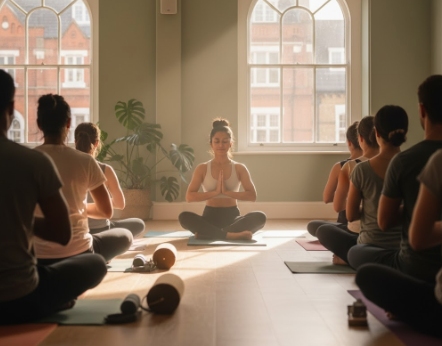
This gesture is performed by pressing the palms firmly but gently together at the center of the chest, over the heart chakra (Anahata). The head is then bowed slightly, with the eyes often closed.
The symbolism of this simple movement is beautiful:
- Balance: It represents bringing together the two sides of the body—the left and right, the masculine and feminine, the logical and the intuitive—into a single, balanced center.
- Connection: It connects the hands, the instrument of our actions, with the heart, the center of our feelings.
- Humility: Bowing the head is a universal sign of respect and a symbolic gesture of surrendering the ego (the mind) to the wisdom of the heart.
Even without the word, performing Anjali Mudra is a complete expression of gratitude and respect.
The Big Question: If “Namaste” is “Hello,” Why Do We Say it at the End?
This is the most common and valid question from beginners. If “Namaste” is a greeting in India, why do yoga classes end with Namaste in the Western world?
It’s a great observation, and the answer reveals a lot about how yoga has been adapted.
In a Western yoga class, “Namaste” is not used as a literal “goodbye.” Instead, it is a symbolic closure of the sacred time you have shared. Think of it as sealing the practice. The class creates a shared energy, a bubble of focus and intention. Ending with “Namaste” is a way to honor that shared experience before you all step back into the busy outside world.
It is, above all, a moment of mutual gratitude:
- From the Teacher: The teacher says “Namaste” to thank the students for allowing them to guide the practice. They honor the students for their hard work, trust, and the energy they brought to the room.
- From the Students: The students say “Namaste” in reply to thank the teacher for their guidance, wisdom, and for holding the space for them to practice.
It’s a final, profound moment of connection, acknowledging that the teacher-student relationship is a two-way street built on mutual respect.
“Is it Cultural Appropriation?” A Respectful Guide for Beginners
This is an important and very real concern, especially for new practitioners in the UK. You might worry: “Am I, as a non-South-Asian person, using this word incorrectly? Is it offensive or is it cultural appropriation?”
This is a nuanced topic. Cultural appropriation generally involves taking something from a minority or marginalized culture without permission or understanding, often stripping it of its original meaning.
The key to avoiding this lies in intention and education. Using “Namaste” as a trendy, meaningless sign-off is disrespectful. However, using it with a genuine understanding of its meaning and with a sincere heart of gratitude is typically seen as cultural appreciation. It’s an act of honoring the roots of the practice.
This is where your inner experience matters most.
A Teacher’s Perspective: Feeling Awkward or Unsure?
As a teacher, I see many new students hesitate, and that’s completely okay. Your practice is your practice. If saying “Namaste” doesn’t feel authentic to you, please don’t feel pressured.
The gesture itself—the simple bow of gratitude with hands at your heart in Anjali Mudra—is a universally understood sign of respect. Your sincere, silent gratitude is felt just as deeply as the word. Never feel forced; yoga is about authenticity, not performance.
South Asian yoga and philosophy educators, like Prasad Rangnekar, often emphasize that the problem isn’t using Sanskrit words, but using them without understanding or respect. By reading this article, you are already practicing respectfully.
What’s the Difference Between “Namaste” and “Namaskar”?
You might also hear the word “Namaskar,” which can be confusing. Are they the same?
Essentially, yes. They are used interchangeably in many contexts and carry the same core meaning of respect.
- Namaste (Namah + te) means “I bow to you” (addressing a single person).
- Namaskar (Namah + kar) comes from the root kar, which means “to do.” It is often translated as “I do the act of bowing” or “I pay my salutations.”
In practice, “Namaskar” is sometimes considered slightly more formal, or it may be used when addressing a group of people (plural) rather than an individual. In the context of a yoga class, however, both words are understood to express the same deep sentiment of gratitude and respect.
Conclusion
So, why do yoga classes end with Namaste? It’s not a simple “goodbye.” It’s a profound gesture of unity, gratitude, and respect.
“Namaste” is far more than just “I bow to you.” It’s a way of looking at your teacher and fellow students and saying, “I honor the part of you that is the same as me. I honor the soul within you.”
Whether you say the word aloud, simply bow your head in Anjali Mudra, or just feel a quiet sense of thanks, you are participating in the true spirit of the gesture. The intention of gratitude is what truly matters, and it’s the most beautiful way to close your practice.
FAQs About “Namaste” in Yoga
What do you say back when a yoga teacher says Namaste?
You simply say “Namaste” in reply. You typically bow your head with your palms in Anjali Mudra at the same time as the teacher and other students.
Is it disrespectful to say Namaste if you are not Hindu?
This is a common concern. The general consensus is that if you say it with genuine respect and an understanding of its meaning (gratitude and honoring the other person), it is seen as an appreciation of the culture, not appropriation. The key is your sincere intention.
Why do some yoga teachers not say Namaste?
Some teachers, particularly those who are South Asian or who have deeply studied the cultural context, may feel that using it as a “goodbye” is an incorrect Western adaptation. Others may choose to use English words of gratitude (“thank you for sharing your practice”) to be more inclusive or to avoid any chance of appropriation.
Is Namaste a religious word?
While it comes from a culture where Hindu traditions are prevalent and is found in ancient Vedic texts (often as a salutation to a divinity), in modern use—both in India and in yoga—it is primarily a cultural and spiritual sign of respect, not a religious one. It acknowledges the “divine” or “soul” in a universal, non-denominational sense.
What is the gesture for Namaste called?
The gesture of pressing the palms together at the heart is called Anjali Mudra. The word “Mudra” means ‘seal’ or ‘gesture’ in Sanskrit.
Do you say Namaste at the beginning or end of class?
While it is a traditional greeting (like “hello”) in India, in most Western yoga classes, it is used exclusively at the end of the class as a sign of mutual respect and to close the practice.
What are alternatives to saying Namaste?
If you don’t feel comfortable saying “Namaste,” you can simply bring your hands to Anjali Mudra and bow your head in silence. This conveys the exact same feeling of gratitude. You can also quietly say “thank you” to the teacher as you leave.
About the Author