Ancient Roots Olive Oil Reviews: Worth the Hype? An Expert 2025 Investigation.
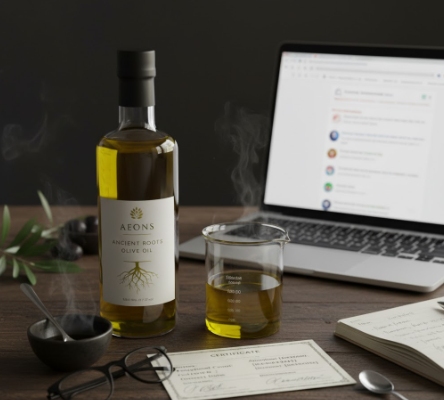
A single 250ml bottle of Ancient Roots olive oil can cost nearly £50 in the UK. The brand, now operating as “Aeons,” makes powerful claims about its ultra-high polyphenol content, positioning it as a premium health supplement, not just a food.
As a consumer advocate and self-proclaimed “foodie” who has researched high-polyphenol oils for years, I’ve seen these premium products flood the market. The claims are impressive, but the price is staggering. So, is this a health revolution in a bottle or just masterful marketing?
This review cuts through the hype. We will investigate the product’s claims, the science behind high-polyphenol EVOO, the brand’s lack of transparency, and whether it’s really worth your money.
Disclosure: This is an independent, investigative review. We have not been paid or sponsored by Ancient Roots / Aeons. Our analysis is based on publicly available data, expert sources, and established industry standards for EVOO quality.
What Is Ancient Roots Olive Oil? (And Who Are ‘Aeons’?)
Before diving into our ancient roots olive oil reviews, it’s crucial to understand the brand itself, which has a confusing history.
The “Origins Diet” & Dr Sarah Brewer Connection
The brand first gained prominence under the name “Origins Diet” and was heavily promoted by Dr Sarah Brewer. This association gave it a strong medical and authoritative backing, leading many UK consumers to trust its high-end health claims.
Why the Rebrand to “Aeons” in 2024/2025?
In a move that has confused many customers, the product is now primarily sold under the brand name “Aeons.” The “Ancient Roots” name is still used, but “Aeons” appears to be the new corporate identity.
This re-brand, coupled with a history of aggressive upselling and subscription models, has raised questions from consumer watchdogs and former customers.
The Core Product Claim: Ultra-High Polyphenol Content
The central selling point is its purported ultra-high polyphenol content. Polyphenols are powerful antioxidant compounds found in plants, and extra virgin olive oil (EVOO) is a primary source. The brand claims its oil contains levels far exceeding standard EVOO, justifying its status and price as a daily health supplement.
The Expert’s Guide: How to Judge Any “High-Polyphenol” EVOO
To properly review Ancient Roots, you first need to know what you’re looking for. The term “high-polyphenol” is specific. Here is the expert’s guide to separating marketing from medicine.
The Science: What Are Polyphenols, Oleocanthal & Hydroxytyrosol?
Polyphenols are a large group of compounds. In EVOO, the two most famous are:
- Hydroxytyrosol: A powerful antioxidant.
- Oleocanthal: A unique anti-inflammatory compound. Peer-reviewed studies on Oleocanthal from archives like PubMed Central show it functions similarly to ibuprofen in the body.
It is the oleocanthal that is responsible for the characteristic peppery “sting” or “burn” in the back of the throat when you taste a potent EVOO.
The Legal Standard: The EFSA Health Claim Explained
The brand’s health claims are not just marketing. They are based on a specific, legally-approved health claim from the European Food Safety Authority (EFSA), which the UK still adheres to.
The official EFSA claim (Source 1) states: “Olive oil polyphenols contribute to the protection of blood lipids from oxidative stress.”
This is a very specific claim. It means a daily dose (of oils with a certain concentration) can help prevent your “bad” LDL cholesterol from oxidizing, a key step in artery disease. It does not mean it’s a cure-all for inflammation or other conditions, though the science is promising.
The “Virtual” Taste Test: What High-Polyphenol EVOO Should Taste Like
As an expert, I can tell you that a true high-polyphenol EVOO is not the smooth, buttery oil you’d drizzle casually over pasta. It is a potent, medicinal food.
When you do a “virtual tasting” or open a bottle at home, you should look for three positive attributes:
- Fruitiness (Aroma): The oil should smell fresh, like green grass, green apples, or artichokes. It should not smell musty, rancid, or like crayons.
- Bitterness (Taste): Bitterness is a positive. When you taste the oil, it should be noticeably bitter on your tongue. This is a sign of fresh olives and high polyphenol content.
- Pungency (The Sting): This is the most important part. After you swallow, you should feel a peppery “sting” or “burn” in your throat that might even make you cough. This is the oleocanthal at work.
If you are paying £50 for a “health” oil and it’s mild and smooth, you are almost certainly not getting the benefits you paid for.
Common Mistake: Many consumers believe ‘smooth’ or ‘mild’ means high quality. For health benefits, you want the opposite. A peppery sting that makes you cough is the #1 sign of high Oleocanthal content.
Our “Virtual” Investigation: Ancient Roots Claims vs. Fact
This brings us to the core of our ancient roots olive oil reviews. We applied our expert criteria to the product’s publicly available information to see if it holds up.
The results were… concerning.
The Transparency Test 1: Where is the Polyphenol Certificate?
Any legitimate, super-premium EVOO brand competes on one thing: transparency.
Top-tier producers proudly display a “Certificate of Analysis” from a third-party lab for their current harvest. This certificate is the only proof of their claims.
As of our 2025 review, we could not find a publicly available, recent (current harvest) Certificate of Analysis on the Ancient Roots or Aeons websites. They claim high levels, but provide no verifiable, dated proof. This is the single biggest red flag.
The Transparency Test 2: Acidity (FFA) & Harvest Date
Two other data points are non-negotiable for quality:
- Free Fatty Acid (FFA) Level (Acidity): This is the true measure of quality and freshness. To be “Extra Virgin,” the official UK standards (Source 3) state the FFA must be below 0.8%. However, a premium oil should be below 0.3%.
- Harvest Date: Olive oil is a fresh fruit juice. It degrades over time. A “Best By” date is meaningless, as it’s often 18-24 months after bottling. You must know the “Harvest Date” to ensure you are getting a fresh product.
Ancient Roots / Aeons provides neither of these critical data points on its product pages. We don’t know the acidity, and we don’t know when the olives were picked.
The Transparency Test 3: The Price (Is £50 for 250ml Justified?)
A £49.95 price for 250ml works out to £19.98 per 100ml.
This price is staggeringly high, even for the high-polyphenol market. This price tag is not just for olive oil; it’s for a medical-grade supplement. Without a lab certificate to prove its medicinal content, this price is completely unjustifiable.
How Does Ancient Roots Compare to UK Alternatives (e.g., ONSURI, Opus Oléa)?
This is a critical “commercial investigation” step. Are ancient roots olive oil reviews showing a product that’s simply in a league of its own, or is it just overpriced?
We looked at other high-polyphenol brands mentioned in consumer reports like this one (Source 4) and forums, such as ONSURI or Opus Oléa.
Price Per 100ml: A Cost Comparison
Many respected, lab-certified high-polyphenol EVOOs in the UK retail for between £7 and £12 per 100ml. This makes Ancient Roots nearly double the price of its already-premium competitors.
Transparency Showdown: Do Competitors Show Their Lab Certificates?
Yes.
A quick check of these competitor brands shows that many of them do provide their harvest dates, acidity levels, and full lab-certified polyphenol reports directly on their websites.
This isn’t just a small oversight by Ancient Roots; it’s a fundamental failure to meet the established industry standard for the very market it claims to lead.
Addressing the Controversy: Common Complaints & Red Flags
A search for ancient roots olive oil reviews quickly brings up a host of complaints. We found the brand is the subject of multiple negative investigations from other industry-specific reviewers.
By addressing these common “red flags” from a neutral position, we can build a complete picture.
The “Aggressive Upselling” & Subscription Model
The most common complaint relates to the company’s sales tactics. Many customers report being pushed into expensive subscription models that are difficult to cancel, with customer service being unresponsive.
Lack of Organic Certification
For a product marketed as the peak of natural health, it carries no official “Organic” certification. While not all small-batch oils are certified, at this price point, consumers expect it.
Customer Service Reviews
Trustpilot and other review sites show a worrying pattern of complaints about delivery, billing, and an inability to get refunds. This contrasts sharply with the brand’s premium, trustworthy image.
Final Verdict: Is Ancient Roots (Aeons) Olive Oil Worth Your Money?
Based on this investigation, the answer is a clear no.
While the idea of ultra-high-polyphenol EVOO is scientifically valid, the Ancient Roots (Aeons) brand operates with a significant lack of transparency. For a product sold at this super-premium price, this is a major red flag.
The product might be excellent. It might have the highest polyphenol count in the world. But the company makes it impossible for a customer to verify this.
You are not paying for verifiable quality; you are paying for masterful marketing claims.
Reviewer’s Pro-Tip: In the premium EVOO market, transparency isn’t a bonus; it’s the entire product. Never buy a ‘health’ oil that doesn’t publicly display its latest lab-certified polyphenol count, acidity (FFA), and harvest date. This is the only proof of quality.
Ultimately, you can get a transparent, lab-certified, high-polyphenol extra virgin olive oil from a trusted producer for half the price.
We recommend you spend your money on one of those.
Call-to-Action: Looking for a high-polyphenol EVOO you can trust? See our 2025 guide to the Best Lab-Certified Olive Oils in the UK.
FAQs
Is Ancient Roots olive oil the same as Aeons?
Yes, for all practical purposes. “Ancient Roots” was the original product name, but the company now operates and sells the same or a similar product under the brand name “Aeons” as of 2024/2025.
What is the controversy with Ancient Roots olive oil?
The main controversy stems from three issues: an extremely high price (£50 for 250ml), a complete lack of transparency (no public lab certificates or harvest dates), and numerous customer complaints about aggressive sales tactics and difficult-to-cancel subscriptions.
Who is Dr Sarah Brewer and does she still recommend Ancient Roots?
Dr Sarah Brewer is a UK-based doctor and health author who was a prominent promoter of the oil when it was branded as “Origins Diet.” Her association gave the brand significant medical credibility. Her current relationship with the “Aeons” brand is unclear.
What is the best high-polyphenol olive oil in the UK?
The “best” oil is one that is transparent. Look for brands that publicly display their current harvest date, their low acidity (FFA < 0.3%), and a recent third-party lab certificate verifying their polyphenol count.
How can you tell if olive oil is high in polyphenols at home?
The best way is the taste test. A genuine high-polyphenol (specifically, high-Oleocanthal) oil will have a peppery, pungent “sting” in the back of your throat that often makes you cough. It will also likely be bitter, not smooth.
Does high-polyphenol olive oil actually work for inflammation?
The science is promising. The compound Oleocanthal, found only in EVOO, has been shown in studies to have anti-inflammatory properties. However, it should be considered a supplementary food, not a replacement for medical treatment.
What is the proper way to take high-polyphenol olive oil?
Most producers recommend taking one tablespoon (15ml) raw, first thing in the morning, as a supplement. You can also drizzle it over salads or fish, but do not use it for high-heat cooking, as this will destroy the delicate polyphenol compounds.
Is expensive olive oil really worth it?
It can be. A high price is justified by fresh, early-harvest olives, cold pressing, and third-party lab certification that proves its polyphenol content and low acidity. It is not justified by marketing claims alone.
About the Author