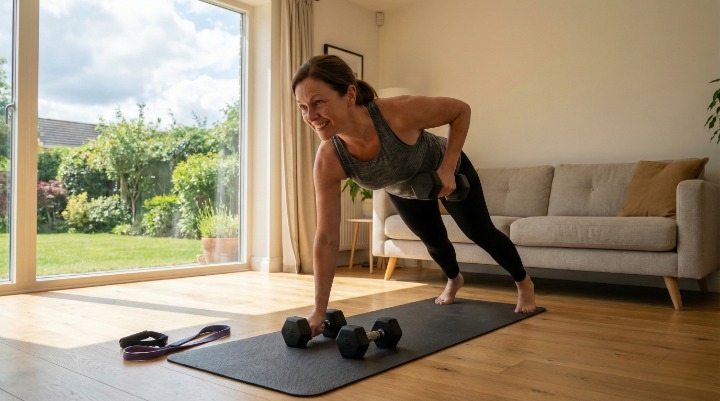
Strength Training for Women Over 40: The Essential UK Guide
You know the feeling. You wake up tired even after a full night’s sleep. You notice your waistline changing, despite eating the same foods you have enjoyed for years. You might feel a general sense of “slowing down,” assuming it is just a natural part of getting older.
Living in the UK does not help. The dark winters and grey skies often make us want to hibernate with a cup of tea rather than move our bodies. But while slowing down feels instinctual, movement is actually the antidote.
This is not about becoming a bodybuilder or spending hours in front of a mirror. The benefits of strength training for women over 40 go far beyond aesthetics. Resistance training is the single most effective medical intervention you can take to protect your future health, bone density, and independence.
It is the difference between ageing and ageing well. Here is why you need to pick up that weight, and exactly how to do it.
Why Your Body Changes After 40: The Science of Sarcopenia
If it feels like your body is fighting against you, there is a biological reason.
From the age of 30, we naturally begin to lose muscle mass—a condition known as Sarcopenia. Research suggests we lose between 3% and 8% of our muscle mass per decade if we are inactive.
The Drop in Oestrogen
For women, this accelerates significantly during perimenopause (usually starting in your 40s). As oestrogen levels drop, your body loses its natural anabolic (muscle-building) stimulus.
According to research on cellular ageing from the Mayo Clinic, resistance training does not just build muscle; it reverses specific signs of aging at the cellular level. Without this stimulus, your metabolism slows down because muscle tissue is metabolically active. Simply put: less muscle means you burn fewer calories just sitting on the sofa.
Why Cardio Alone Isn’t Enough Anymore
Many women I speak to are diligent about their steps. They walk the dog, they run, or they do Pilates. While the NHS recommends 150 minutes of moderate activity, cardio primarily works your heart and lungs. It does not provide the mechanical stress your bones and muscles need to stay strong.
Running keeps you fit; lifting weights keeps you functional.
Top 5 Benefits of Strength Training for Women Over 40
1. Bulletproofing Your Bones (Osteoporosis Prevention)
In the UK, we struggle with Vitamin D deficiency due to our lack of sunlight. This puts British women at higher risk for Osteoporosis (brittle bones).
Your bones are living tissue. When you lift a weight, the muscle pulls on the bone, signaling it to lay down more mineral density. A 2025 protocol review in the British Journal of Sports Medicine (BJSM) highlights that heavy resistance training is superior to low-impact exercise for improving lumbar spine and femoral neck bone density.
2. Revving Up a Slowing Metabolism
You cannot control your age, but you can control your Basal Metabolic Rate (BMR). Muscle is “expensive” tissue. Your body burns more energy maintaining a pound of muscle than a pound of fat.
By adding strength training to your routine, you increase your engine size. You will burn more calories while you sleep, work, and watch TV.
3. Managing Menopause Symptoms
The drop in hormones during menopause can lead to hot flushes, mood swings, and “brain fog.”
A recent University of Exeter (January 2025) study found that women aged 40-60 who engaged in resistance training saw a 19% increase in hip function and significant improvements in flexibility. More importantly, the study noted improvements in mood regulation and sleep quality, helping to dampen the “vasomotor symptoms” like hot flushes.
4. Joint Protection and Pain Reduction
A common fear is that weights will hurt your joints. The opposite is true.
Knee pain often comes from weak glutes (bum muscles) failing to support the leg. Back pain often stems from a weak core. Strengthening the muscles around the joint acts like a brace, absorbing impact and reducing wear and tear.
5. The Mental Shift: Feeling Powerful, Not Invisible
Society has a habit of making women over 40 feel invisible. Strength training is the psychological antidote. There is a profound confidence shift that happens when you realise you can lift a heavy box or carry all your shopping bags without struggling. You feel physically capable, which translates to mental resilience.
Common Myths That Hold Women Back
“I Will Get Bulky”
This is the number one fear I hear. Biologically, it is extremely difficult for women to get bulky. You lack the testosterone levels required for massive muscle growth. Those female bodybuilders you see work incredibly hard for years and follow strict diets to look that way. You will not wake up accidentally bulky after a few dumbbell squats. You will just look “toned.”
“It’s Dangerous for My Back/Joints”
Coach’s Note: Actually, weakness is dangerous. Most back injuries happen when picking up a pen or a grandchild awkwardly, not in the gym. Learning proper form (lifting with your legs, not your back) is the cure for chronic aches.
How to Start: A Real-World UK Strategy
You do not need an expensive membership to start.
Gym vs. Home: What’s Right for You?
-
The Gym: Chains like PureGym, The Gym Group, or David Lloyd are great because they have all the equipment. Don’t overlook your local Council leisure centre—they are often cheaper and less intimidating.
-
Home Training: If the gym floor intimidates you, start at home. It is private, convenient, and free.
The £50 Home Starter Kit
You don’t need a Peloton. You can build a complete physique with two simple items you can grab from Argos, Decathlon, or Amazon:
-
A pair of Dumbbells: Start with 4kg or 5kg. (Avoid the tiny pink 1kg weights; they are too light to stimulate bone growth).
-
A Resistance Band: Great for warming up and working your back muscles.
Your First 4-Week “Foundation” Routine
Aim for 2 sessions per week, with at least one rest day in between.
The Fundamental Movements
Do 2 sets of 10-12 repetitions for each exercise.
-
The Squat (Legs): Stand in front of a sturdy chair. Sit down until your bum taps the seat, then stand back up. Keep your chest up.
-
Progression: Hold a dumbbell at your chest (Goblet Squat).
-
-
The Push (Chest/Arms): Perform push-ups against your kitchen counter or a wall.
-
Coach’s Note: Don’t drop to your knees on the floor yet. Incline push-ups engage your core better.
-
-
The Pull (Back/Posture): Bent-over dumbbell row. Hold a weight in one hand, lean on a chair for support, and pull the weight to your hip like you are starting a lawnmower.
-
The Hinge (Glutes/Hamstrings): Glute Bridge. Lie on your back, knees bent, feet flat. Squeeze your bum to lift your hips to the ceiling.
The Secret Sauce: Progressive Overload
This is where most people fail. They use the same 2kg weights for five years and wonder why they don’t see changes.
The body adapts quickly. To keep seeing results, you must do more over time. This is Progressive Overload.
-
Week 1: 10 reps with 4kg.
-
Week 2: 12 reps with 4kg.
-
Week 3: 10 reps with 6kg.
If the last two reps don’t feel difficult, the weight is too light. The NHS Guidelines specifically state we need muscle-strengthening activities “on at least 2 days a week”—make those days count.
Nutrition: Fueling the 40+ Body
You cannot build muscle out of thin air. You need building blocks.
Prioritising Protein
UK diets are often heavy on carbs (toast, cereal, sandwiches, pasta). As we age, our body becomes less efficient at processing protein, so we need more of it, not less.
Simple Swaps:
-
Breakfast: Swap the toast and jam for Greek yoghurt with berries or two eggs.
-
Lunch: Ensure there is a palm-sized portion of chicken, fish, tofu, or beans with your sandwich/salad.
-
Snack: Swap the biscuit for a handful of nuts or a protein shake.
FAQs
How often should a 40-year-old woman lift weights?
Twice a week is the sweet spot for beginners. It provides enough stimulus for growth and enough rest for recovery.
Can you build muscle after 40 as a woman?
Absolutely. Muscle tissue remains responsive to training at any age, even into your 80s and 90s.
Is 20 minutes of strength training enough?
Yes, if the intensity is right. A focused 20-minute session where you challenge your muscles is far better than an hour of aimless movement.
Should I do cardio or weights first?
If your goal is strength and muscle tone, do weights first while you have the most energy. Save the cardio for after, or for a separate day.
What is the best exercise for menopausal belly fat?
There is no single exercise to “spot reduce” fat. However, compound movements like squats and deadlifts burn the most calories and build the most metabolism-boosting muscle.
Can I start with just body weight?
Yes, for the first few weeks. But remember, your bones need load to get stronger. Eventually, you will need to add external weight.
Do I need protein shakes?
Not necessarily. Real food is best. But if you struggle to eat enough protein (aim for 1.2g per kg of body weight), a shake is a convenient tool.
How long does it take to see results?
You will feel stronger mentally in 2 weeks. You will feel physical strength improvements in 4-6 weeks. Visible muscle tone usually takes 3-6 months of consistency.
Conclusion
Starting a strength training journey can feel daunting, especially if you have never stepped foot in a weights room. But remember: this is not about vanity. It is about longevity.
The best time to start was 20 years ago. The second best time is today. Your 60-year-old self will thank you for picking up that dumbbell.
Don’t overthink it. Go grab two tins of beans from the cupboard or perform 10 sit-to-stands from your chair right now. You have officially started.
About the Author