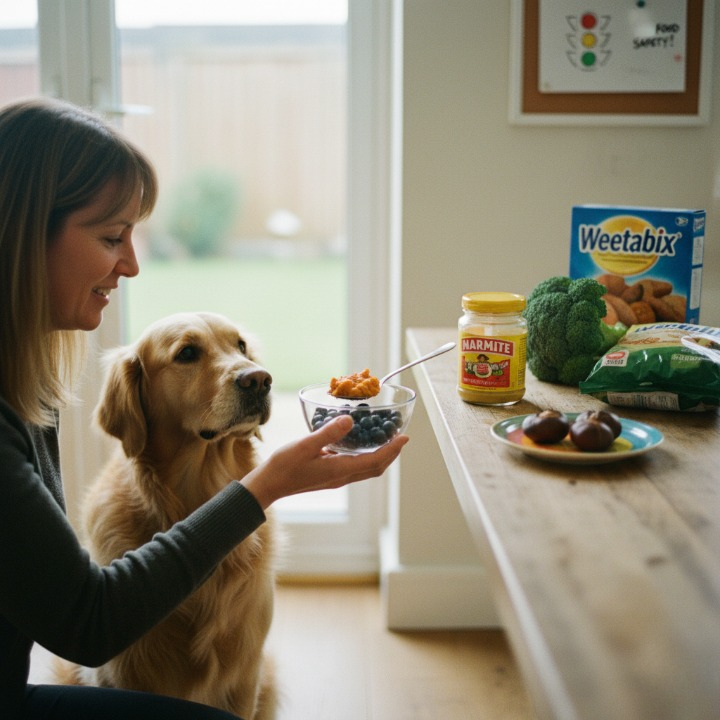
Can Dogs Eat Human Food? The Ultimate UK Safety Guide (From Blueberries to Aubergine)
It starts with the same scene in almost every British household. You sit down for your Sunday Roast or open a packet of crisps, and suddenly, you feel eyes on you. The “puppy dog stare” is powerful. But while sharing a scrap of meat seems harmless, the difference between a healthy treat and a medical emergency can be subtle.
In 2025, the trend towards “human-grade” diets for pets is skyrocketing. We want our dogs to eat as well as we do. However, human metabolism and canine digestion are vastly different. A single raisin can cause kidney failure, and a slice of toast with the wrong topping can overload a puppy’s kidneys.
This guide categorises 20 common UK pantry items using a strict Traffic Light System. We aren’t just guessing; we are applying toxicity data from the Veterinary Poisons Information Service (VPIS) and nutritional guidelines from the Kennel Club.
Here is your definitive answer to “Can dogs eat…”
| Food Item | Safe? | Key Safety Note |
| Aubergine | 🟢 Yes (Cooked) | Remove leaves/stems; must be cooked. |
| Baby Corn | 🟢 Yes | Safe plain, raw, or steamed. |
| Blueberries | 🟢 Yes | Excellent low-calorie training treat. |
| Broccoli (Raw) | 🟠 Caution | Small florets only. Stems are a choking hazard. |
| Chestnuts | 🟢 Yes (Sweet) | Roasted Sweet Chestnuts only. Conkers are TOXIC. |
| Crisps | 🔴 No | High salt/fat. Often contain toxic onion powder. |
| Custard | 🟠 Caution | High sugar/dairy. Yogurt is a safer alternative. |
| Halloumi | 🔴 No | Extremely high salt content. |
| Mackerel (Canned) | 🟠 Caution | Only if in Spring Water. Avoid Brine or Tomato sauce. |
| Mackerel (Fresh) | 🟢 Yes | Ensure it is de-boned. Great for Omega-3. |
| Marmite | 🟠 Caution | Tiny smear only (high salt). Not for puppies. |
| Onions | 🔴 NO (Toxic) | Causes anaemia. Emergency vet visit required. |
| Pate | 🔴 No | High fat triggers pancreatitis; usually contains onion. |
| Pistachios | 🟠 Caution | Shells are a choking hazard. High fat content. |
| Prawn Crackers | 🔴 No | Deep-fried; often contain toxic onion/garlic powder. |
| Rice | 🟢 Yes | White is good for upset stomachs. |
| Shrimp (Fresh) | 🟢 Yes | Shell/tail removed. Cooked plain. |
| Swede | 🟢 Yes | Peel, cook, and mash like potato. |
| Sweet Potatoes | 🟢 Yes | Must be cooked. Raw is hard to digest. |
| Weetabix | 🟠 Caution | Good fibre, but avoid if dog has wheat allergy. |
🔴 The Red Light: TOXIC & DANGEROUS (Avoid Completely)
These foods pose serious health risks ranging from immediate toxicity to long-term organ damage. If your dog consumes items marked “Toxic,” contact your vet immediately.
1. Can Dogs Eat Onions? (And Food with Onions)
Verdict: 🔴 TOXIC
This is arguably the most dangerous item on this list because it is hidden in almost everything we cook.
The Risk: Onions, along with garlic, leeks, chives, and shallots (the Allium family), contain a compound called N-propyl disulphide. This compound causes oxidative damage to your dog’s red blood cells. Essentially, it destroys the cells that carry oxygen, leading to a condition called Haemolytic Anaemia.
According to The Kennel Club (UK), toxicity can build up over time. It doesn’t matter if the onion is raw, cooked, or powdered.
Common Danger Zones:
-
Gravy: Often contains onion powder.
-
Stuffing: A staple of the roast dinner, usually packed with onions.
-
Takeaways: Chinese and Indian dishes often use onion/garlic bases.
🚨 Emergency Check: If your dog has eaten onions and shows signs of lethargy, pale gums, or fainting, do not wait. Call your vet or the VPIS immediately.
2. Can Dogs Eat Crisps?
Verdict: 🔴 UNSAFE
While a single plain crisp dropped on the floor won’t kill a large dog, they are fundamentally unsafe for canines.
The Risk: Most popular UK crisp brands (Walkers, Pringles, etc.) are heavily processed and saturated in fat and salt.
-
Salt Poisoning: Dogs are much more sensitive to sodium than humans. Excessive salt can cause dehydration, vomiting, and even seizures.
-
Hidden Toxins: Flavoured crisps (Cheese & Onion, Prawn Cocktail) contain onion powder and garlic powder. As we established above, these are toxic.
3. Can Dogs Eat Prawn Crackers (Shrimp Crackers)?
Verdict: 🔴 UNSAFE
You’ve just ordered a Friday night takeaway. Is it okay to toss the dog a prawn cracker? No.
The Risk: Prawn crackers are essentially deep-fried starch. They offer zero nutritional value and are incredibly high in fat and calories, which can trigger pancreatitis in sensitive dogs. Furthermore, the “prawn” flavour often comes from concentrated powders mixed with—you guessed it—onion and garlic powder.
Better Alternative: If you want to treat your dog, cook a plain, fresh prawn (shell removed) in boiling water.
4. Can Dogs Eat Halloumi?
Verdict: 🔴 AVOID
We love squeaky cheese, but it is a nightmare for your dog’s kidneys.
The Risk: Halloumi is chemically distinct from other cheeses because it is preserved in brine. It is one of the saltiest cheeses available, often containing up to 3g of salt per 100g. A medium-sized dog should generally not exceed 1g of salt in their entire daily diet. A single slice of Halloumi blows this limit out of the water.
5. Can Dogs Eat Pate?
Verdict: 🔴 HIGH RISK
The Risk: Pate is high-fat liver often mixed with cream, salt, and spices. High-fat foods are the leading dietary cause of Pancreatitis, a painful and potentially life-threatening inflammation of the pancreas. Additionally, almost all commercially available pates contain onion or garlic for flavour.
🟠 The Amber Light: CAUTION (Moderation Required)
These foods are not toxic, but they come with specific rules. Portion control and preparation are the difference between a tasty treat and a tummy ache.
6. Can Dogs Eat Marmite?
Verdict: 🟠 AMBER (Tiny Amounts Only)
This is the most debated food in the UK dog community. Can they have it? Technically, yes, but be extremely careful.
The Nuance: Marmite is rich in B vitamins (Thiamin, Riboflavin), which are good for dogs. However, it is a yeast extract, meaning the salt content is astronomical.
The Serving Rule:
-
Safe: A tiny smear (literally the size of a pea) on a piece of plain toast is generally safe for a healthy adult dog.
-
Unsafe: A spoonful.
-
Puppies: Avoid completely. Their developing kidneys cannot handle the salt load.
7. Can Dogs Eat Weetabix?
Verdict: 🟠 AMBER
The Nuance: Weetabix is high in fibre and low in sugar, making it a surprisingly common breakfast treat for dogs. It can help firm up stools.
The Catch:
-
Wheat Allergies: Many dogs are intolerant to wheat. If your dog itches or gets ear infections often, skip the Weetabix.
-
No Milk: Adult dogs are effectively lactose intolerant. Do not serve Weetabix with cow’s milk. Use warm water or a little dog-safe bone broth instead.
8. Can Dogs Eat Raw Broccoli?
Verdict: 🟠 AMBER
The Risk: Broccoli is packed with nutrients, but the florets contain isothiocyanates. In small amounts, this is fine. In large amounts (more than 10% of their daily diet), it can cause severe gastric irritation and gas.
Pro-Tip: The tough stems are a choking hazard if swallowed whole. I recommend steaming the broccoli stems to soften them. It retains the nutrients but makes them easier to digest.
9. Can Dogs Eat Pistachios?
Verdict: 🟠 AMBER
The Risk: Unlike Macadamia nuts (which are highly toxic and cause paralysis), pistachios are not poisonous. However, they are high in fat and phosphorus.
-
The Shell Danger: The real risk is the shell. They are sharp, indigestible, and can cause intestinal blockages requiring surgery.
-
Mould: Stale pistachios can grow mould containing aflatoxins, which are dangerous to dogs. If you feed them, ensure they are shelled, unsalted, and fresh.
10. Can Dogs Eat Custard?
Verdict: 🟠 AMBER
The Risk: Traditional custard is a mix of cream, sugar, and egg yolks. It’s a calorie bomb. While a quick lick of the bowl won’t poison them, the sugar and dairy combo is a recipe for diarrhoea.
Better Alternative: In 2025, we are focused on Gut Health. Swap the custard for a spoonful of plain, natural yogurt or Kefir. It provides the creamy texture they love but adds beneficial probiotics to their microbiome.
11. Can Dogs Eat Canned Mackerel?
Verdict: 🟠 AMBER (Check the Label)
Crucial Check: Mackerel is fantastic, but the liquid it comes in matters.
-
Mackerel in Spring Water: 🟢 YES. Excellent source of Omega-3.
-
Mackerel in Brine: 🔴 NO. Too much salt.
-
Mackerel in Tomato Sauce: 🔴 NO. Often contains sugar and onion powder.
-
Mackerel in Oil: 🟠 CAUTION. High calorie; drain thoroughly before feeding.
🟢 The Green Light: SAFE & HEALTHY (Superfoods)
These are the “Superfoods.” They are safe, healthy, and can be added to your dog’s bowl to boost nutritional variety.
12. Can Dogs Eat Blueberries?
Verdict: 🟢 SAFE
Blueberries are widely considered the ultimate training treat. They are low in calories but packed with antioxidants and Vitamin C. Studies suggest antioxidants can help support cognitive function in ageing dogs.
How to Serve: Feed them fresh or frozen. Frozen blueberries make a fantastic cooling treat in the summer.
13. Can Dogs Eat Sweet Potatoes?
Verdict: 🟢 SAFE (Must Be Cooked)
Sweet potato is a dietary staple for many dogs, widely used in hypoallergenic dog foods. It is a brilliant source of dietary fibre, Vitamin A, and Vitamin B6.
Experience Insight: Never feed raw sweet potato; it is hard to digest and can cause blockages. My Recipe: Peel, boil until soft, and mash. I like to stuff mashed sweet potato into a Kong toy and freeze it. It keeps my dog busy for 20 minutes and is completely healthy.
14. Can Dogs Eat Swede?
Verdict: 🟢 SAFE
A classic British root vegetable. Swede (rutabaga) is safe, low-calorie, and full of vitamins.
How to Serve: Treat it exactly like sweet potato. Peel it, cook it thoroughly, and mash it. It’s a great “filler” for dogs who need to lose weight but still want a full bowl of food.
15. Can Dogs Eat Rice?
Verdict: 🟢 SAFE
White vs. Brown:
-
White Rice: The go-to remedy for upset stomachs. It is bland and easy to digest.
-
Brown Rice: Higher in fibre and protein, better for everyday feeding if your dog has a strong stomach.
16. Can Dogs Eat Fresh Mackerel?
Verdict: 🟢 SAFE
Oily fish like Mackerel are one of the best natural sources of Omega-3 fatty acids. These acids are vital for maintaining a glossy coat, healthy skin, and reducing joint inflammation in arthritic dogs.
Prep: Ensure it is boneless or cooked until the bones are soft enough to crumble.
17. Can Dogs Eat Baby Corn?
Verdict: 🟢 SAFE
Full-sized corn on the cob is dangerous because the cob itself causes fatal blockages. Baby corn, however, does not have a hard cob. It is safe, crunchy, and dogs usually love the texture. Serve it plain and uncooked as a chew, or steamed.
18. Can Dogs Eat Aubergine (Eggplant)?
Verdict: 🟢 SAFE (Cooked Only)
Aubergine is generally safe, but with a caveat. It belongs to the nightshade family. It contains solanine, but usually in low amounts safe for dogs.
The Rules:
-
Remove the green leaves and stems (highest toxin concentration).
-
Cook it thoroughly (roasted or boiled).
-
If your dog has kidney issues, consult your vet first as it contains oxalates.
19. Can Dogs Eat Chestnuts?
Verdict: 🟢 SAFE (Sweet Chestnuts Only)
We must make a critical distinction here for UK dog owners walking in autumn.
-
Sweet Chestnuts (roasted/cooked): Safe. They are low fat and tasty.
-
Horse Chestnuts (Conkers): 🔴 TOXIC. Never let your dog play with or eat conkers found on the ground. They contain Aesculin, which is poisonous.
20. Can Dogs Eat Shrimp/Prawns (Fresh)?
Verdict: 🟢 SAFE
Unlike the crackers, actual fresh prawns or shrimp are great. They are high in protein, Vitamin B12, and phosphorus.
Prep: Remove the shell, head, and tail (choking hazards). Boil them plain. Do not feed raw shellfish due to parasite risks.
FAQs (The 2025 UK Edition)
Can dogs eat cooked onions if I pick them out of the stew?
No. The toxins in onions are water-soluble. This means if you cook onions in a stew, the toxins leach out into the meat and gravy. Picking the onion pieces out does not remove the poison.
Is Marmite toast safe for puppies?
No. Puppies have developing kidneys and are much more sensitive to salt than adult dogs. Stick to plain toast or safe puppy treats.
My dog ate a single grape, should I panic?
You should call your vet immediately. Research has shown that grape/raisin toxicity is idiosyncratic—meaning it affects some dogs massively and others not at all. There is no “safe dose.” It is safer to induce vomiting (under vet supervision) than to wait and see.
Can dogs eat Quorn or meat substitutes?
Proceed with caution. While the mycoprotein (fungus) is generally safe, many meat substitutes are heavily processed with onion powder, garlic powder, and high salt levels to mimic the taste of meat. Always read the label.
Can dogs eat green onions (Spring Onions)?
No. Spring onions are part of the Allium family, just like regular onions and garlic. They are toxic to dogs.
Is pork pie jelly safe for dogs?
It is not recommended. The jelly is essentially solidified fat and gelatine, often very high in salt. High-fat loads can trigger pancreatitis.
Can dogs eat digestive biscuits?
Occasionally, yes. A plain digestive biscuit is not toxic, but it is high in sugar and calories. It shouldn’t be a daily habit.
Conclusion: The “Rule of Snout”
Feeding your dog “human food” doesn’t have to be a gamble. By sticking to the Green Light foods like blueberries, sweet potatoes, and fresh mackerel, you can boost your dog’s health, improve their coat, and make their dinner exciting without the risk.
However, the UK pantry is full of hidden dangers. The onion powder in your crisps, the salt in your Halloumi, and the raisins in your fruit cake are genuine threats.
My Final Experience Insight: In 2025, we know more about canine gut health than ever before. Don’t just feed your dog table scraps because they are begging. Use food functionally. Use sweet potato for fibre, yogurt for probiotics, and oily fish for joints.
But if you are ever unsure—if you are holding a piece of food and don’t know if it’s safe—follow the Rule of Snout: If you aren’t 100% sure, don’t feed it.
Read Guide on “Best Dog-Safe Fruits for Summer
About the Author