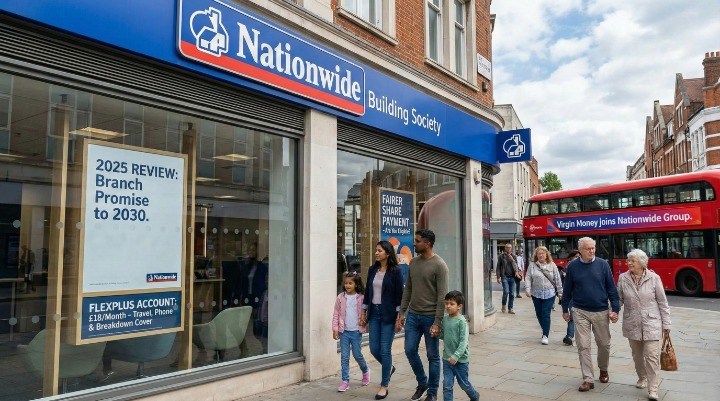
Nationwide Building Society Review 2025: Is the “Fairer Share” Worth It?
While high-street banks like Barclays and Lloyds seem to be in a race to close their doors the fastest, the Nationwide Building Society is doing something strange: they are promising to stay open.
But this loyalty to the high street comes with a price tag. In 2025, we saw the popular FlexPlus packaged account fee hike to £18 per month, and the massive acquisition of Virgin Money has left many members wondering if the “world’s largest building society” is starting to act just like the corporate banks it claims to be different from.
Is the “Fairer Share” payment actually fair? Does the new Virgin Money merger diluting your benefits? And is that £18 monthly fee justified?
This review cuts through the marketing noise to analyze the real value of banking with Nationwide in 2025.
What is Nationwide? (The Mutual Difference)
To understand if Nationwide is right for you, you have to understand the “Mutual” model. Unlike a bank, which has shareholders demanding dividends, a building society is owned by its members—you.
If you have a current account, mortgage, or savings account with them, you are a member. Theoretically, this means profits are reinvested into better rates and services rather than paid out to investors.
The Virgin Money Acquisition: What Members Need to Know
The biggest news shaking the financial sector this year was Nationwide’s acquisition of Virgin Money. This deal has created a banking superpower with over 24 million customers.
Does this mean your local Nationwide is turning into a Virgin Money store?
Not yet. According to the Nationwide Annual Report & Accounts 2025, the two brands will continue to operate separately for the immediate future. However, the “Branch Promise”, the guarantee to keep branches open—has now been extended to the combined network until at least 2030.
[Nationwide Annual Report 2025 – Corporate Structure Update]
For you, this is generally good news. It secures the financial stability of the society, though some critics argue the costs of merging IT systems might eat into the “Fairer Share” profits for the next few years.
The “Fairer Share” Payment: Did You Qualify in 2025?
Forget interest rates for a second. The biggest draw for joining the Nationwide Building Society recently has been the “Fairer Share” payment—a £100 cash distribution paid directly to eligible members in June/July 2025.
Competitors don’t do this. But don’t assume you will get it just because you have an account. The criteria are strict, and thousands of angry customers missed out this year because they didn’t read the fine print.
The “Hidden” Eligibility Criteria: Sarah vs. Mike
To show you exactly how this works, let’s look at two hypothetical members, Sarah and Mike. Both have banked with Nationwide for years.
-
Sarah (Got the £100): Sarah has a FlexDirect account. She treats it as her main account.
-
The key: She deposited at least £500 per month and had two active Direct Debits going out in January, February, and March 2025. She also had £100 in a savings account.
-
-
Mike (Got £0): Mike has a mortgage with Nationwide and a FlexAccount he uses occasionally. He has £5,000 in savings.
-
The failure: Mike didn’t use his current account for daily banking during the qualifying window (Jan-March). Even though he pays them thousands in mortgage interest, he didn’t meet the “main current account” criteria.
-
The Lesson: If you want the 2026 payment, you cannot leave your Nationwide account dormant. You must actively use it.
Current Accounts Review: FlexPlus vs. FlexDirect
Most people join Nationwide for one of two accounts. One pays you interest; the other charges you a fee. Here is the breakdown.
FlexPlus (£18/month): The Analyst’s Verdict
The FlexPlus account used to be the unbeatable champion of packaged bank accounts. But with the monthly fee rising to £18 (that is £216 a year), many are cancelling.
Is it still worth it?
Let’s do the math based on 2025 market rates. If you were to buy the included insurance policies separately, here is what you would pay:
| Benefit Included | Estimated Market Value (Annual) | Notes |
| Worldwide Family Travel Insurance | £150 – £200 | Includes winter sports & golf. Covers family even if they travel without you. |
| UK & EU Breakdown Cover | £60 – £80 | Provided by AA. Includes Homestart. |
| Mobile Phone Insurance | £80 – £120 | Covers the whole family (parents + dependent kids). |
| Total Value | ~£350+ | Cost of Account: £216 |
The Verdict:
If you are a family that travels at least once a year and owns a car, this account is still a bargain. You are saving roughly £130+ a year compared to buying these products separately.
However, if you are single, don’t drive, or don’t travel, you are throwing money away. Switch to a free account immediately.
FlexDirect: The 5% Interest Bait
FlexDirect is the free option. The headline offer is attractive: 5% AER interest on balances up to £1,500.
The Catch:
This rate is introductory. It only lasts for 12 months. After that, the rate drops significantly (often to 0.25% or similar standard rates).
-
Strategy: Use FlexDirect for one year to max out the interest (earning you roughly £75 free cash), then be prepared to switch or move your money to a dedicated savings account.
Savings & ISAs: Member Exclusive Bonds
This is where the “Mutual” status actually pays off. Nationwide frequently launches Member Exclusive Bonds—fixed-rate savings accounts available only to existing members.
In 2025, these bonds have consistently beaten the rates offered by high-street competitors like HSBC or NatWest, often sitting near the top of the “Best Buy” tables alongside challenger banks.
-
Triple Access Online ISA: A standout product for 2025. It offers a competitive variable rate but penalizes you if you make more than three withdrawals a year. This is excellent for building a “rainy day” fund that you don’t intend to touch often.
-
Start to Save: For those with smaller balances, this regular saver offers a prize draw entry alongside interest, incentivizing the habit of saving rather than just the amount.
Digital Banking vs. The App
If you are coming from Monzo, Starling, or Revolut, the Nationwide app will feel… safe. And slightly boring.
Don’t get me wrong—the app is robust. It allows you to:
-
Freeze/unfreeze your card instantly.
-
View pending transactions.
-
Manage your savings goals.
Where it falls short:
It lacks the granular “pots” features of modern fintechs. You can’t easily segregate your rent money from your beer money within a single account. The spending categorization is basic compared to the AI-driven analytics of Starling.
If you want a digital assistant to manage your financial life, Nationwide isn’t it. If you want a secure way to check your balance and pay bills, it works perfectly.
Customer Service & The Branch Promise 2030
This is Nationwide’s “Killer App.” It isn’t software; it’s brick and mortar.
While the “Big Four” banks have decimated their branch networks, leaving many towns with zero banking facilities, Nationwide has renewed its Branch Promise. They have pledged not to leave any town or city where they are currently present until at least 2030.
According to a 2025 report by Which?, face-to-face access remains the #1 priority for customers over 60. If you are managing Power of Attorney for a parent, or simply prefer explaining a mortgage problem to a human rather than a chatbot, Nationwide is arguably your only reliable long-term option in the UK.
Is Nationwide Safe? (FSCS Update)
Safety is the primary concern for any saver.
Yes, Nationwide is safe.
Despite being a building society, they are fully covered by the Financial Services Compensation Scheme (FSCS).
Important Update: Following the announcement in November 2025, the FSCS deposit protection limit is set to rise. Currently, your money is protected up to £85,000 per person (or £170,000 for joint accounts). The proposed increase to £120,000 effective December 1, 2025, will make Nationwide an even safer haven for large balances, particularly for those who have just sold a property.
[FSCS Official Protection Limits]
Pros & Cons Summary
Is the Nationwide Building Society right for you? Here is the quick-scan summary.
| Pros | Cons |
| Branch Promise: Guaranteed face-to-face banking until 2030. | FlexPlus Cost: The £18/month fee is steep for singles/non-travelers. |
| Fairer Share: The potential for a £100 annual profit share. | Strict Criteria: Easy to miss out on the Fairer Share payment if inactive. |
| Insurance Value: Top-tier travel and breakdown cover included. | App Experience: Functional, but lacks advanced fintech features. |
| Ethical Status: No shareholder pressure means better long-term stability. | Low Standard Rates: Once the 5% intro offer ends, current account rates are poor. |
FAQ
Is Nationwide safer than a bank?
Technically, they are subject to the same regulations. However, their “Mutual” status makes them less risky in terms of investment banking gambles. They are covered by the FSCS, making them just as safe as any high-street bank.
Who is eligible for the Nationwide Fairer Share payment?
Eligibility changes annually, but typically requires you to have a main current account (active with deposits/direct debits) and £100 in savings during the qualifying months (usually Jan-March).
Does Nationwide own Virgin Money?
Yes. Nationwide acquired Virgin Money in a deal formalized in 2025. They currently operate as separate brands, but are part of the same group.
Is the FlexPlus account worth £18 a month?
Only if you use the benefits. If you buy family travel insurance and breakdown cover separately, you will likely pay more than £216/year. If you don’t use these, the account is a waste of money.
Will Nationwide close my local branch?
Unless there are lease issues outside their control, Nationwide has promised to keep branches open until 2030, making them the most secure option for physical banking.
What is the Nationwide switching bonus for 2025?
Nationwide periodically offers £175 or £200 to switch. These offers are time-limited. Check their website for the current active incentive.
How do I contact Nationwide from abroad?
FlexPlus members have a dedicated priority line. Standard members can use the secure message feature in the app or call the international number listed on the back of their debit card.
Final Verdict
The Nationwide Building Society remains an anomaly in 2025 UK banking—and that is a good thing.
They are the last line of defense for traditional banking services. If you value the ability to walk into a branch, or if you are a family looking for comprehensive insurance at a discount via FlexPlus, Nationwide is an easy recommendation.
However, the days of loyalty for loyalty’s sake are over. The “Fairer Share” payment is a brilliant perk, but you have to play the game to get it. If you open an account, make sure you use it. Don’t let it sit dormant, or you will be watching from the sidelines while other members collect their £100.
Next Step: Check your current travel insurance renewal quote. If it’s over £150, switching to Nationwide FlexPlus is a mathematical no-brainer.
About the Author