New Driveway Rule Change 2026: Avoiding the £1k Legal Trap
In 2025, over 15,000 UK homeowners received enforcement notices for non-compliant driveways. The days of simply laying concrete and hoping for the best are over. With the UK government enforcing strict environmental mandates and preparing for a future dominated by electric vehicles, the landscape of home improvements has shifted dramatically.
If you are planning a renovation, understanding the new driveway rule change for 2025 and 2026 is no longer optional, it is a financial necessity. Two major legislative shifts are now in play: the aggressive rollout of mandatory Sustainable Urban Drainage Systems (SuDS) and the sweeping deregulation of electric vehicle (EV) charger installations.
This guide cuts through the bureaucratic noise. We will break down exactly what the 2026 regulations mean for your property, how to navigate the new “0.2 cubic metre” EV limit, and how to avoid the hidden costs that catch thousands of homeowners out every year.
The “5-Square-Metre” Rule: Permitted Development in 2026
The cornerstone of driveway planning law in England remains the “5-square-metre rule,” but enforcement has tightened significantly under the latest guidance. This rule dictates whether you can proceed under “Permitted Development” rights or if you must endure the full planning application process.
When You Don’t Need Planning Permission
You will not need to apply for planning permission if your new or replacement driveway meets specific criteria set out on the Planning Portal. The primary condition is permeability.
If the surface area exceeds five square metres, you are exempt from planning permission only if:
- You use permeable (porous) surfacing which allows water to drain through it, such as gravel, permeable concrete block paving, or porous asphalt.
- You direct the rainwater to a lawn, border, or soakaway within the boundary of your property.
If you opt for a traditional, non-porous surface like standard concrete or tarmac and the area is over five square metres, you must obtain planning permission. Failing to do so is a direct violation of the Town and Country Planning (General Permitted Development) Order.
Quick-Scan Table: Permeable vs. Impermeable Materials
| Surface Type | Permeability Status | Planning Permission Required? (>5m²) |
| Loose Gravel | Highly Permeable | No |
| Resin-Bound | Permeable | No |
| Resin-Bonded | Impermeable | Yes (unless drained to a border) |
| Standard Tarmac | Impermeable | Yes (unless drained to a border) |
| Block Paving | Variable | No (if gaps permit drainage) |
Why “Porous” is the New Standard for England
The government’s push for porous surfacing is not aesthetic; it is a critical infrastructure requirement. Impermeable driveways contribute heavily to flash flooding by overloading public sewers during heavy rainfall.
Pro-Tip: The Resin Trap
Do not confuse “Resin-Bound” with “Resin-Bonded.”
- Resin-Bound mixes stone with resin before laying, creating a porous surface that lets water through. It is generally compliant.
- Resin-Bonded scatters stone onto a layer of resin. It is watertight (impermeable). If you install resin-bonded surfacing over 5m² without a drainage channel, you are breaking the law.
Mandatory SuDS: The Biggest Change for 2026
The most significant update for developers and homeowners alike is the full implementation of Schedule 3 of the Flood and Water Management Act 2010, which has seen renewed focus and stricter enforcement mechanisms in 2025/2026.
What the Flood and Water Management Act Means for You
Historically, drainage was often an afterthought. Under the new driveway rule change, surface water management is now a priority. The government has empowered SuDS Approving Bodies (SABs) within local councils. These bodies will eventually have the power to review and approve drainage plans separately from the standard planning application process for larger developments, though this scrutiny is increasingly trickling down to individual household projects in flood-risk areas.
If you live in an area prone to flooding, your local council may have removed Permitted Development rights entirely using an Article 4 Direction. In these zones, even a small gravel driveway requires a full application to ensure it meets SuDS standards.
The Hierarchy of Drainage: From Rain Gardens to Soakaways
The new regulations follow a strict “drainage hierarchy” outlined in the DEFRA SuDS National Standards. You cannot simply pipe water into the street sewer because it is convenient. You must prioritize natural drainage methods in this order:
- Infiltration: Allowing water to soak into the ground (e.g., via a soakaway or permeable paving).
- Watercourses: Directing water to a nearby ditch or stream.
- Surface Water Sewers: Connecting to a dedicated storm drain.
- Combined Sewers: The last resort, only allowed if all other options are impossible.
For most homeowners, infiltration is the target. This means using a geotextile membrane under your sub-base to prevent silt clogging while allowing water to return to the water table.
EV Charger Breakthrough: The 2025 “No Permit” Update
In a bid to accelerate the transition to electric vehicles, the Department for Transport (DfT) introduced major easements in May 2025. However, deregulation does not mean “anything goes.” There are precise physical limits you must respect to avoid a planning breach.
New Size and Placement Limits (The 0.2m³ Rule)
You can now install an electric vehicle charging point as Permitted Development, meaning no planning application is needed, provided you stick to these rigid constraints:
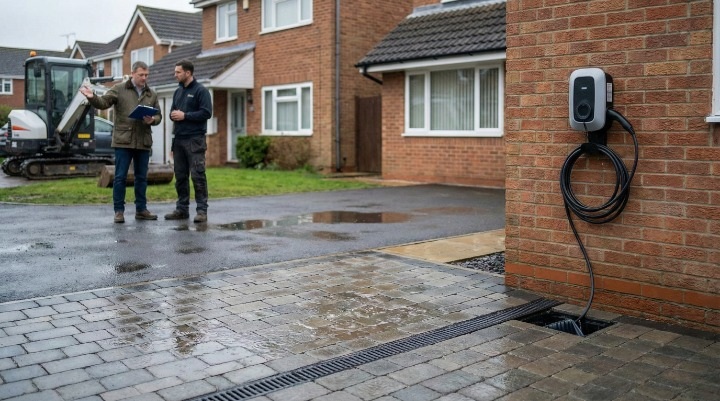
- Size Limit: The casing of the charger must not exceed 0.2 cubic metres. This accommodates almost all standard home wall-box units but may exclude larger commercial-style pedestals.
- Height: A wall-mounted charger cannot be higher than 1.6 metres above the ground. A floor-mounted stand cannot exceed 2.3 metres.
- Highway Proximity: This is the most common failure point. The charger must be located at least two metres from any highway (which includes the public pavement).
If you live in a Listed Building or a scheduled monument, these exemptions do not apply. You will always need Listed Building Consent.
Shared Driveways and Leasehold Hurdles
While the government has removed planning barriers, private contracts still bite. If you share a driveway or live in a leasehold property, check your title deeds immediately.
Experience Note: The Covenant Conflict
I recently consulted on a project in Manchester where a homeowner installed a compliant EV charger under Permitted Development rights. Two weeks later, the freeholder ordered its removal. Why? A restrictive covenant in the lease prohibited “external alterations without written consent.”
The Lesson: Planning permission is public law; covenants are private law. You need to satisfy both.
The Dropped Kerb and Section 163 Legal Requirements
You cannot legally drive over a public footway to access your property without a proper vehicle crossover, commonly known as a dropped kerb. Doing so is an offence under the Highways Act 1980.
Preventing Surface Water Runoff onto Public Highways
Section 163 of the Highways Act 1980 gives the Highway Authority the power to prosecute if water from your private property flows onto the public footpath or road.
This is a strict liability offence. In winter, runoff can freeze, creating dangerous black ice on public pavements. If a pedestrian slips and is injured because your driveway drains onto the street, you could be liable for substantial personal injury claims.
To comply, you must install a drainage channel (often called an Aco drain) at the boundary line of your property. This channel must direct water to a soakaway on your land, not into the gutter.
Visibility Splays: The 2m x 2m Safety Standard
When applying for a dropped kerb, the council officer is not looking at your paving choice; they are looking at safety. The “Visibility Splay” is the critical metric.
For a standard residential driveway, you typically need a 2-metre by 2-metre visibility splay. This means that at the point where your car enters the pavement, you must have a clear line of sight for 2 metres along the back of the pavement in both directions. Walls, fences, or hedges within this zone must be lowered (usually to under 0.6 metres) to ensure you can see pedestrians and they can see you.
Pro-Tip: The Inspector’s Checklist
Before you pay the non-refundable survey fee (often £100–£300), check these three “deal-breakers”:
- Street Furniture: Is there a lamp post or telegraph pole within 1 metre of your proposed entrance? Relocating these can cost £2,000+.
- Tree Roots: Is there a street tree nearby? Councils protect root protection areas (RPAs) aggressively.
- Junctions: Is your entrance within 10 metres of a road junction? If so, it will likely be refused on safety grounds.
2026 Cost Breakdown: Planning Fees vs. Penalties
Ignoring the new driveway rule change carries a heavy price tag. Understanding the costs upfront allows you to budget effectively and demonstrates the value of compliance.
Current Application Fees and Hidden Costs
As of April 2025/2026, the baseline fee for a Householder Planning Application in England is approximately £258. However, the real cost of a “legal” driveway involves more than just the application fee.
- Lawful Development Certificate: ~£129 (Optional but recommended to prove legality to future buyers).
- Dropped Kerb Application Fee: £100 – £400 (varies by council).
- Street Works Licence: Required for the contractor to work on the highway.
-
Enforcement Action: If you build without permission and get caught, you may be issued an Enforcement Notice. Appealing this costs double the original application fee, plus you risk having to pay thousands to rip up the new driveway and restore the land to its original state.
Retrospective approval is never guaranteed. It is far cheaper to pay for a soakaway (£500–£1,000 installed) than to fight a legal battle with the council.
Checklist: Is Your New Driveway Legal?
Before you break ground, run your project through this compliance filter. If you answer “No” to any of the safety or drainage questions, you need to pause and reassess.
- [ ] Size Check: Is the driveway larger than 5 square metres?
- [ ] Material Check: Is the surface permeable (e.g., gravel, resin-bound)?
- [ ] Drainage Check: If impermeable, does it drain to a lawn or soakaway within your boundary?
- [ ] Runoff Check: Is there a channel drain to stop water flowing onto the highway?
- [ ] Access Check: Do you have an approved dropped kerb?
- [ ] Safety Check: Do you have 2m x 2m visibility splays clear of obstructions?
- [ ] EV Check: Is your charger <0.2 cubic metres and >2 metres from the highway?
- [ ] Legal Check: Have you checked your title deeds for restrictive covenants?
Conclusion
The new driveway rule change for 2025 and 2026 is driven by a clear logic: environmental responsibility and road safety. While the regulations regarding SuDS and Section 163 may seem burdensome, they are designed to protect your property from flooding and your bank balance from liability claims.
The days of paving over front gardens without a second thought are behind us. The smart homeowner today builds with permeability in mind, respects the drainage hierarchy, and checks the fine print on their title deeds.
Final Insight: Compliance is cheaper than correction. Retrofitting a drainage system after the paving is laid can cost three times as much as installing it correctly the first time.
Next Step: Before you hire a contractor, visit your local council’s website and search for “Article 4 Directions” in your street. Confirming you still have Permitted Development rights is the single most valuable check you can do today.
FAQs
Do I need planning permission for a resin driveway in 2026?
It depends on the type. Resin-bound driveways are permeable and generally do not require planning permission. Resin-bonded driveways are impermeable; if they are over 5 square metres, you will need planning permission unless you direct runoff to a permeable area on your land.
What happens if I build a driveway without permission in the UK?
The local council can issue an Enforcement Notice requiring you to demolish the driveway and restore the land to its original condition. Failure to comply can lead to prosecution and an unlimited fine.
Is gravel considered a permeable surface for planning?
Yes, loose gravel is considered fully permeable and is an excellent way to avoid needing planning permission. However, you must ensure the gravel does not spill onto the public highway.
Can I install an EV charger if I have a shared driveway?
Planning law may allow it, but private property law might not. You must check your title deeds and leasehold agreement. You will likely need written consent from the freeholder or the other driveway owners.
How much does a dropped kerb cost in 2026?
Costs vary by location and the amount of work required (e.g., moving utility cables). Typically, you can expect to pay between £1,500 and £3,000 for the council-approved contractor to complete the work.
Do new driveway rules apply to existing drives being repaired?
If you are repairing a small area, usually no. However, if you are replacing the entire hard surface, the new rules regarding permeability and drainage apply immediately.
What is the 2-metre highway rule for EV chargers?
To be installed without planning permission, an EV charger must be located at least two metres away from the public highway. This includes the pavement, not just the road itself.
About the Author