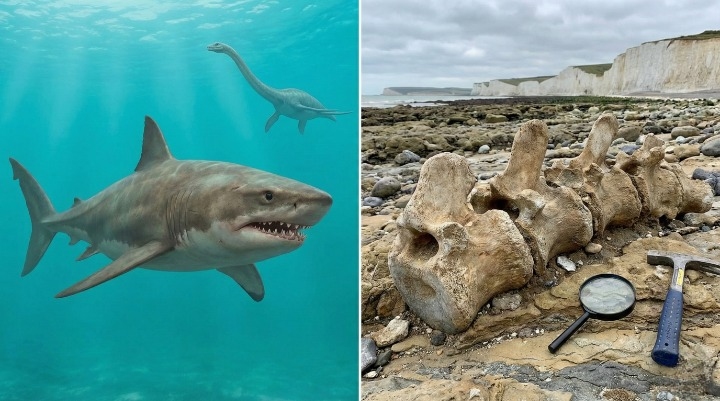
Prehistoric Shark Fossils Found: Australia’s New Mega Shark & The UK Link
Something massive has just surfaced from the depths of the Early Cretaceous.
While most of the world looks to the US or North Africa for giant predator discoveries, a groundbreaking set of prehistoric shark fossils found near Darwin, Australia, has just rewritten the timeline of ocean evolution.
We aren’t talking about a standard, garden-variety shark here. Scientists have unearthed the calcified vertebrae of a Cardabiodon, a monster that measured over 8 meters (26 feet) long and prowled the oceans 115 million years ago.
For context, that is significantly larger than a modern Great White and far older than the famous Megalodon.
If you are a UK-based fossil enthusiast or science follower, you might be tempted to think this is just an Australian story. It isn’t. The Cardabiodon didn’t respect modern borders. Its cousins patrolled the waters that now form the white cliffs of Sussex and the clays of Kent.
Here is what the experts found, why it matters, and how you can find traces of this prehistoric giant on British beaches.
The Discovery Down Under: A Timeline Rewritten
Finding shark fossils is notoriously difficult. Unlike dinosaurs, which leave behind hard calcium-phosphate skeletons, sharks are made of cartilage. Cartilage rots. In 99% of cases, all that remains of a prehistoric shark are its teeth.
That is why this discovery is a scientific miracle.
The Gearle Siltstone Find
According to the latest report from Dr. Mikael Siversson at the Western Australian Museum, these fossils were recovered from the Gearle Siltstone in the Southern Carnarvon Basin.
The team didn’t just find teeth; they found associated vertebrae.
Finding a column of shark spine is the “Holy Grail” for paleontologists because it allows for accurate size estimates. You cannot cheat the math on vertebral growth.
The “Big” Numbers
Let’s break down the data to see why this is causing such a stir in the paleontology community:
-
Age: 115 Million Years Old (Albian stage of the Early Cretaceous).
-
The Shark: Cardabiodon (believed to be Cardabiodon ricki).
-
Estimated Length: 8 to 9 meters.
-
Previous Assumptions: Before this, scientists believed sharks didn’t reach this “mega” size until the Late Cretaceous (about 15 million years later).
Expert Insight: “We are looking at a shark that reached ‘Jaws’ proportions way earlier than we thought possible. This suggests that as soon as the oceans got warm enough, sharks got massive to compete with marine reptiles.”
What is the Cardabiodon? (The Real-Life Jaws)
When you hear “prehistoric shark fossils found,” you likely picture the Megalodon. But the Megalodon arrived almost 100 million years after this shark.
The Cardabiodon was a different beast entirely. It belonged to the order Lamniformes (the same group as Great Whites and Mako sharks), but it was built like a tank.
Built for Brutality
Based on the anatomy of the vertebrae and teeth found in both Australia and the UK, we know this animal was a heavy-bodied swimmer.
-
Speed: It had a stiff, thunniform body shape (like a tuna), meaning it was built for high-speed bursts.
-
Teeth: unlike the slicing teeth of a Great White, Cardabiodon teeth are robust, curved, and unserrated. They were designed to grasp and tear.
-
Diet: It likely hunted large prey, including Ichthyosaurs and Pliosaurs.
!
Can You Find Cardabiodon Fossils in the UK?
This is where the story hits home. While the vertebrae were found in Australia, the Cardabiodon species had a global distributon.
The UK is actually one of the best places in the world to find evidence of these giants. During the Cretaceous period, Britain was submerged under a warm, shallow sea, the exact environment this shark loved.
Where to Look: The Gault Clay & Chalk
If you want to find a tooth from this specific lineage, you need to look at the Gault Clay formations and the Lower Chalk.
Top UK Locations for Cretaceous Shark Fossils:
Field Guide: How to Identify Shark Fossils
I’ve spent years walking the foreshores of Kent, and I know the feeling of heart-pounding excitement when you see a dark shape in the clay. But I also know the disappointment of picking up a “fossil” that turns out to be a rusty rock.
If you are inspired by the news of these prehistoric shark fossils found in Australia and want to hunt for their UK counterparts, you need to know what to look for.
1. The Texture Test (Vertebrae)
The Australian find was special because it was a vertebrae. If you find a round, disk-like object in the UK chalk, look at the texture.
-
Bone: Shark vertebrae have a distinct honeycomb or sponge-like texture on the inside if broken, and a fibrous texture on the outside.
-
Rock: Iron pyrite (Fool’s Gold) nodules often form round shapes in the clay. They will be heavy, metallic, and smooth or cuboid, no honeycomb structure.
2. The “Lick” Test (Pro-Tip)
This sounds strange, but it is a classic field trick used by geologists.
-
The Method: If you found a potential bone or vertebrae, tap it against your teeth (gently) or touch it to your tongue.
-
The Result: Fossilized bone is porous. It will feel slightly “sticky” against your tongue as the capillary action absorbs moisture. A rock will just feel wet.
3. The Tooth Shape
Cardabiodon teeth are distinct. They are not serrated. They look like thick, curved spikes. If you find a tooth with serrations (like a steak knife), you might have found a Cretoxyrhina or a different species. Both are incredible finds.
Experience Note: When hunting in Gault Clay (like at Folkestone), be careful. The clay is sticky and dangerous near cliffs. Never hammer into the cliff face—only search the loose spoil heaps on the beach.
Why This Discovery Matters for Science
Beyond the cool factor of a “Mega Shark,” this discovery solves a major puzzle in marine biology.
Filling the Gap
For decades, there was a “gap” in the fossil record. We knew sharks got big in the Late Cretaceous (90 million years ago), but we didn’t have proof of gigantism in the Early Cretaceous (110+ million years ago).
The prehistoric shark fossils found this month prove that sharks didn’t wait. They evolved large bodies rapidly to avoid being eaten by the massive marine reptiles that dominated the era. It was an oceanic arms race, get big, or get eaten.
The Temperature Link
The study suggests the rise of these giants coincided with a global warming event. Higher ocean temperatures allowed their metabolisms to support larger body masses. As our modern oceans warm, understanding how apex predators react to temperature changes is more relevant than ever.
Summary
The discovery of the 8-meter Cardabiodon in Australia is a monumental win for paleontology, proving that sharks became “mega” far earlier than history previously recorded.
But remember, you don’t need a plane ticket to Darwin to touch this history. The same creatures that left those spines in the Australian siltstone were shedding their teeth in the waters of prehistoric Britain.
Next time you are walking the beaches of the South Coast, look down. That black pebble might just be a tooth from the real-life Jaws.
Have you ever found a fossil on a UK beach? Tell us about your best find in the comments below!
FAQs
How big was the prehistoric shark found in Australia?
The Cardabiodon shark found in the Darwin Formation is estimated to be between 8 and 9 meters (approx. 26 to 30 feet) long.
Where can I find shark fossils in the UK?
The best places are coastal areas with Cretaceous geology, specifically Folkestone (Kent), Eastbourne (Sussex), and the Isle of Wight.
Is Cardabiodon related to the Megalodon?
Distant cousins, yes. Both are in the order Lamniformes, but they lived millions of years apart. Megalodon is much younger (Miocene/Pliocene).
What is the difference between Cardabiodon and Cretoxyrhina?
Cardabiodon had thick, grasping teeth without serrations. Cretoxyrhina (the Ginsu Shark) had sharp, serrated slicing teeth.
Why are shark vertebrae fossils so rare?
Shark skeletons are made of cartilage, not bone. Cartilage usually decomposes before it can fossilize. Only under specific chemical conditions (calcification) do they preserve.
Did Cardabiodon live at the same time as dinosaurs?
Yes. It lived during the Early Cretaceous period, sharing the world with dinosaurs like Spinosaurus and Iguanodon.
How much is a prehistoric shark tooth worth?
Common teeth found in the UK might be worth £5-£20. Rare, large, perfect specimens like those of a Cardabiodon can fetch hundreds.
What did the “Mega Shark” eat?
It was an apex predator that likely ate large fish, marine reptiles (like Ichthyosaurs), and smaller sharks.
About the Author