USS Abraham Lincoln: 2026 Deployments, Specs & Royal Navy Interoperability
In early 2026, global attention remains fixed on the Middle East. Major naval assets continue projecting power in the region to protect international shipping routes. The USS Abraham Lincoln serves as the flagship for Carrier Strike Group 3, operating on the front lines of global maritime security. Understanding the strategic value of this warship requires looking beyond its impressive United States specifications. We must also examine its deep, ongoing interoperability with the UK Royal Navy.
The USS Abraham Lincoln (CVN-72) is a 100,000-tonne, Nimitz-class nuclear-powered aircraft carrier of the United States Navy. Homeported in San Diego, it accommodates upwards of 6,000 personnel. In early 2026, the carrier was deployed to the U.S. 5th Fleet in the Middle East to support regional maritime security.
Key Takeaways
- Fifth Nimitz-class nuclear-powered carrier, named after the 16th US President.
- Active in the U.S. 5th Fleet (Middle East) area of operations in early 2026.
- Displaces roughly 100,000 tonnes and houses a crew of over 6,000 sailors, marines, and aviators.
- Routinely escorted by Royal Navy Type 45 destroyers during joint maritime operations.
- Core missions include global power projection, maritime security, and disaster response.
Current Status: USS Abraham Lincoln Location & 2026 Operations
The USS Abraham Lincoln Carrier Strike Group is actively deployed to the U.S. 5th Fleet area of operations in the Middle East as of early 2026. This deployment directly supports regional maritime security and ongoing combat operations. Analysts track these movements through official U.S. Central Command press releases to understand shifting geopolitical priorities.
Common Mistake: A frequent error is assuming the carrier only performs combat strike missions. Its operational mandate also officially includes disaster response and humanitarian assistance capabilities.
Pro Tips:
- Monitor U.S. 5th Fleet statements for real-time updates when the carrier is deployed to the Middle East, as this indicates heightened regional security operations.
- When evaluating maritime security missions, consider disaster response and humanitarian assistance as core capabilities alongside combat operations.
Carrier Deployment Decision Tree
- Step 1: Is the carrier actively deployed?
-
-
If No, assess maintenance cycles or training status out of Naval Air Station North Island.
-
If Yes, proceed to Step 2.
-
- Step 2: Which Fleet area is it operating in?
-
If U.S. 5th Fleet (Middle East), evaluate against current maritime security missions and combat operations.
-
If U.S. 7th Fleet (Indo-Pacific), focus analysis on Pacific power projection and allied regional exercises.
-
Technical Specifications: Inside the Nimitz-Class Carrier
The USS Abraham Lincoln is the fifth Nimitz-class nuclear-powered aircraft carrier of the United States Navy. The military designated Naval Air Station North Island, located in San Diego, California, as its official homeport.
Displacing approximately 100,000 tonnes, the warship relies on advanced nuclear reactors for power. This massive scale allows the vessel to accommodate upwards of 6,000 sailors, marines, and aviators. The ship functions essentially as a floating city, requiring complex logistical support to maintain its operations at sea.
Pro Tips:
- Track the carrier’s homeport reassignments; currently, Naval Air Station North Island in San Diego serves as the logistical hub for CVN-72.
- Factor in personnel constraints: Nimitz-class carriers accommodate upwards of 6,000 personnel, making their resupply needs immense.
- When analyzing Carrier Strike Group 3 capabilities, always account for the integrated air wing squadrons, which provide the primary offensive power.
3 Steps to Understanding Carrier Strike Group 3 Operations
- Flagship Command: The USS Abraham Lincoln serves as the central command node, directing the movements and objectives of the entire strike group.
- Air Wing Integration: The carrier conducts carrier air warfare operations by launching and recovering integrated air wing squadrons from its flight deck.
- Escort and Logistics: The core carrier relies heavily on allied vessels, including British destroyers, for airspace surveillance and physical defence.
Nimitz-Class vs. Queen Elizabeth-Class
| Specification | USS Abraham Lincoln (Nimitz-Class) | UK Royal Navy (Queen Elizabeth-Class) |
| Displacement | ~100,000 tonnes | ~65,000 tonnes |
| Power Source | Nuclear reactors | Integrated electric propulsion |
| Crew Capacity | Upwards of 6,000 personnel | ~1,600 personnel (with air group) |
Mid-Article Summary Box
- The CVN-72 functions as a floating city, supporting upwards of 6,000 personnel.
- Naval Air Station North Island in San Diego serves as its primary logistical hub.
- The vessel operates as the central command flagship for Carrier Strike Group 3.
The UK Connection: Royal Navy Interoperability & Joint Operations
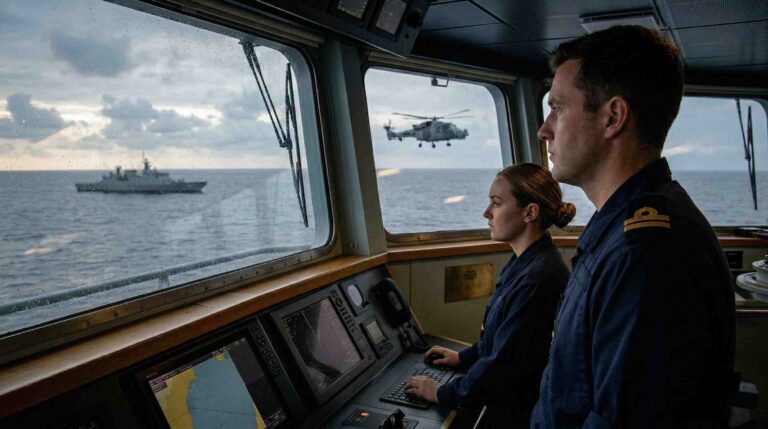
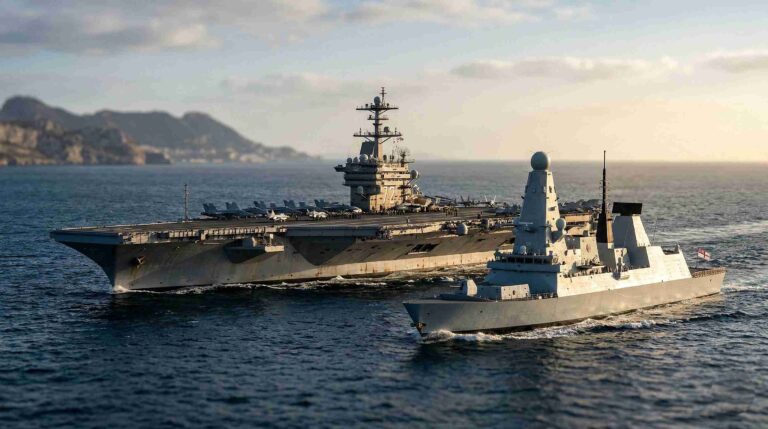
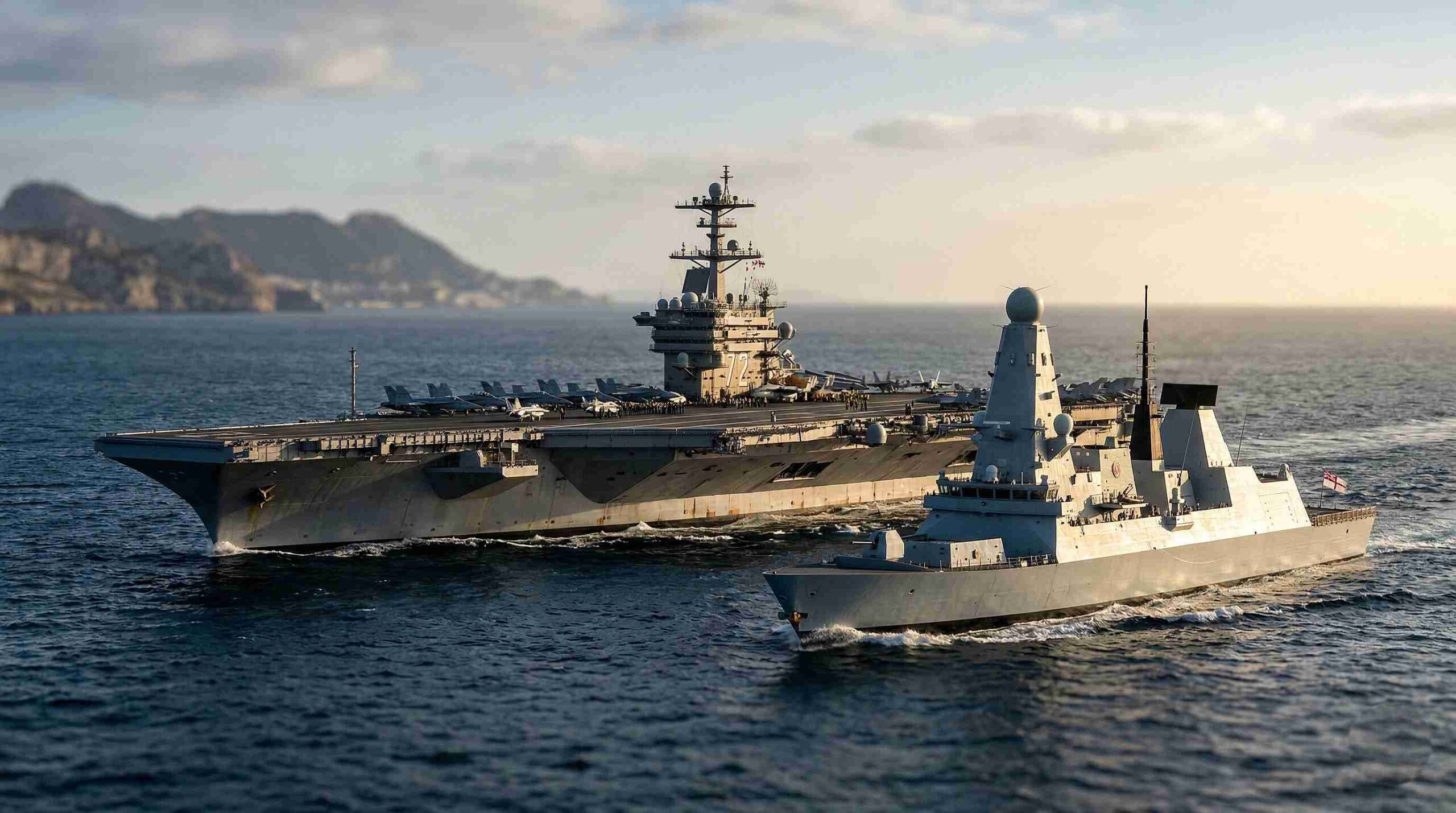
The United States does not operate its carrier strike groups in isolation. The Royal Navy frequently integrates its advanced warships with the USS Abraham Lincoln Carrier Strike Group for joint maritime operations. British Type 45 destroyers, including HMS Daring, HMS Defender, and HMS Duncan, have a long history of escorting this specific American carrier.
In January 2012, the USS Abraham Lincoln led a carrier group through the Strait of Hormuz to deter threats to international shipping. UK and French naval forces accompanied the American flagship during this high-stakes transit.
Mini Case Studies: Joint Naval Operations
- Joint Airspace Surveillance (2012): During a deployment in the Gulf, the British destroyer HMS Daring provided complex airspace surveillance for the USS Abraham Lincoln Carrier Strike Group. The Royal Navy vessel tracked thousands of air contacts, proving the tactical value of UK-US naval interoperability.
- Mediterranean Interoperability (2019): HMS Duncan joined the USS Abraham Lincoln in the Mediterranean. This deployment allowed the Royal Navy to develop interoperability skills directly applicable to the UK’s own Queen Elizabeth-class aircraft carriers.
Expert Perspectives Naval officers involved in these joint operations highlight the intense preparation required. One official noted, “Working with the US carriers and their air wings is the culmination of many months of training and hard work for the ship’s company.” Another officer operating alongside the carrier stated, “Taking control of F-18 Super Hornets in this busy operational environment is hugely rewarding.” Royal Navy leadership views these deployments as essential foundations. As one official remarked regarding wider interoperability, “It is exciting to be integrating HMS Defender into the UK-led Carrier Strike Group.”
Pro Tips:
- For UK-focused defence analysis, highlight the historical reliance on Royal Navy Type 45 destroyers for complex airspace surveillance.
- Use historical transit data, such as the 2012 Strait of Hormuz crossing, to contextualize modern geopolitical deterrence strategies.
Tactical Analysis: Evaluating Allied Naval Integration
Evaluating the success of allied naval integration requires looking at specific technical benchmarks. Defence analysts use structured criteria to assess how well a Royal Navy destroyer operates within an American carrier strike group. You can explore more about these specific operational standards through Royal Navy maritime operations.
Naval Integration Checklist Analysts use these parameters to evaluate tactical interoperability:
- [ ] Radar Compatibility: Can the Type 45 destroyer seamlessly share its air picture with the American flagship?
- [ ] Airspace Handover: Are protocols established for British officers to control US F-18 fighter jets?
- [ ] Encryption Standards: Do both navies utilize compatible, secure communication networks to prevent interception?
Pro Tip:
- Compare the roughly 100,000-tonne displacement of Nimitz-class carriers to the 65,000-tonne Queen Elizabeth-class to understand differing logistical footprints and basing requirements.
Conclusion & Next Steps
The USS Abraham Lincoln operates as a massive instrument of United States power projection. However, it also serves as a vital partner to the UK Royal Navy. The regular integration of British Type 45 destroyers ensures that both nations can secure international waters and respond to global maritime threats effectively.
Next Steps
- Monitor official Ministry of Defence channels for future HMS Duncan or HMS Daring joint deployments alongside US forces.
- Review U.S. 5th Fleet press releases for early 2026 Middle East operational shifts.
- Compare the technical specifications of the CVN-72 with the HMS Queen Elizabeth using public naval databases.
FAQs
Where is the USS Abraham Lincoln right now?
In early 2026, the carrier is actively deployed to the U.S. 5th Fleet area of operations in the Middle East to support maritime security.
How big is the USS Abraham Lincoln compared to HMS Queen Elizabeth?
The US carrier displaces approximately 100,000 tonnes, while the UK’s Queen Elizabeth-class displaces around 65,000 tonnes.
How many aircraft can the USS Abraham Lincoln carry?
While exact numbers vary by mission, the carrier integrates multiple air wing squadrons to conduct extensive carrier air warfare operations.
Has the Royal Navy ever escorted the USS Abraham Lincoln?
Yes. Royal Navy Type 45 destroyers, including HMS Daring and HMS Duncan, have historically integrated with its strike group.
What is Carrier Strike Group 3?
It is a US Navy operational formation. The USS Abraham Lincoln serves as the flagship for this specific group.
Are Nimitz-class carriers nuclear-powered?
Yes, these vessels use advanced nuclear reactors to power their propulsion and shipboard systems.
How many people live on the USS Abraham Lincoln?
The warship accommodates upwards of 6,000 sailors, marines, and aviators during a deployment.
Why was HMS Duncan deployed with the USS Abraham Lincoln?
In 2019, HMS Duncan joined the US carrier in the Mediterranean to develop interoperability skills applicable to the UK’s own carrier strike groups.
About the Author