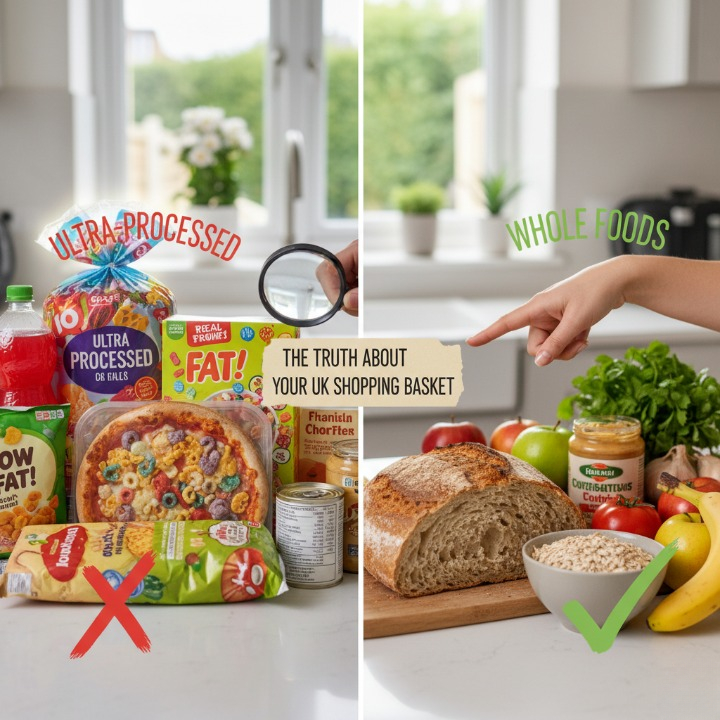
What Are Ultra Processed Foods? The Truth About Your UK Shopping Basket
Did you know that 57% of the average UK diet is now made up of ultra-processed food? That is higher than anywhere else in Europe.
We aren’t just eating food anymore; we are eating industrial formulations. You walk into Tesco or Sainsbury’s, pick up a loaf of bread or a “healthy” fruit yogurt, and assume you are making a good choice. But often, you are buying products engineered to bypass your body’s fullness signals.
If you are confused by the headlines, you are not alone. One day porridge is a superfood; the next, you hear it’s processed. So, what are ultra processed foods really?
This guide is not here to scare you. It is here to give you the tools to spot the difference between real food and edible science experiments—and exactly what to put in your trolley next time you shop.
What Are Ultra Processed Foods? (The Definition)
To understand what you are eating, you need to understand the NOVA classification system. This is the global standard used by researchers to group food based on how much it has been altered.
Think of it as a sliding scale. It helps to visualize an apple:
-
Group 1: Unprocessed or Minimally Processed Foods.
-
The Apple. You pick it off a tree. Maybe you wash it, chill it, or chop it up. It is still an apple. Nothing has been added.
-
Examples: Fresh meat, plain milk, eggs, fruit, vegetables, dried pasta, plain oats.
-
-
Group 2: Processed Culinary Ingredients.
-
The Sugar & Butter. You wouldn’t eat these alone, but you use them to cook Group 1 foods.
-
Examples: Butter, olive oil, sugar, salt, vinegar.
-
-
Group 3: Processed Foods.
-
The Apple Pie. You take the apple (Group 1) and bake it with sugar and butter (Group 2). It is processed, but you could make it in your own kitchen.
-
Examples: Canned vegetables in brine, freshly baked bread, cheese, salted nuts.
-
-
Group 4: Ultra-Processed Foods (UPF).
-
The Apple Flavour Pop-Tart. This contains almost no apple. It is made from derived substances like high fructose corn syrup, modified starch, and hydrogenated oils, held together by emulsifiers and coloured with dyes. You cannot make this in your kitchen because you don’t have jars of “hydrolysed protein” in your cupboard.
-
The Key Difference:
Processing itself isn’t the enemy. Pasteurising milk is processing, and it saves lives. The problem arises when food undergoes industrial extrusion, moulding, and chemical modification to the point where the original ingredients are unrecognizable.
According to the British Nutrition Foundation, the definition relies on the intent of the processing: is it to preserve the food, or to make it hyper-palatable and profitable?
Why Is Everyone Talking About Them? (The Health Risks)
The conversation around what are ultra processed foods has shifted from “calories” to “quality.”
Recent large-scale studies, including research published in The Lancet, have linked high consumption of UPFs to over 32 harmful health effects. These aren’t minor issues. We are looking at strong associations with heart disease, type 2 diabetes, and obesity.
The “Bliss Point” Trap
Why can’t you eat just one Pringle? It’s not a lack of willpower. These foods are engineered to be hyper-palatable.
Food scientists manipulate the ratio of salt, sugar, and fat to hit a “bliss point” that overrides your brain’s “stop” signals. When you eat a steak or an apple, your body signals satiety (fullness) efficiently. When you eat a UPF snack, that signal is delayed or silenced. You essentially overeat before your body realizes it.
Note: The British Heart Foundation (BHF) highlights that UPFs often displace nutritious foods in our diet. If you fill up on chemically formulated bread, you aren’t eating fibre-rich whole grains.
How to Spot UPFs: The “3-Second Label Test”
You don’t need a degree in chemistry to shop safely. You just need my “3-Second Label Test.”
When you pick up a packet, flip it over. Ignore the marketing claims on the front (“High Protein!”, “Natural!”, “Low Fat!”). Look strictly at the ingredients list at the back.
The Golden Rule:
If you see an ingredient that sounds like it belongs in a chemistry set rather than a kitchen cupboard, put it back.
The “Red Flag” Ingredients List
If you spot these, it is almost certainly an Ultra-Processed Food:
-
Emulsifiers: These act as “glue” to hold ingredients together that naturally want to separate. Look for Soy Lecithin, Xanthan Gum, Carboxymethylcellulose, or Polysorbate-80.
-
Sweeteners: Aspartame, Sucralose, High Fructose Corn Syrup (or Glucose-Fructose Syrup), Invert Sugar Syrup.
-
Modified Starches: Maltodextrin, Dextrose.
-
Protein Isolates: Soy protein isolate, Hydrolysed vegetable protein.
-
Flavour Enhancers: Monosodium Glutamate (MSG), Disodium Inosinate.
My Pro-Tip: Don’t look at the calories first. Look at the length of the ingredient list. Real food usually has 1-5 ingredients. UPFs often have 15+. If the list looks like a short novel, it’s a red flag.
The Great British Bread Scandal (And What to Buy)
Bread is the biggest source of UPF in the UK diet.
Traditional bread requires flour, water, salt, and yeast. It needs time to rise. But time is money. In the 1960s, the UK adopted the Chorleywood Bread Process. This uses high-speed mixing and intense additives (like emulsifiers and preservatives) to produce a loaf in a fraction of the time.
The result? That soft, squishy white bread that sticks to the roof of your mouth. It is essentially pre-digested starch.
What to Buy Instead:
You don’t have to spend £5 on an artisanal sourdough (though that’s a great option).
-
Jason’s Sourdough: widely available in Tesco and Sainsbury’s. No additives, just proper fermentation.
-
Waitrose No.1 Sourdough: Clean ingredients.
-
Bertinet Bakery: Available in Waitrose and Ocado.
-
Supermarket “In-Store” Bakery: Check the label. Often, the crusty cobs baked in-store are just flour, water, yeast, and salt, whereas the sliced plastic-wrapped loaves two aisles over are UPF.
Your Non-UPF UK Supermarket Shopping List
Navigating the aisles can be a minefield. Here is a “Swap This for That” table to help you lower your UPF intake immediately.
| Category | Instead of (UPF) | Buy This (Minimally Processed) |
| Breakfast | Chocolate Hoops, Frosties, Multigrain Shapes | Plain Porridge Oats, Weetabix (Original), Shredded Wheat |
| Yogurt | Fruit Corners, “Lite” mousses, Flavoured yogurts | Plain Greek Yogurt + Honey + Fresh Berries |
| Lunch | Pot Noodles, Supermarket Meal Deals | Couscous (soak in boiling water) + Spices + Tinned Tuna |
| Snacks | Pringles, Doritos, flavoured rice cakes | Plain Salted Popcorn, Nuts, Apple slices with Peanut Butter (100% nut) |
| Dinner | Jarred Pasta Sauce (Dolmio etc.) | Tinned Tomatoes + Dried Oregano + Garlic |
| Meat | Ham slices with added water/stabilizers, Nuggets | Roast Chicken slices (check ingredients), Homemade Goujons |
| Drinks | Fizzy Pop, Diluting Juice (Squash) | Water, Tea, Coffee, Sparkling Water with Lemon slice |
Realistic Swaps for Busy Parents (The “Good Enough” Approach)
I know what you’re thinking. “I don’t have time to bake bread or blend tomatoes.”
As a parent, I get it. The goal isn’t perfection; it’s reduction. If you try to cut 100% of UPFs overnight, you will burn out. Aim for the 80/20 rule. If 80% of what you eat is real food, the occasional biscuit won’t hurt you.
The Lunchbox Wins:
-
Swap: Dairylea Dunkers or Cheese Strings $\rightarrow$ Blocks of Cheddar Cheese. Cubed cheese is cheaper and has zero additives.
-
Swap: Fruit Winders or Fruit Flakes $\rightarrow$ Dried Mango or Raisins. Or just an actual banana.
-
Swap: Flavoured Water $\rightarrow$ Water bottle with ice.
Does Eating “Clean” Cost More?
There is a misconception that avoiding what are ultra processed foods is a luxury for the wealthy. While fresh sourdough is pricey, a diet based on whole foods can actually be cheaper.
Let’s look at the maths:
-
UPF Meal: A frozen pizza and a bag of chips can cost £4.50 – £6.00.
-
Real Food Meal: A bag of dried pasta (75p), a tin of tomatoes (45p), an onion (15p), and frozen veggies (£1.50 bag) serves four people for roughly £3.00.
Bulk buying staples like rice, potatoes, lentils, and frozen vegetables is the most cost-effective way to shop. You are paying for the food, not the marketing, the plastic packaging, or the factory processing.
Summary
We have covered a lot, but the takeaway is simple. Ultra-processed foods are industrial creations designed to make you buy more and eat more. They are linked to poor health outcomes and dominate the UK food market.
However, you don’t need to be perfect. You just need to be aware.
-
Read the label. If it has an ingredient you don’t recognize, it’s likely UPF.
-
Cook from scratch where possible, even if it’s just assembling simple ingredients.
-
Beware the “Health Halo.” Just because it says “High Protein” or “Vegan” doesn’t mean it isn’t ultra-processed.
Next Step: Go to your cupboard right now. Pick up your favourite snack and read the back. What is the first “chemical” ingredient you see? Swap that item on your next shop.
FAQs
What are the most common ultra-processed foods in the UK?
The biggest culprits in the British diet are mass-produced factory bread, fizzy drinks, crisps, reconstituted meat products (like ham and nuggets), breakfast cereals, and “fruit” yogurts.
Is porridge ultra-processed?
No, plain rolled oats are Group 1 (Unprocessed). However, those “instant” porridge pots where you add water often contain milk powder, sugar, and flavourings, pushing them into Group 4 (Ultra-Processed).
Are baked beans ultra-processed?
This is a grey area. Standard baked beans are usually Group 3 (Processed) because they contain beans, tomatoes, sugar, and salt. However, check the label for “modified corn flour” or spice extracts. If those are present, it tips into UPF territory. Organic or low-sugar versions are often cleaner.
Is supermarket bread ultra-processed?
Yes, most wrapped, sliced bread (white or wholemeal) is UPF due to the Chorleywood Bread Process which uses emulsifiers and preservatives. Look for sourdough or fresh bakery loaves with simple ingredients (Flour, Water, Salt, Yeast).
How can I avoid ultra-processed foods on a budget?
Focus on “single-ingredient” foods. Tinned pulses (chickpeas, kidney beans), frozen vegetables, rice, pasta, potatoes, and eggs are some of the cheapest items in the supermarket and are totally unprocessed.
Is Weetabix ultra-processed?
Weetabix is generally considered a “safe” choice. While it is processed, its ingredient list is short (Wheat, Malted Barley Extract, Sugar, Salt, Niacin, Iron). Most experts classify it as Group 3 (Processed) rather than Ultra-Processed, making it a good breakfast option.
What is the difference between processed and ultra-processed?
Processed means the food has been modified to preserve it or make it tasty (e.g., cheese, tinned tuna, salted nuts). Ultra-Processed means the food has gone through industrial formulation using additives you wouldn’t find in a kitchen (e.g., cheese strings, reformed meat shapes).
What specific additives should I look for on the label?
Keep an eye out for Emulsifiers (Lecithins, Gums, Polysorbates), Sweeteners (Aspartame, Acesulfame K), Preservatives (Sodium Benzoate), and Modified Starches. These are practically guaranteed markers of ultra-processing.
About the Author