Extra Deep Mattress Fitted Sheets: UK Buying Guide & Top Picks (2025)
We have all been there. It’s 3 AM. You roll over, and suddenly, PING.
The corner of your fitted sheet snaps off, curling up under your back. Now you are sleeping directly on the mattress protector, tangled in a wad of cotton. If this sounds familiar, you don’t need a new bed; you need to solve the geometry problem of modern bedding.
The standard UK fitted sheet has a depth of 25cm to 28cm. Ten years ago, that was fine. But today, with the rise of deep hybrid mattresses (like Simba or Emma) and the addition of plush memory foam toppers, the average British bed setup often exceeds 32cm in height.
Standard sheets essentially create a “trampoline” over these deeper setups. They might fit when you force them on, but the moment you lie down, your body weight pulls the fabric, and the corners give way.
In this guide, I will walk you through the exact formula for measuring your bed (most people get this wrong), the specific fabrics that grip best, and my top recommendations for extra deep mattress fitted sheets available in the UK right now.
Why Standard Sheets Fail: The “Pop-Off” Mechanics
Before we look at brands, it is vital to understand why your current sheets are failing. It usually comes down to two mechanical issues: insufficient corner depth and elastic style.
The Depth Deficit
Most “standard” sheets sold in supermarkets are designed for the mattresses of the 1990s. A standard 25cm sheet on a 30cm mattress isn’t just tight; it has zero “tuck.” Without fabric to tuck under the mattress, the only thing holding the sheet in place is friction. That is a losing battle.
Corner vs. All-Round Elastic
Flip your current sheet over. Does the elastic only run around the four corners? This is a cost-saving measure used by many budget manufacturers. For an extra deep fit, you need a fully elasticated hem. This means the elastic runs the entire perimeter of the sheet, creating a drawstring effect that cinches tight underneath the mattress, regardless of how much you move.
My Pro-Tip: The Pop-Off Test
Before you buy new sheets, do this quick test. Put your current sheet on the bed. Try to slide your hand flat, palm up, between the mattress corner and the sheet. If you can’t fit your hand in because the fabric is stretched to its limit, that sheet will pop off tonight. You need at least 2cm of “give” for a secure fit.
How to Measure for Extra Deep Sheets (The Golden Rule)
This is where 90% of returns happen. You might think, “My mattress is 30cm deep, so I’ll buy a 30cm sheet.”
Do not do this. If you buy a sheet the exact same size as your mattress, it will cover the side but won’t have any fabric left to grip underneath.
The Calculation Formula
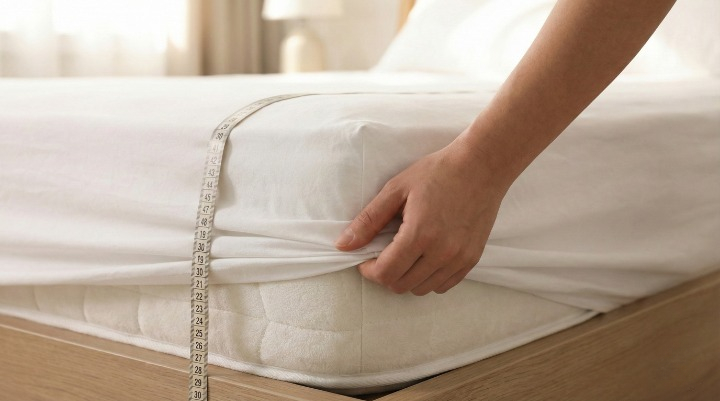
To get the perfect fit, you need to do a little maths. Grab a tape measure (a stiff metal one is better than a sewing tape for this).
-
Measure the Mattress Depth: Measure from the bottom piping to the top piping.
-
Measure the Topper (If applicable): Do not compress it; measure the loft at rest.
-
Add the “Tuck Allowance”: You need 5cm to 8cm of extra fabric to wrap under the bed.
This leads me to my absolute rule for buying bedding:
The Golden Rule of Depth
(Mattress Depth + Topper Depth) + 5cm = Minimum Sheet Depth
Example: If you have a 30cm mattress and a 5cm topper, your total height is 35cm. You need a sheet with a minimum depth of 40cm. Buying a 35cm sheet will result in the dreaded 3 AM “ping.”
The “Shrinkage Tax”
Natural fibers shrink. It is an unavoidable fact of textiles. According to industry standards, even high-quality cotton can shrink between 3% and 5% on the first wash.
If your calculation says you need exactly 38cm, do not buy a 40cm sheet expecting it to stay 40cm forever. Safe yourself the headache and jump up to the 46cm (Ultra Deep) category. It is always better to have a little extra fabric to tuck in than to be fighting a shrinking sheet.
Deep vs. Extra Deep vs. Ultra Deep: What’s the Difference?
The terminology in the UK market can be confusing. Retailers often use these terms loosely, but here is the general industry standard breakdown to help you filter your search results.
| Category | Typical Depth | Best For… |
| Standard | 25cm – 28cm | Older, sprung mattresses; Guest beds; No toppers. |
| Deep | 30cm – 34cm | Modern hybrid mattresses (e.g., Simba, Eve) without a topper. |
| Extra Deep | 38cm – 40cm | Thick luxury mattresses OR standard mattresses with a protector/thin topper. |
| Ultra Deep | 46cm – 50cm+ | The “Princess and the Pea” setup. Thick mattress + thick memory foam topper. |
Best Materials for Deep Sheets (Grip & Hygiene)
When buying extra deep mattress fitted sheets, the material affects more than just comfort—it affects the fit.
1. Brushed Cotton (The “Gripper”)
If you are a restless sleeper, brushed cotton (flannelette) is fantastic. The surface texture creates natural friction against the mattress ticking, making it less likely to slide around than silky fabrics. It’s warm, cosy, and practical for winter.
2. Egyptian Cotton (The Luxury Choice)
Egyptian cotton is renowned for breathability. However, crisp Percale weaves (often found in hotel bedding) have very little stretch. If you choose Egyptian cotton, ensure the sizing is generous.
[National Bed Federation – Buying Guide]
3. The “Stretch” Synthetics (Microfiber/Jersey)
While I generally prefer natural fibers for breathability, Jersey cotton or high-quality Microfiber blends have a distinct advantage here: elasticity. They stretch like a T-shirt. If you have an oddly shaped mattress or are right between sizes, a stretchy jersey sheet is often the most secure option.
Safety Note: If you opt for synthetic blends to save money, always check for the OEKO-TEX® Standard 100 label. This ensures the fabric is free from harmful chemicals, which is vital for something you press your face against for 8 hours a day.
Top Picks for Extra Deep Fitted Sheets in the UK (2025)
Based on depth, elastic quality, and material durability, here are the top categories to look for.
1. Best Overall: The 40cm Percale (200TC+)
Target: The “Set and Forget” Shopper
For most UK homes with a modern mattress and a thin protector, a 40cm cotton percale sheet is the sweet spot. Look for “crisp” finishes. They feel cool to the touch and tend to hold their structure better than soft sateens, which can drape and loosen over time.
-
Look for: 100% Cotton, 40cm depth, fully elasticated hem.
2. The “Ultra Deep” Problem Solver (46cm+)
Target: Memory Foam Topper Users
If you have a 5cm or 7cm memory foam topper, you need to look at specialist retailers like Victoria Linen or The Bettersleep Company on Amazon UK. High street retailers like Dunelm or John Lewis often cap out at 38cm.
-
Why it works: These sheets are cut specifically to envelop both the mattress and the topper as a single unit.
3. Best Budget Option: Microfiber Blends
Target: Spare Rooms & Rentals
If you run an Airbnb or need a spare sheet, “easy-care” microfiber sheets are wrinkle-resistant and dry incredibly fast. Because they are synthetic, they don’t shrink in the wash, meaning a 40cm sheet stays a 40cm sheet.
Care Guide: Keeping the Elastic Tight
You found the perfect sheet. Now, don’t ruin it. The number one killer of fitted sheets isn’t friction; it’s heat.
The elastic in your fitted sheet is essentially a rubber compound wrapped in thread. High heat breaks down rubber, causing it to become brittle and snap.
-
Wash Cool: Stick to 30°C or 40°C. According to The Sleep Charity, washing at 60°C is good for killing dust mites, but it degrades elastic over time. Try to rotate high-heat washes rather than doing it weekly.
-
Skip the Tumble Dryer (If possible): I know, drying sheets in the UK winter is a nightmare. But if you must tumble dry, use the “Low Heat” or “Synthetic” setting. Blasting your deep sheets on high heat is a guaranteed way to turn your “Extra Deep” sheet back into a “Standard” one.
Frequently Asked Questions (FAQs)
What size is a standard UK King vs. Super King?
This causes so much confusion! In the UK, a King is 150cm x 200cm. A Super King is 180cm x 200cm. Note: If you are buying from sites like Wayfair or Amazon, check if the sizing is “EU King” (160cm wide), which will be too baggy for a standard UK King.
Will a 40cm sheet fit a 30cm mattress?
Yes, absolutely. In fact, it’s recommended. The extra 10cm will simply tuck further underneath the mattress, providing a much more secure grip than a 30cm sheet would.
Why do my sheets bobble (pill) after a few months?
Bobbling usually happens with poly-cotton blends or shorter-staple cottons where fiber ends break and tangle. To avoid this, look for “Long Staple Cotton” or combed cotton, and avoid washing your sheets with towels (the friction from the towels damages the smooth sheet fabric).
My sheet fits the depth but is loose in the middle. Why?
This often happens with Jersey or stretch fabrics if the elastic isn’t tight enough. Try “sheet suspenders” (criss-cross clips that go under the mattress) as a last resort, or switch to a crisp woven cotton (Percale) which has less give.
Do I really need to iron extra deep sheets?
Trying to iron a fitted sheet is like trying to wrap water. Life is too short. If you buy “Easy Care” or poly-cotton blends, you can put them straight on the bed slightly damp, and they will dry smooth. If you love 100% cotton, just accept the wrinkles—they will be covered by the duvet anyway!
Final Thoughts
Finding the right extra deep mattress fitted sheets isn’t just about luxury; it’s about sanity. There is nothing worse than waking up on a bare mattress protector.
Remember the math: measure your mattress, add your topper, and add 5cm. If you are on the fence between sizes, always size up. It is far better to have a little extra fabric tucked away than to fight a losing battle with a sheet that’s too small.
Ready to upgrade your sleep setup?
Check the depth of your current mattress now (go on, grab the tape measure), and treat yourself to a sheet that actually stays put. Your sleep quality, and your sanity, will thank you.
About the Author