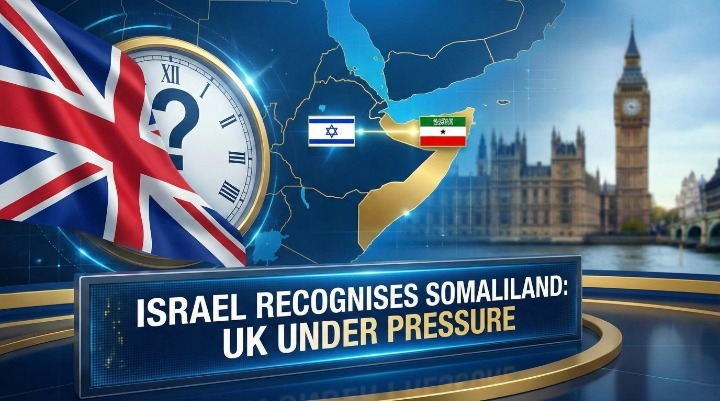
Israel Recognises Somaliland: What This Historic Move Means for the UK and Global Geopolitics
On 26 December 2025, the geopolitical landscape of the Horn of Africa underwent a seismic shift. In a move that blindsided many Western diplomats, Israel became the first United Nations member state to formally recognise the Republic of Somaliland as an independent and sovereign nation.
Israeli Prime Minister Benjamin Netanyahu and Somaliland President Abdirahman Mohamed Abdullahi “Irro” signed a mutual declaration of recognition during a historic video call. Netanyahu described the moment as “seminal,” explicitly linking the breakthrough to the spirit of the Abraham Accords. This decision ends 34 years of diplomatic limbo for Somaliland, a territory that has functioned as a stable, self-governing democracy since 1991 while the rest of Somalia struggled with instability.
For the UK, Somaliland’s former colonial protector, this announcement creates an immediate and pressing foreign policy dilemma. With Israel taking the first step, the British government now faces unprecedented internal and external pressure to follow suit or risk losing its historical influence in a strategically vital region.
The December 2025 Announcement: A New Era for Hargeisa
The recognition was not a sudden impulse. It followed over a year of discreet high-level dialogue facilitated by the Mossad and Israeli Foreign Minister Gideon Sa’ar. The signed agreement establishes full diplomatic relations, including the exchange of ambassadors and the opening of embassies in Jerusalem and Hargeisa.
Joining the Abraham Accords: The Trump Factor
A critical component of this deal is Somaliland’s expressed intention to join the Abraham Accords. President Abdullahi confirmed that Hargeisa seeks to become a signatory to the framework, which has already normalised ties between Israel and several Arab nations.
The timing is heavily influenced by the 2025 US administration’s shift in African policy. Reports suggest that the “Project 2025” doctrine, which advocates for recognizing Somaliland as a hedge against Chinese influence in Djibouti, provided the necessary diplomatic cover for Israel to move forward. This alignment suggests that Israel is not acting in isolation but as the vanguard for a broader Western realignment.
Strategic Rationale: Why Israel Recognised Somaliland Now
Israel’s decision is driven by cold, hard strategic necessity. Somaliland’s 460-mile coastline sits at the mouth of the Gulf of Aden, directly overlooking the Bab el-Mandeb Strait—a primary chokepoint for global maritime trade.
Red Sea Security and the Houthi Threat
The ongoing threat from Iranian-backed Houthi rebels in Yemen has made the Red Sea a dangerous corridor for Israeli-linked shipping. By securing a foothold in Somaliland, Israel gains a “forward base” for intelligence monitoring and maritime security operations. Access to Somaliland’s airspace and territory allows Israel to surveil Houthi armament efforts with much higher precision.
Countering China and Turkey’s Influence
While China operates a massive military base in neighbouring Djibouti, Israel’s presence in Somaliland offers a strategic alternative. Furthermore, it counters the growing influence of Turkey and Egypt in Mogadishu. For Israel, an independent Somaliland is a stable, non-Iranian platform in an otherwise volatile region.
The UK Dilemma: Why the Former Protectorate is Lagging Behind
The UK holds a unique historical responsibility toward Somaliland. Between 1884 and 1960, the territory was the British Somaliland Protectorate. When it gained independence in 1960, the UK was among the first of 35 nations to recognise it before Somaliland voluntarily entered a fateful union with the former Italian Somalia.
Historical Ties vs. Diplomatic Caution
Despite decades of lobbying from British-Somalilanders, the Foreign, Commonwealth & Development Office (FCDO) has long maintained that “Somaliland and Somalia should reach an agreement on their future first.”
However, Israel’s 2025 move has shattered this “African Union first” policy. Recent remarks by the British Foreign Secretary suggest that Westminster is finally reconsidering. The argument that “the UK should not be the first to recognise” is no longer valid. Israel has taken the leap, and the UK now risks appearing indecisive regarding its own former territory.
The British-Somaliland Diaspora Pulse
In cities like Cardiff, Sheffield, London, and Liverpool, the reaction has been electric. These cities host large, politically active Somaliland communities that have successfully passed local council motions in favour of recognition.
Expert Analysis: “For the diaspora, Israel’s recognition is the validation they have sought for 34 years. They are now turning their sights on their local MPs, demanding that the UK government acknowledges the reality on the ground in Hargeisa.”
Regional Backlash: Somalia, Egypt, and the Arab League
The announcement has triggered a diplomatic firestorm. The Federal Government of Somalia (FGS) in Mogadishu immediately denounced the move as a “blatant attack” on its sovereignty.
Mogadishu’s Response: “A Violation of Sovereignty”
Somalia has called for an emergency meeting of the Arab League and the African Union. Turkey and Egypt have stood firmly behind Mogadishu, warning that recognizing separatist entities sets a “dangerous precedent” for other secessionist movements across Africa.
Addressing the Resettlement Rumours
To build trust and provide a balanced view, it is vital to address the controversial rumours suggesting that Israel recognised Somaliland in exchange for a deal to resettle Palestinians from Gaza. Both the Israeli Prime Minister’s Office and the Somaliland presidency have officially denied these reports, framing the partnership strictly around security, agriculture, and technology.
Economic Implications: Trade, Technology, and the Berbera Port
Beyond security, the Israel Somaliland recognition opens doors for significant economic cooperation.
-
Agricultural Innovation: Israel plans to export advanced “Ag-Tech” to help Somaliland manage its semi-arid climate and improve food security.
-
Berbera Port Expansion: With growing British investment via British International Investment (BII), the Berbera Port is becoming a world-class maritime hub. Israeli partnership in port security and logistics will further accelerate its growth as a competitor to Djibouti.
-
Water Management: Somaliland’s chronic water shortages could be addressed through Israeli desalination and drip-irrigation technology.
FAQs
Which countries recognise Somaliland in 2025?
As of late December 2025, Israel is the first UN member state to formally recognise Somaliland. South Sudan has indicated it may follow shortly. Many others, including the UK, UAE, and Ethiopia, maintain high-level diplomatic offices in Hargeisa without formal recognition.
Is Somaliland part of the Abraham Accords?
Somaliland has officially expressed its firm intention to join the Abraham Accords following the mutual recognition agreement signed with Israel on 26 December 2025.
Why does the UK not recognise Somaliland?
Historically, the UK has deferred to the African Union’s stance, which prioritises the territorial integrity of existing states. However, the UK’s position is currently under intense review following Israel’s historic move.
Is Somaliland a safe country to visit?
Compared to the rest of the region, Somaliland is remarkably stable. It has its own police force, currency, and democratic government. However, the UK FCDO still maintains specific travel advisories that should be checked before visiting.
Final Thoughts: A Domino Effect in the Making?
Israel’s recognition of Somaliland is not merely a bilateral deal; it is the first crack in a long-standing international wall of silence. For 34 years, Hargeisa has operated as a “de facto” state. In 2025, it has finally begun its transition to a “de jure” sovereign nation.
The UK can no longer afford a “wait-and-see” approach. As the former protectorate power, Britain holds the moral and historical keys to Somaliland’s future. With the Red Sea increasingly militarised and Israel leading the way, the question in Westminster is no longer if the UK will recognise Somaliland, but when.
[Official Statement from the Israel Government Press Office]
[Exploring UK Foreign Policy in the Horn of Africa]
About the Author