Lindsey Vonn Crash: 2026 Olympic Downhill Dream Ends in Airlift
The silence that fell over Cortina d’Ampezzo at 11:30 AM today was deafening. It wasn’t the silence of anticipation, it was the collective gasp of thousands witnessing a nightmare scenario unfold in real-time.
Lindsey Vonn, the 41-year-old “Speed Queen” who had defied every medical textbook to stand in the starting gate, lay motionless on the snow just 13 seconds into her run. She had launched out of the hut with the aggression that defined her career, but as she approached the fourth gate of the Olimpia delle Tofane course, physics and physiology collided.
The Lindsey Vonn crash at the 2026 Winter Olympics wasn’t just a sporting accident; it was the brutal conclusion to one of the most audacious gambles in alpine history. Competing with a fully ruptured ACL sustained only nine days prior, Vonn’s knee finally gave way under the immense G-forces of an Olympic downhill.
This report covers the technical breakdown of the crash, the immediate medical fallout, and the bittersweet gold medal victory for Team USA that followed in the shadow of the helicopter blades.
The 13-Second Disaster: What Happened in the Cortina Downhill?
To understand why this crash occurred, we have to look beyond the headline and at the snow itself. The Women’s Downhill final in Cortina is not a forgiving environment. It requires absolute precision, and arguably, two healthy legs.
Clipping the Fourth Gate: A Technical Analysis
Vonn started with aggressive intent. Her split time at the first interval was competitive, signaling that she wasn’t there just to participate. However, the trouble began entering the first significant compression.
According to the live feed and replay analysis, Vonn approached the fourth gate, a high-speed left-hander, slightly late on her line. In alpine skiing, “late” means you are fighting centrifugal force rather than riding it. As she fought to bring her skis back under her center of gravity, her right arm clipped the gate panel.
Usually, a gate clip is a minor error. But Vonn was skiing on a compromised chassis. The impact threw her weight backward, forcing a heavy load onto her left leg, the very leg holding the 100% ruptured ACL from her crash in Crans-Montana on 30 January. Without the anterior cruciate ligament to stabilize the knee joint, the tibia shifted forward, the ski lost its edge, and stability vanished instantly.
The Moment of Impact at Olimpia delle Tofane
The result was a high-speed somersault that looked painfully familiar to long-time fans of the sport. Vonn was thrown into the safety netting with significant velocity. The Lindsey Vonn crash mechanism here is classic “phantom foot” syndrome, where the tail of the downhill ski acts as a lever, twisting the knee violently.
Expert Insight: When you ski without an ACL, you are relying entirely on muscular strength (quadriceps and hamstrings) to stabilize the joint. At 70 mph, muscle reaction time is often too slow to counteract sudden terrain changes. Once Vonn lost her balance, her muscles couldn’t save the joint.
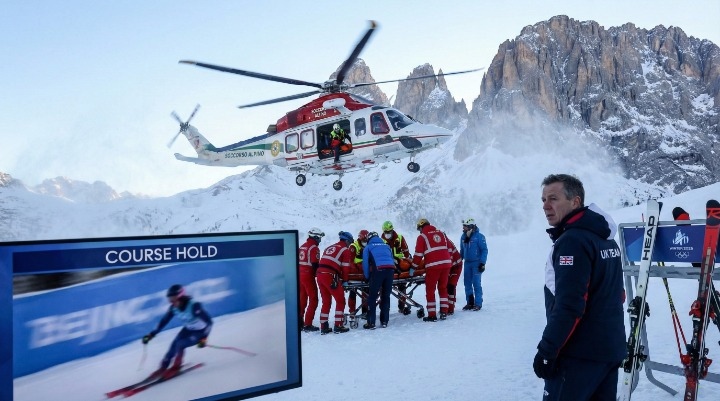
Medical personnel were on the scene within seconds. The race was immediately red-flagged, pausing the event for nearly 20 minutes as doctors stabilized her leg in a vacuum splint before calling for the rescue helicopter.
Official FIS Race Report for Cortina 2026
Lindsey Vonn Injury Update: Medical Airlift to Codivilla Hospital
The image of the yellow rescue helicopter lifting off against the backdrop of the Dolomites will likely be the defining photo of the 2026 Games. For Vonn, this was a devastating case of déjà vu.
Second Helicopter Evacuation in 9 Days
This is the second time in less than two weeks that Vonn has required an airlift. The first was in Crans-Montana, Switzerland, where the initial ACL rupture occurred. Today’s evacuation to Codivilla Hospital in Cortina was urgent, not just because of the knee, but to assess for secondary trauma.
In high-speed crashes involving safety nets, physicians must immediately rule out:
- Concussion or TBI: The whiplash effect of catching an edge.
- Tibial Plateau Fractures: Common when the knee collapses under load.
- Hip Trauma: Especially risky given her history of high-impact falls.
[Sky News UK Live Updates on Vonn Condition]
Assessing the Damage: ACL Rupture vs. New Trauma
The primary medical concern right now is the extent of new damage. We know she entered the race with a ruptured ACL. The fear is that the crash may have caused damage to the meniscus, the MCL (Medial Collateral Ligament), or the bone structure itself.
We are currently awaiting the official MRI results from the US Ski & Snowboard team. However, early reports from the course suggest Vonn remained conscious throughout the extraction, communicating with doctors, a small mercy in a chaotic situation.
The Medical Gamble: Can You Really Ski Without an ACL?
The question dominating social media and sports bars across the UK is simple: Why was she allowed to race?
Titanium Joints and Torn Ligaments: The 41-Year-Old’s Battle
Lindsey Vonn’s anatomy is a roadmap of alpine skiing surgery. In April 2024, she underwent a partial knee replacement on her right knee, receiving a titanium implant to fix severe degeneration.
Skiing the 2026 Winter Olympics with a titanium knee was already groundbreaking. Doing it with a fresh ACL tear in the other knee (left) pushed the boundaries of medical ethics and athletic bravery.
The logic behind her return was likely based on “coping.” Some athletes, known as “copers,” can stabilize a knee without an ACL using immense thigh muscle strength. However, this usually applies to soccer or jogging, not hurtling down an ice-injected slope at motorway speeds.
The Surgeon’s Perspective: Risks of Periprosthetic Fractures
The biggest risk Vonn faced wasn’t just pain; it was catastrophic structural failure.
The Surgeon’s Perspective: Why 9 Days is Dangerous
According to standard orthopaedic protocols outlined by the NHS and British Journal of Sports Medicine, acute ACL ruptures require weeks of swelling reduction before heavy loading.
- The Instability: Without an ACL, the shin bone slides forward freely.
- The Compensation: The athlete over-relies on the healthy leg.
- The Nightmare: If Vonn crashed onto her right leg (the titanium one) while protecting her left (the ACL tear), she risked a periprosthetic fracture. This is where the bone breaks around the metal implant, a devastating injury that often ends mobility, not just careers.
By clipping that gate, Vonn rolled the dice on this exact scenario. Fortunately, initial footage suggests the impact was distributed, but the stress on her titanium joint would have been immense.
[NHS Guide to ACL Injuries and Recovery]
From Tragedy to Triumph: Breezy Johnson Secures Olympic Gold
While the cameras focused on the medical helicopter, the race eventually resumed. In a twist of fate that only sports can script, the gold medal stayed within the US team.
Team USA’s Bitter-Sweet Podium in Italy
Breezy Johnson, Vonn’s teammate and mentee, had to stand at the top of the course for 20 minutes, watching her idol be airlifted away. The mental fortitude required to strap into skis and attack the same course immediately after a Lindsey Vonn crash cannot be overstated.
Johnson delivered the run of her life. She attacked the Olimpia course with a fluidity that Vonn couldn’t maintain, crossing the finish line in 1:36.10.
Final Results: Johnson, Aicher, and Goggia
The final podium for the Women’s Downhill serves as a testament to the new generation of speed:
- Breezy Johnson (USA) – 1:36.10 (Gold)
- Emma Aicher (GER) – +0.22 (Silver)
- Sofia Goggia (ITA) – +0.35 (Bronze)
Johnson’s victory is monumental, but her post-race interview was subdued. “This is for Lindsey,” she told reporters in the finish area. “She paved the road that I just skied down.”
The Legacy of the Speed Queen: Is This the Final Race?
If this is indeed the end of Lindsey Vonn’s competitive career, it ends exactly as it was lived: at the absolute limit of human possibility.
Vonn retired in 2019, only to undergo surgery and return five years later for a shot at the 2026 Games. Critics will call the decision to race recklessly. Fans will call it heroic. Both are likely true.
Her stats remain untouched: 82 World Cup wins, Olympic Gold in 2010, and a comeback at age 41 that, while ending in a crash, captured the world’s attention. The Lindsey Vonn crash today does not erase the legacy; it underscores the brutal price paid for it.
Final Thoughts
The 2026 Winter Olympics will be remembered for many things, but the image of Lindsey Vonn fighting gravity one last time will endure.
Today proved that while the spirit is willing, biology has hard limits. The Lindsey Vonn crash was a collision between an unstoppable will and an immovable object. As Vonn recovers in Codivilla Hospital, the ski world celebrates Breezy Johnson’s gold, a torch passed not in a ceremony, but in the chaotic, adrenaline-fueled reality of the downhill.
FAQs
Did Lindsey Vonn crash in the 2026 Olympics?
Yes. Lindsey Vonn crashed 13 seconds into her downhill run at the Milano Cortina 2026 Winter Olympics on 8 February.
What is Lindsey Vonn’s current injury status?
Vonn was airlifted to Codivilla Hospital. She was competing with a pre-existing ruptured ACL in her left knee. Official updates on new fractures or tears are pending.
How did Breezy Johnson win gold after Vonn’s crash?
After the race resumed, Breezy Johnson skied a flawless run of 1:36.10, beating the field despite the emotional delay caused by Vonn’s injury.
Can you ski with a 100% ruptured ACL?
Technically, yes, with a custom brace and immense muscle strength (“coping”), but it is highly unstable and dangerous for professional downhill racing.
How old is Lindsey Vonn in the 2026 Winter Olympics?
Lindsey Vonn is 41 years old. She came out of retirement specifically to compete in these games.
[Subscribe to Eurosport UK for Live Olympic Coverage]
About the Author