How Much Does It Cost to Run a Dehumidifier in the UK? (2026 Guide)
Turning on any plug-in appliance can feel terrifying when energy prices run high. You watch the smart meter flash. But letting black mould take over your walls is much worse. With the April 2026 Ofgem price cap now active, households need exact numbers instead of guesswork. The truth? Running a dehumidifier is cheaper than you think. Smart usage can even save you money on your winter heating and laundry bills.
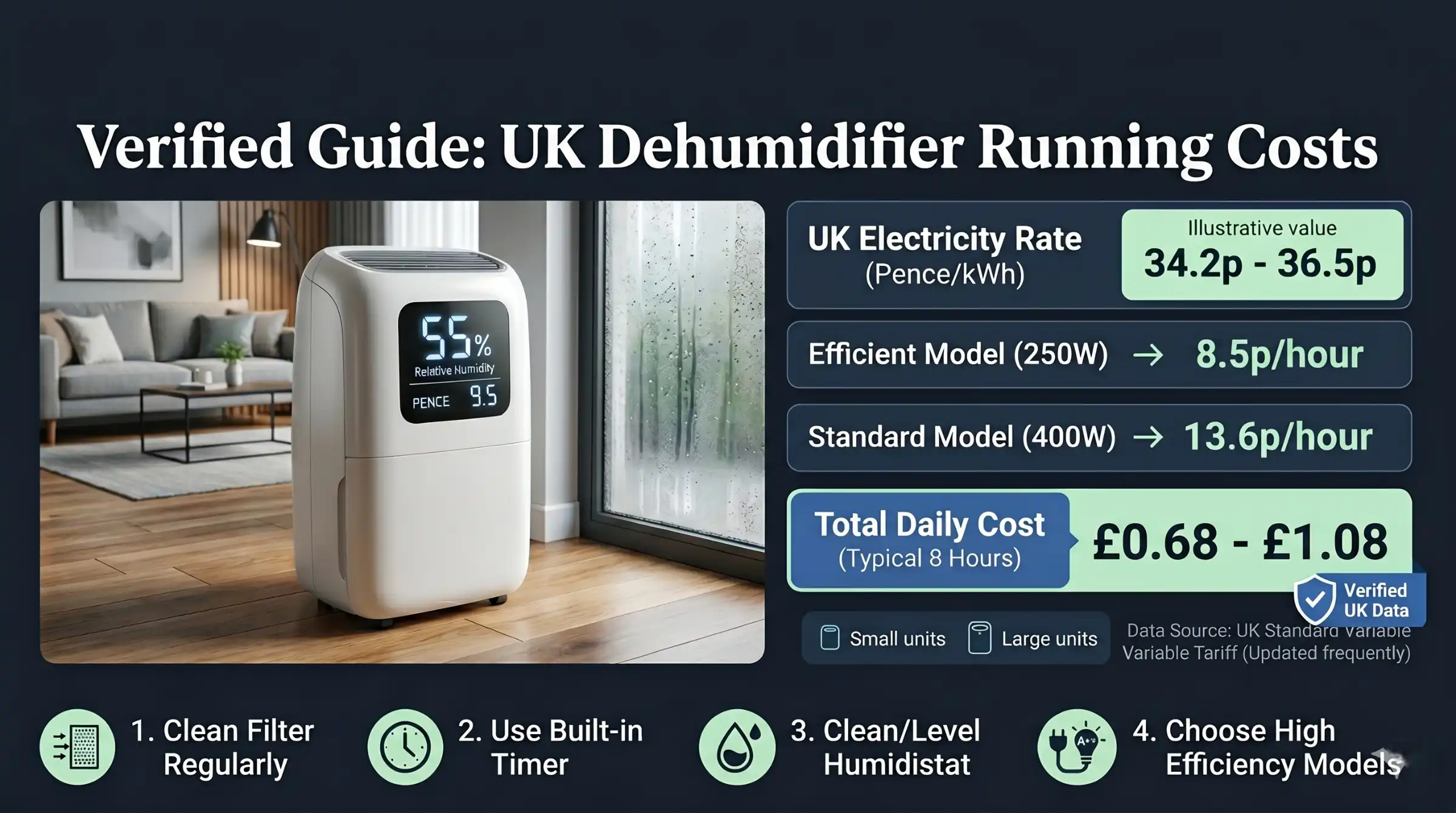
At the April 2026 Ofgem electricity cap of 24.67p per kWh, a typical 250W compressor dehumidifier costs roughly 6.1p per hour to run. Operating it for 8 hours a day will cost approximately 49p daily, or £14.70 a month, depending on your exact household tariff and indoor humidity levels.
Key Takeaways
- Average hourly costs sit between 5p and 15p for standard domestic models.
- Calculations rely on the April to June 2026 Ofgem price cap of 24.67p per kWh.
- Compressor models are cheaper to run but struggle in cold rooms.
- Desiccant models cost more per hour but work brilliantly in unheated garages.
- Using a dedicated laundry mode is significantly cheaper than running a tumble dryer.
- Hidden maintenance costs like replacement HEPA filters can add up over the year.
Quick Start: The Dehumidifier Running Cost Calculator
Want to know your exact hourly cost? Use this quick four-step method.
- Find the wattage. Look at the specification sticker on the back of your unit (for example, 250W).
- Convert to kilowatts. Divide the wattage by 1,000 to get the Kilowatt (kW) rating (250 / 1000 = 0.25 kW).
- Check your energy rate. Look at your latest bill or use the current standard variable rate of 24.67p.
- Do the final math. Multiply your kW figure by the pence rate (0.25 x 24.67 = 6.16). Result: Your appliance costs exactly 6.16 pence per hour to operate.
Understanding UK Dehumidifier Running Costs by Type
The 2026 Ofgem Price Cap Reality
To get an accurate picture, you must use current figures. From 1 April to 30 June 2026, the Ofgem energy price cap sets the average standard variable rate for electricity at 24.67p per kWh. Your exact hourly cost will fluctuate slightly based on your specific energy tariff, where you live in the UK, and how you pay your bills. Direct debit customers often pay slightly different rates than those on prepayment meters. You can verify the latest standard figures through official Ofgem price cap data.
Compressor vs. Desiccant: The Cost Divide
Not all machines use power the same way. The two main types available to UK buyers are compressor and desiccant models.
A typical domestic dehumidifier in the UK consumes between 0.3 kW and 0.8 kW of electricity per hour. However, highly efficient, low-power compressor models—like a 20-litre unit drawing just 219 watts—cost roughly 5.4p to 6p per hour to operate at the capped rate.
Desiccant dehumidifiers generally consume more electricity. They do not use cold coils. Instead, they use an absorbent material to pull moisture from the air. Because of this, they remain highly effective in cold environments like unheated utility rooms or garages at temperatures near 1°C.
Common mistake: Putting a cheap compressor dehumidifier in a freezing garage. The machine will waste electricity constantly trying to defrost its internal coils instead of collecting water.
Chris Michael from Meaco highlights this modern efficiency: “Many dehumidifiers are highly energy-efficient, some costing as little as 4p per hour to run.”
Industrial and Continuous Operation
Sometimes domestic models are not enough. If you have severe structural dampness or have recently suffered a flood, you need heavy-duty equipment. Professional-grade units draw significantly more power, often between 0.5 kW and 0.8 kW. Continuous 24-hour operation of these high-capacity machines results in electricity costs between £3.00 and £5.00 per day.
Instead of buying one outright, many people choose to rent. Hiring an industrial dehumidifier for severe damp in London costs approximately £22.00 plus VAT per day. This is a very cost-effective alternative to a £1,000 purchase if you only need it for a week to dry out fresh plaster.
The Hidden Savings: How a Dehumidifier Pays for Itself
Looking purely at the hourly wattage only tells half the story. Running a dehumidifier can actually put money back in your pocket.
Here are three ways these machines offset their own running costs:
- The Heating Offset Advantage: Dry air heats up faster than damp air. Water particles in the air absorb heat. If your home is humid, your boiler works overtime just to warm up the moisture. Running your dehumidifier might cost 6p an hour, but it removes that water. You can then turn your central heating thermostat down by a full degree, partially offsetting the electricity expense.
- The ‘Laundry Mode’ Hack: Ditch the tumble dryer. Using a dehumidifier’s dedicated ‘laundry mode’ to dry clothes indoors is highly energy-efficient. Efficient models cost under 10p per hour to run. Consider a typical UK renter in a small flat. They turn off their power-hungry 2500W tumble dryer and place a 220W compressor dehumidifier near a clothes horse. Instead of spending over £1.00 per load in the dryer, the dehumidifier costs around 32p. It safely dries the clothes while stopping window condensation dead in its tracks.
- Preventing Structural Damage: Mould destroys homes. The financial cost of running a small appliance pales in comparison to replastering a damp-damaged wall or replacing rotting window frames.
Mid-Article Summary
- Running a dehumidifier removes moisture, making your home cheaper to heat.
- Swapping your tumble dryer for a dehumidifier’s laundry mode saves significant cash per load.
- Investing pennies per hour prevents thousands of pounds in structural damp damage.
Hidden Fees & Real-World Scenarios
The True Cost of Ownership
Electricity is not the only expense. Buyers often forget about ongoing maintenance. Hidden expenses, such as HEPA filter replacements and regular limescale cleaning, add an estimated £20 to £80 to the annual cost of running a dehumidifier in the UK. If you buy a two-in-one purifier and dehumidifier, you must budget for those yearly filter swaps.
The Unheated Garage Scenario
Standard rules change in freezing conditions. Imagine storing a classic car in a cold garage. You need to prevent rust. A homeowner uses a 600W desiccant dehumidifier because the room temperature sits near 2°C. A standard compressor model would simply freeze up and waste power. The desiccant model costs roughly 14.8p per hour. It is more expensive to run, but it actually works in freezing UK winter conditions. You can read more about managing complex cold-room damp through the Energy Saving Trust damp guide.
5 Pro Tips to Keep Your Dehumidifier Bills Low
- Know Your Cap: Always calculate your costs against the current Ofgem price cap. Do not rely on outdated blog posts. As of April 2026, use 24.67p per kWh to get an accurate daily figure.
- Use the Humidistat: Never run a unit continuously if you do not have to. Set the target humidity to 55%. The built-in humidistat will automatically cycle the compressor on and off, slashing your long-term running costs.
- Match the Tech to the Temp: Stop using compressor models in unheated conservatories. They waste electricity trying to defrost. Use a desiccant model for anything below 10°C.
- Vacuum the Coils: Domestic dehumidifiers typically draw more power when operated in colder, wetter conditions due to the increased workload. A dust-clogged machine works even harder. Vacuum the rear filter monthly to maintain low power consumption.
- Smart Meter Synergy: Plug your dehumidifier in and watch your in-home display. This reveals exactly what the unit costs per hour on your specific household tariff.
Which Model Should You Choose?
Use this quick decision tree to pick the most cost-effective machine for your home.
- Is the room heated and generally above 15°C?
-
Yes → Buy a Compressor Dehumidifier. It offers the lowest running cost, typically around 5p to 6p per hour.
-
- Is the room unheated, dropping below 10°C (like a garage or loft)?
-
Yes → Buy a Desiccant Dehumidifier. It has a higher running cost of roughly 15p per hour, but it is the only type that functions properly in the cold.
-
- Will you primarily use it to dry clothes indoors?
-
-
Yes → Look for models featuring a dedicated “Laundry Mode”. You need a high air volume capacity to maximize your efficiency per hour.
-
End Summary
You do not need to fear your dehumidifier. While there is an upfront electricity cost, strategic use makes it highly economical in the wet UK climate. Built-in humidistats and laundry modes keep daily costs low, often hovering around a few pence per hour. By removing moisture, you protect your property and make your heating system more efficient.
Next Steps:
- Check your exact household energy tariff against the April 2026 Ofgem cap.
- Find the wattage on your current or desired unit to calculate the real hourly rate.
- Choose between a compressor or desiccant model based on your room temperature.
FAQs
Does a dehumidifier use a lot of electricity?
Not necessarily. As Les Roberts, a Bionic Energy Expert, explains: “The average dehumidifier uses approximately 500 watts per hour, which costs around 13p per hour of use.” Smaller, efficient models use far less.
Is it cheaper to leave a dehumidifier on all the time?
No. It is cheaper to use a model with an automatic humidistat. Set it to 55% relative humidity. The machine will turn itself off when the air is dry enough, saving you money.
What is the cheapest dehumidifier to run in the UK?
Low-wattage compressor models are the cheapest. For example, some highly efficient 20L compressor units draw around 219 watts, costing roughly 5.4p to 6p per hour to run.
How much does a 20L dehumidifier cost to run?
An energy-efficient 20L compressor model costs about 5.4p to 6p per hour based on the April 2026 energy cap. Older or less efficient 20L models may draw closer to 400 watts, costing nearly 10p per hour.
Is it cheaper to use a dehumidifier or tumble dryer for clothes?
It is vastly cheaper to use a dehumidifier. Using a dehumidifier’s laundry mode costs under 10p per hour. A standard vented tumble dryer can cost over £1.00 per load.
Will a dehumidifier reduce my heating bill?
Yes, it can. Damp air requires more energy to warm up. By removing excess moisture from the room, your central heating system does not have to work as hard, allowing you to turn the thermostat down slightly.
Do dehumidifiers use more power in cold rooms?
Yes. Domestic models generally draw slightly more power when working in colder, wetter conditions. This happens because the machine requires an increased workload to extract moisture from heavy, cold air.
About the Author