Omaze Norfolk House Planning Breaches: Why It Took A Year to Resolve
Imagine winning a £6 million mansion in a highly desirable coastal village. Now imagine finding out it breaks local property laws.
That is exactly what happened with ‘Larkfields’ in Blakeney. This luxury build was the grand prize for an Omaze charity draw supporting Comic Relief. Soon after the draw, the North Norfolk District Council discovered major structural issues.
While news headlines focused on the glamorous prize, the reality behind the scenes was quite different. Resolving the Omaze Norfolk house planning breaches turned into a complex, year-long battle. It involved retrospective permissions, strict environmental protections, and heavy landscaping rules.
The Omaze Norfolk house planning breaches involved unapproved structural additions to a £6 million prize property in Blakeney. These included an eastern wing extension, a four-bay garage, a swimming pool, and a tennis court built without consent in an Area of Outstanding Natural Beauty. The issue was resolved in 2026 through retrospective planning permission.
Key Takeaways
- The £6 million Blakeney property was built with an unapproved pool, tennis court, and garage extensions.
- Strict rules apply because the home sits in an Area of Outstanding Natural Beauty (AONB).
- The local parish council strongly objected to keeping the illegal structures.
- North Norfolk District Council officially approved a retrospective planning application in October 2025.
- Workers had to manually dig up paved areas to protect mature pine trees before handover.
- Omaze legally guaranteed the winner would not face any financial liability for the historical breaches.
- Final conveyancing and property handover completed in April 2026 after all remedial landscaping finished.
Quick Start Timeline: What Actually Happened?
- 2020: Original structural blueprints received formal approval from the local council.
- Pre-2025: Private developers built the house but completely deviated from the approved plans. They added an eastern wing extension and a four-bay garage without consent.
- March 2025: Omaze featured the property in a massive grand prize draw.
- Mid-2025: An official investigation by the North Norfolk District Council confirmed the planning breaches.
- October 2025: The council’s development committee approved retrospective planning permission.
- April 2026: Landscaping remediation finished and legal conveyancing finally transferred the home to the winner.
Common mistake: Buyers often assume a finished, newly built home is fully legal. In reality, you inherit all historical planning liabilities from the private developer unless legally indemnified. Always verify the physical layout against the official council portal.
The Core Violations: What Was Built Without Permission?
The original private developers ignored the approved designs. They constructed several large additions without securing the correct legal paperwork.
This wasn’t just a misplaced fence. The unapproved structural additions discovered at the property included an eastern wing extension and a massive four-bay garage.
They also added major leisure facilities. A large swimming pool and a tennis court were installed at the Larkfields property without the required prior planning consent. Swimming pools almost always require explicit permission when they alter the ground levels.
The Impact of the AONB and Conservation Area
Building rules in the UK are not the same everywhere. Development at the site is strictly controlled because it sits within a designated Area of Outstanding Natural Beauty (AONB) and a local conservation area.
These zones have heavily restricted permitted development rights. You cannot simply build what you want. Assume any external change in an AONB needs permission from the council.
To understand these specific restrictions, always review the NNDC official planning portal guidance before making alterations.
The Battle for Retrospective Planning Permission
Omaze had a massive problem to fix. They submitted a retrospective planning application to NNDC. This was a direct attempt to retain the unapproved outbuildings and extensions without tearing them down.
Blakeney Parish Council’s “Rogue Developer” Argument
The local community fought back hard. Blakeney Parish Council formally urged NNDC to reject any regularisation. They argued that approval would encourage rogue developers to simply ignore established planning procedures.
A representative for Blakeney Parish Council made their stance crystal clear. They urged the committee “to reject this application so that others do not follow this unfortunate example.” If the parish council objects, your application is guaranteed to face intense, highly public scrutiny.
The 10-2 Pragmatic Ruling (Site Containment)
Despite local anger, property law often leans on pragmatism. In October 2025, NNDC’s development committee formally approved the retrospective planning application. This vote saved the unapproved structures from demolition.
Why did it pass? The legal argument centred on site containment. The unapproved additions did not visually ruin the wider AONB landscape because the site is naturally hidden. Paul Heinrich, Chairman of the NNDC Development Committee, confirmed the decision relied on “a detailed investigation by our planning department and their expert advice.”
Comparing Standard vs. Retrospective Planning Risks
| Feature | Standard Planning Consent | Retrospective Application |
| Timing | Applied for before building begins. | Applied for after structures are built. |
| Risk of Demolition | Zero. You know what is allowed. | High. Councils can force full demolition. |
| Cost Predictability | Fixed application fees. | Unknown. May involve costly legal appeals. |
| Parish Council Influence | Standard consultation period. | Often triggers aggressive local objections. |
Mid-Article Summary Box
- NNDC approved the application because the site was naturally contained.
- Blakeney Parish Council strongly objected to the precedent it set.
- Approval was strictly conditional on reversing environmental damage.
The 2026 Delay: Environmental Remediation Explained
The committee vote happened in October 2025. But the winner did not get the keys immediately. There was a catch.
Protecting Blakeney’s Pine Trees
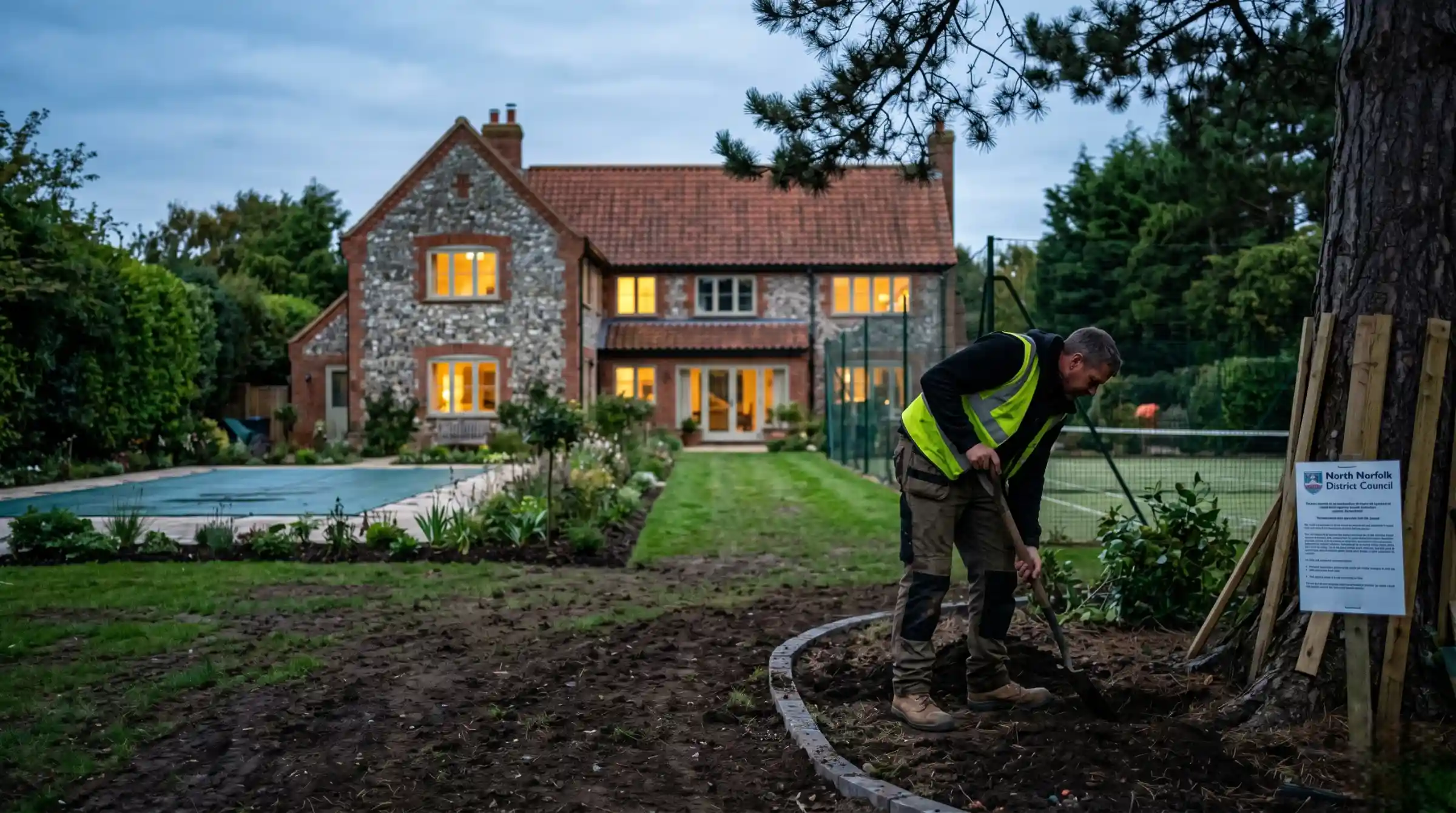
As part of the resolution, the council required Omaze to undertake manual landscaping remediation. They had to avoid harming protected pine trees and preserve the conservation area’s aesthetic.
Heavy machinery was banned. Workers had to manually dig up unapproved paved areas to protect sensitive root systems. This slow, tedious work pushed the final timeline back by months. As of April 2026, Omaze confirmed that all required remedial works had finally been completed.
What This Means for the £6M Winner (and Future Buyers)
Winning a house with legal baggage sounds terrifying. Fortunately, Omaze took the hit.
Omaze’s Financial Guarantee
Omaze issued a public guarantee that the competition winner would not incur any financial liability for resolving the historical planning breaches. An Omaze spokesperson stated the company was delighted the application was approved, allowing them to “finalise conveyancing and arrange the transfer of the property.”
Lessons in Conveyancing and Inherited Liability
The property was originally built by private developers and was only purchased by Omaze following its completion.
This is a massive lesson for anyone buying a home. If you purchase a house with illegal extensions, you inherit the legal liability. It does not matter if the previous owner built it. Mortgage lenders and conveyancing solicitors will often halt property transfers completely if they find unresolved planning breaches.
How to Check Your Own Property for Compliance
Do not blindly trust an estate agent’s floor plan. You must verify the facts yourself.
5 Steps to Verify Planning History
- Locate the exact physical property boundaries on the Land Registry title plan.
- Download the original structural blueprints from your local council’s planning portal.
- Check if the property sits within an AONB, Conservation Area, or Green Belt.
- Visually verify that all external outbuildings, garages, and pools are present on the approved council plans.
- Consult a conveyancing solicitor for historical indemnity if you spot unauthorized development works.
Retrospective Planning Decision Tree
- Is the structure or extension built without local authority permission? (If Yes, proceed).
- Is the breach immune from enforcement under the 4-year or 10-year rule?
-
If Yes -> Apply for a Certificate of Lawfulness.
-
If No -> Proceed to the next step.
-
- Does the structure harm the visual landscape, local amenities, or violate AONB protections?
-
If Yes -> Expect a high risk of refusal and enforcement action (demolition).
-
If No -> Apply for Retrospective Planning Permission (and anticipate potential remediation conditions).
-
Conclusion and Next Steps
The Blakeney house saga proves that property laws bite hard. Even luxury prize homes are not exempt from the rules. Omaze navigated a minefield of strict UK planning regulations to deliver the property. The system worked through conditional, pragmatic regularization rather than a forced wrecking ball, but it took an entire year to fix.
Next Steps:
- Review the property planning compliance checklist before putting an offer on any home.
- Consult your local district council portal for specific AONB and conservation guidelines.
- Ensure your solicitor performs exhaustive local authority searches during the conveyancing process.
FAQs
What were the Omaze Norfolk house planning breaches?
The property was built with an unapproved eastern wing extension, a four-bay garage, a swimming pool, and a tennis court that deviated from the 2020 approved plans.
Did the Omaze Norfolk house have to be demolished?
No. The North Norfolk District Council voted 10-2 to approve a retrospective planning application, saving the structures from demolition.
Who built the Omaze house in Blakeney?
The property was originally constructed by private developers. Omaze purchased the completed property later to use as a prize draw.
Does the Omaze winner have to pay for the planning fines?
No. Omaze publicly guaranteed that the winner would not face any financial liability for the historical planning breaches or the remediation work.
What is retrospective planning permission in the UK?
It is a formal application submitted to a local council to regularise a structure or extension that was already built without prior legal consent.
Why did Blakeney Parish Council object to the Omaze house?
They objected on the grounds of moral hazard, arguing that approving the illegal structures would encourage rogue developers to bypass the proper planning system.
How long did it take for the Omaze Norfolk winner to get the keys?
While the draw occurred in early 2025, conveyancing was only finalised in April 2026. Delays were caused by the retrospective application and mandatory manual landscaping remediation.
About the Author